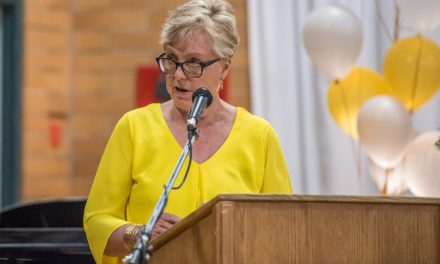

Brian Rothwell spoke at February’s public consultation meeting and argued that school districts can incur deficits. Although the Minister of Education fired trustees in one district for doing so, four districts ran deficits temporarily, while working with the ministry to get back on track.
A budget squeeze is cited as the reason for closing one of Osoyoos’ schools, but some are questioning the idea that school districts cannot run deficits.
Brian Rothwell, an education consultant who spent more than two decades in the Coquitlam school district and now lives in Osoyoos, believes running a deficit is a possible option.
Rothwell points to New Westminster, which ran a deficit five years ago when its cost pressures became insurmountable. That district received permission to run a deficit on the understanding that it had a plan to get back on its feet, he said.
“The ministry (of education) doesn’t want to fire school boards,” said Rothwell, responding to suggestions by trustees they would be fired if they incur a deficit. “Firing school boards would just make them look even more ‘Darkside’ than they are. Their job is to help districts make ends meet.”
Other districts have also run deficits when faced with financial problems, Rothwell said.
School District 53 Chair Marieze Tarr has sometimes cited Cowichan Valley school board in 2012 as an example of what happens if a school district submits a deficit budget.
When that school board refused to submit a balanced budget, following a 5-4 vote, the education minister at the time, George Abbott, dismissed the entire board and replaced it with a ministry-appointed trustee.
The “restoration” budget the board tried to submit projected a $3.77 million deficit.
The move backfired, as the ministry-appointed trustee began closing schools. In 2013, five schools were closed in the district and another was closed in 2014.
Cowichan Valley is the only case of the government firing a school board since the B.C. Liberals came to power in 2001.
Under section 156 (12) of the School Act, a board may not incur a deficit of any kind unless the board has the approval of the minister or meets criteria prescribed by order of the minister.
A Ministry of Education spokesperson said there have only been four school districts granted permission to incur an operating deficit since 2009 – Langley, New Westminster, Coquitlam and Mission.
“Districts may not plan to incur a deficit when setting [a] budget for the next school year,” said the spokesperson. “However, school districts may occasionally find themselves in circumstances during the school year when a deficit is anticipated. Those school districts must then seek the approval from the Minister of Education to incur a deficit.”
In the case of New Westminster, they were able to work with ministry officials on a turnaround plan, which was implemented quickly, he said.
School districts are allowed to hold a referendum to generate additional funds through residential taxes under section 112 of the School Act. However, this section explicitly excludes doing this to fund operating deficits. It can only be used to provide new programs, enhance existing programs or for local capital initiatives.
“It should be noted that boards have not been successful in the very few referenda held,” said the ministry spokesperson.
One option remains open for school districts unable to balance their budgets – obtaining grants from municipalities.
“There are no provincial policies restricting grants or donations from municipalities to school districts,” the spokesperson said.
He added that some school districts might have internal policies preventing this.
Rothwell says the school board shouldn’t use the fear of getting fired as a reason not to stand up to the provincial government in the face of funding cuts.
“On the one hand, they should get fired,” he said. “On the other hand, they shouldn’t be afraid of getting fired. Their mandate is to serve the people of this area.”
RICHARD McGUIRE
Osoyoos Times