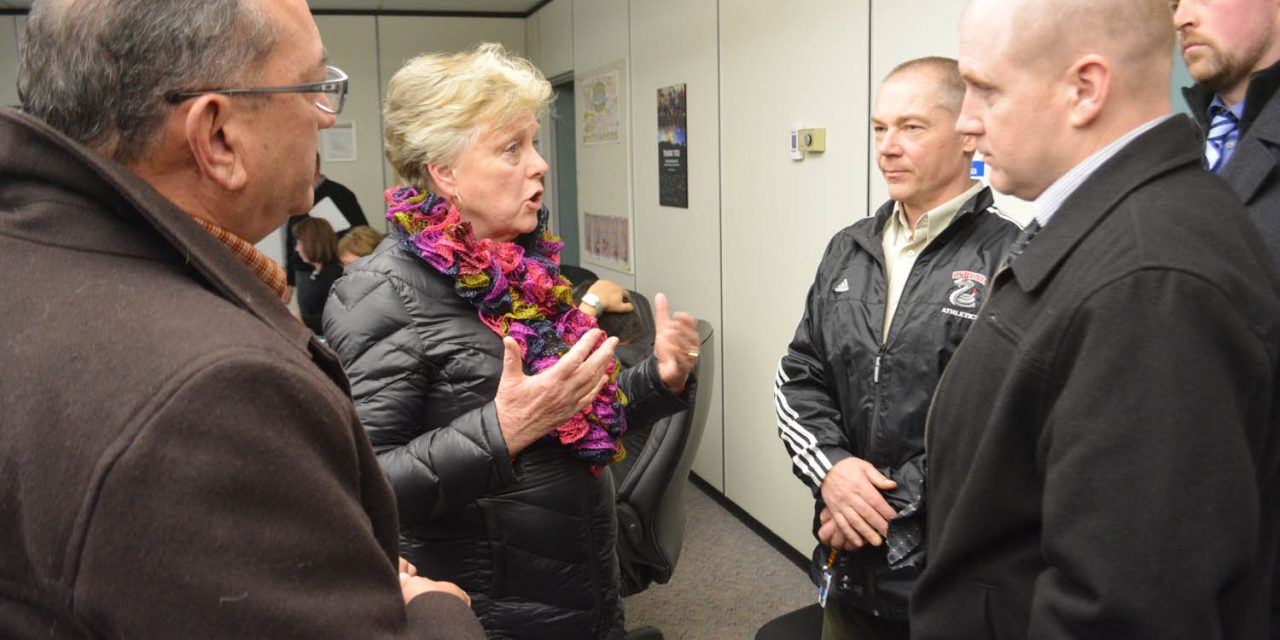
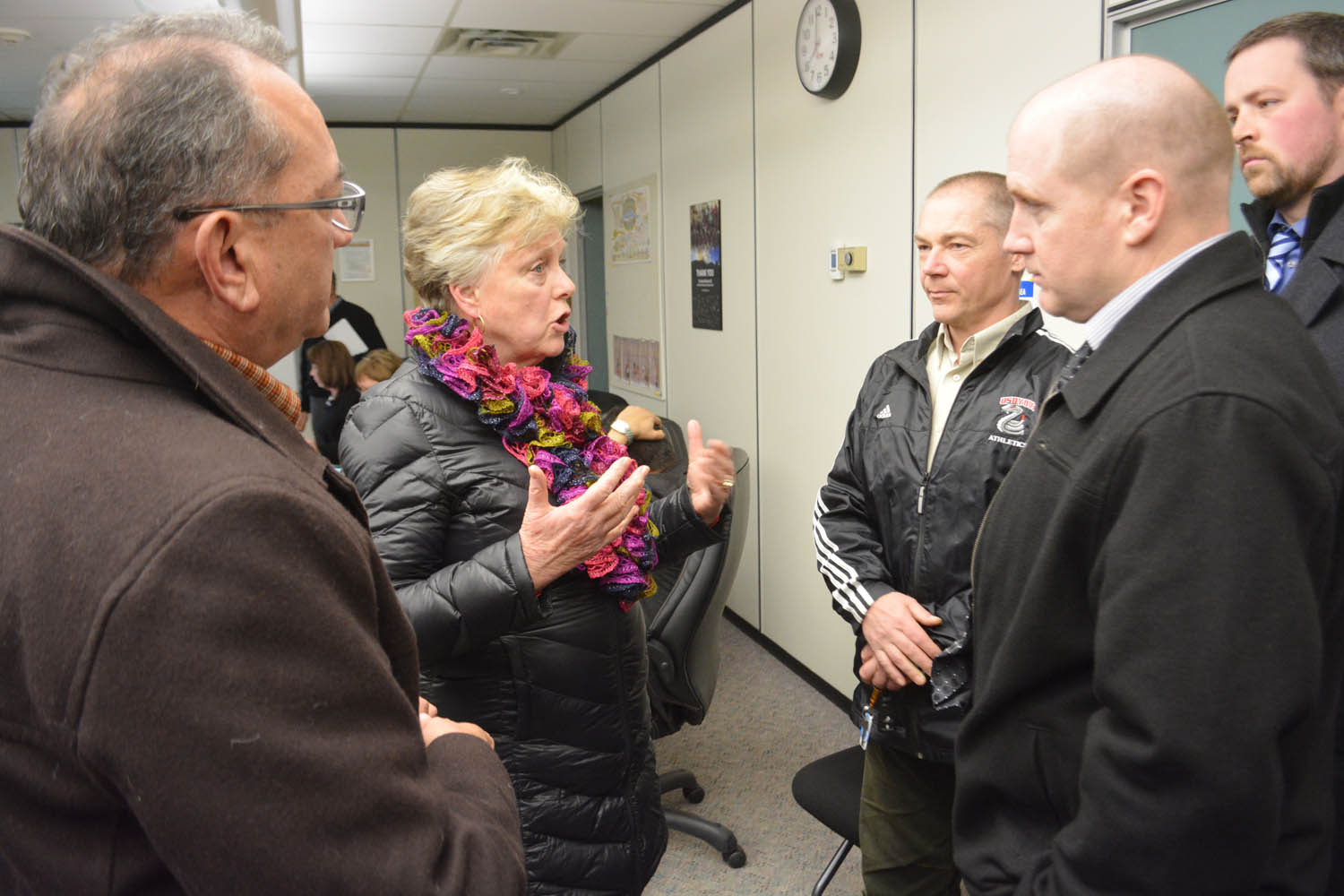
Osoyoos Mayor Sue McKortoff (second from left) reacts negatively to the proposal to close Osoyoos Secondary School (OSS) at the meeting Wednesday night of the board of School District 53. From Left are Ron Hovanes, mayor of Oliver; McKortoff, Mike Safek, principal of OSS; Dave Foster, principal of Osoyoos Elementary School (OSE); and Jason McAllister, vice principal of OSE. (Lyonel Doherty photo)
As enrolments across School District 53 decline, trustees are faced with a funding squeeze that has led them to consider closing one of the schools in Osoyoos.
The board voted last Wednesday to move forward with consultation processes to consider closing Osoyoos Secondary School (OSS) or Osoyoos Elementary School (OSE).
If OSE is closed, elementary students would be sent to a renovated OSS, which would serve Kindergarten to Grade 9, and students in grades 10 to 12 would be bused to Oliver.
Enrolment in the district, at 2,144 in 2015, is predicted to fall to 2,078 in 2017 and 2,032 in 2020. Most of the provincial funding the school district receives is based on the number of students.
The result is a structural deficit for 2015-16 of $530,000, which is predicted to rise to $1.1 million in 2016-17.
“We were elected to be fiscally responsible,” said Marieze Tarr, an Osoyoos trustee who is also chair of the school board. “The Ministry of Education expects us to balance our budget. If we were not to balance our budget, if we were to head into a deficit, we as trustees would all be fired.”
Tarr said this occurred in a Vancouver Island school district where a board refused to close schools and trustees were fired. The trustee appointed by the provincial government ended up closing twice as many schools, Tarr added.
Tarr said the decision to look into closing either OSS or OSE is a difficult one.
“Obviously it’s my community,” she said. “We will be listening to the community. Both (fellow Osoyoos trustee) June (Harrington) and I know this will impact our community. This is where we live. This is where my kids all went to school. Obviously it will be a very sad day if the board decides to close the high school. I don’t think anyone becomes a trustee because we want to close schools. We become trustees because we love our communities and are passionate about the education of students.”
Community consultation meetings will be held on Feb. 9 and March 8.
A facilities plan presented to the school board shows that not only is enrolment and funding falling, but most of the schools in the district are aging and their conditions are rated as “poor.”
The average age of the schools is 57 years. Meanwhile, only 70 per cent of capacity is being used.
School trustee Sam Hancheroff blamed the provincial government for continued cutbacks to education spending. Hancheroff ran provincially for the NDP in 2013, but was defeated by current Boundary-Similkameen MLA Linda Larson, a B.C. Liberal.
Larson, however, denies there are cutbacks.
“Money for school districts is based on enrolment,” Larson said in an emailed response to the Oliver Chronicle. “Declining enrolment means less money. These are not ‘cutbacks’ by government – just a redistribution to where there is the greatest need. No one can afford to keep empty buildings operational. This issue has been on the books for five years. It could not be ignored forever. The school board will always do what’s best for the students.”
Nonetheless, the school district’s facilities plan shows that Osoyoos Elementary School is utilized more than any other school in the district, with the exception of Cawston Primary School, which receives students bused from Keremeos.
Osoyoos Elementary has a capacity of 325 and 2015 enrolment is at 317. If the school’s enrolment drops to 317 as forecasted in 2017, utilization would still be at 96 per cent. It is the only school with a condition rating of “average.”
OSS also has a capacity of 325, but its 2015 enrolment is only 230. Its projected 2017 enrolment would put its utilization at just 66 per cent.
This, however, is slightly higher than the 63 per cent utilization of Southern Okanagan Secondary School (SOSS) in Oliver following its recent renovation.
Perhaps tellingly, the capacity of SOSS is 700 students, but the school now has only 431. If all OSS students were sent to SOSS, based on 2017 enrolment projections, the Oliver high school would have a population of 653 – just below its 700 capacity.
Based on staff recommendations, the school board ruled out closures to other schools – Cawston Primary, Okanagan Falls and Tuc-el-Nuit, even though those schools are in about the worst condition, all rated “poor.”
Only Similkameen Elementary Secondary School (SESS) in Keremeos rates worse – “very poor.”
Nonetheless, the structure of provincial grants was a major factor in decisions not to close Cawston Primary or Okanagan Falls.
“The Cawston/Keremeos schools generate unique geographic factor grants totaling $500,000 that would not continue if Cawston Primary School was closed and the students transferred to SESS,” the school district’s facilities plan says. “It would require $1.6 million to upgrade SESS to current standards and accommodate all students within the facility.”
Similarly, Okanagan Falls generates a small community grant of $160,000 that would not continue if that school were closed. Additionally, the board is concerned that a closure could cause some Okanagan Falls students to go to school in Penticton or Kaleden, both out of the district, meaning that SD53 would lose funding for those students.
“Both OK Falls and the Cawston schools are cash generators,” observed former Osoyoos mayor Stu Wells, who served as a school trustee before sitting on town council. “I think obviously that information became part of the decision.”
Tarr acknowledged this.
To close Okanagan Falls, she said, would be “a double whammy.”
“We will lose the grant money if they close the school and then on top of that we will lose funding for all the students who decide to go to Penticton,” she said.
Tarr said there were three reasons why staff did not recommend amalgamating Tuc-el-Nuit and Oliver Elementary.
• Oliver Elementary has a lot of stairs reducing its accessibility for students with mobility issues;
• While the schools could move Grade 7 students to SOSS, they would lose preschool and daycare programs;
• The coming of the Okanagan Correctional Centre to Oliver could cause elementary school enrolments to increase in Oliver, meaning that if one of the Oliver schools closes, there would not be the space to accommodate those students.
School district staff said closing a school saves between $250,000 and $400,000 on average, but more precise estimates of cost savings weren’t provided to the trustees.
Tarr said she worries that even with the closure of a school in Osoyoos, it may not be enough for the school district to balance its books.
“We are still going to have to look at more places where we can save money,” she said, acknowledging that further closures could still be coming.
Trustees Rob Zandee and Rachel Allenbrand both expressed some relief that Oliver schools were spared from closure this time, but they warned that if enrolment continues declining, that could happen in the future.
Oliver schools are “not out of the woods yet,” Zandee said.
RICHARD McGUIRE
Osoyoos Times
With files from Lyonel Doherty, Oliver Chronicle.