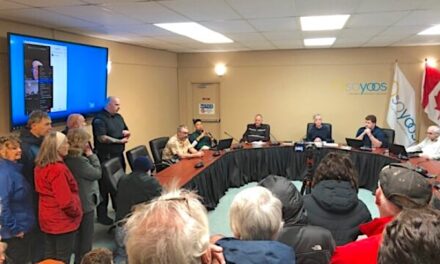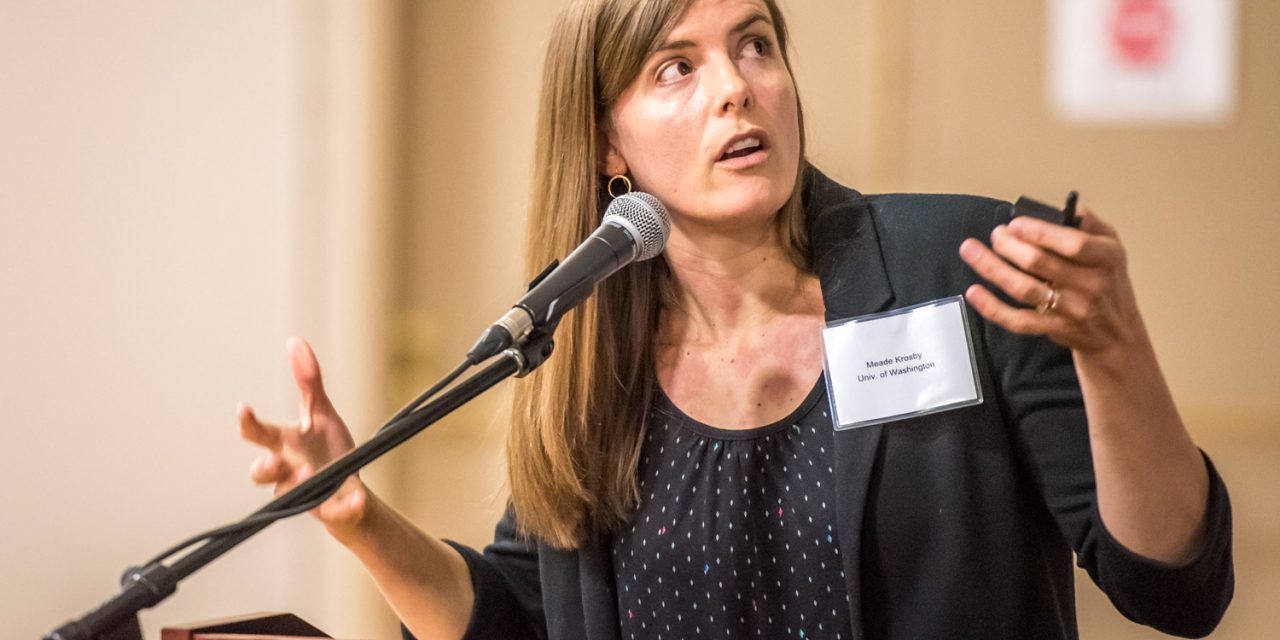
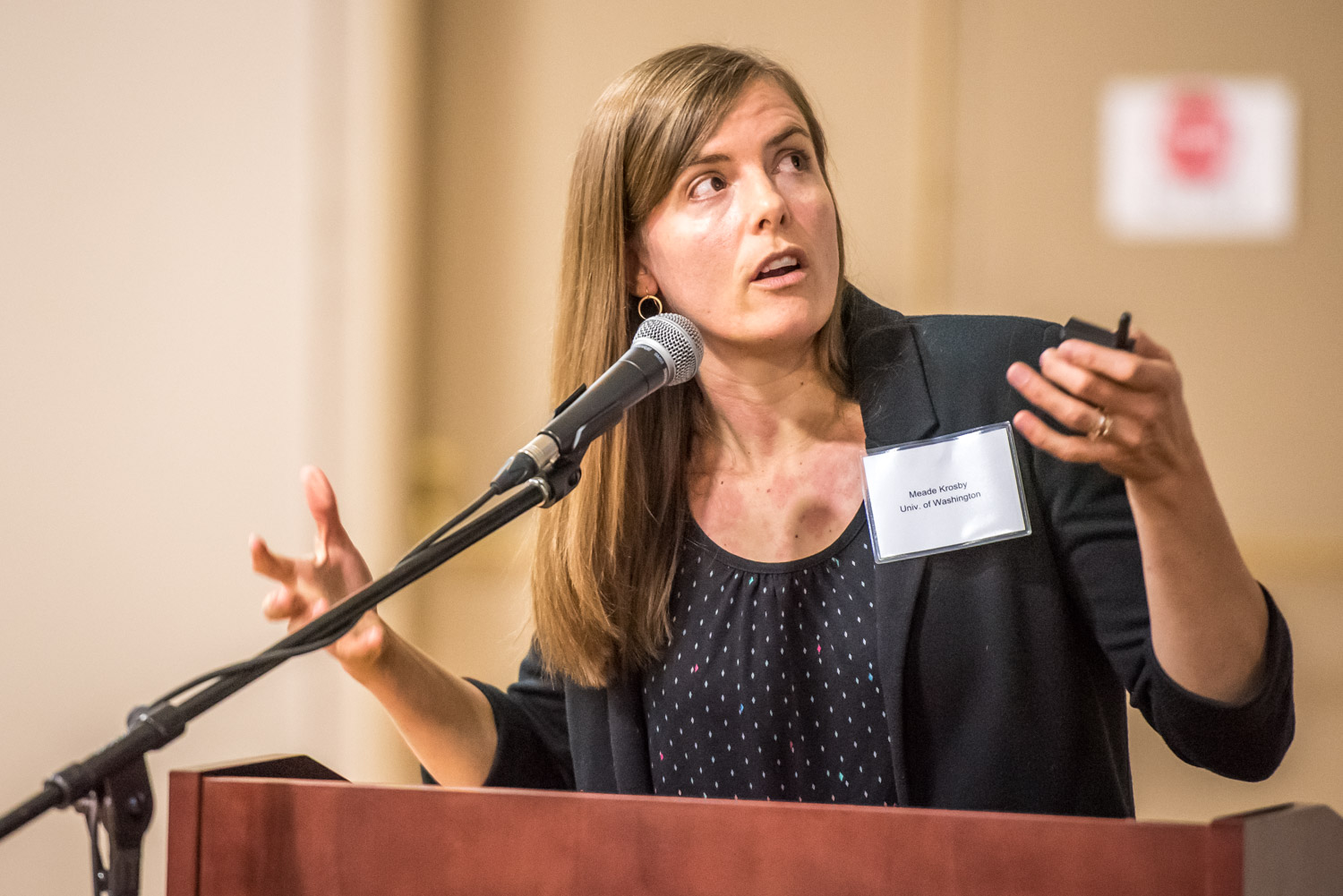
Meade Krosby of University of Washington gave an overview of the impacts people can expect from climate change in the Pacific Northwest. (Richard McGuire photo)
The severe drought of 2015 is a preview of what’s to come in B.C. and the Pacific Northwest as the impact of human-caused climate change is increasingly felt.
That message was delivered by speaker after speaker at last week’s Osoyoos Lake Water Science Forum at the Sonora Community Centre on Thursday and Friday. It was also discussed in a session at the Columbia River Treaty Workshop, a separate, but related event held Wednesday.
“Many of us in the climate community have talked about this year being a dress rehearsal for mid-century,” said Meade Krosby, a research scientist with the Climate Impacts Group at University of Washington. “That’s a useful way to think about it.”
Among the changes we can expect are decreased snowpacks, winter precipitation increasingly coming as rain instead of snow, an earlier melt and warmer, drier summers putting stress on trees, crops and fish populations.
Others called this year and coming ones like it “the new normal.”
“I think that 2015 was a wake-up call,” said Glen Davidson, director and comptroller of water rights with the water management branch at the B.C. Ministry of Forests, Lands and Natural Resource Operations.
Davidson talked about B.C.’s preparedness for this year’s drought as climate patterns converged to cause this year’s severe conditions. Many communities, he said, were unprepared and some came perilously close to running out of water.
Of course drought and climate change were far from the only topics discussed at the forum, but they kept slipping into other conversations – the state of the salmon fishery, water rights, the effects of forest fires on water, the threat of toxic blue-green algae, protection of wetlands.
Krosby, the Washington climate scientist, acknowledged that her message about climate change may be easier to deliver in Canada than it is south of the border, although there are people in both countries who don’t want to hear it.
She was unequivocal that humans are changing climate through the burning of fossil fuels, producing greenhouse gases that warm the atmosphere.
“The current concentrations of carbon dioxide, methane and nitrous oxide in the atmosphere exceed anything we’ve seen for at least 800,000 years,” Krosby said.
The evidence of this can be found in tiny air bubbles in ice found in Antarctica, which preserve a record of the earth’s atmosphere from the distant past.
“The rate at which we are releasing these gases is faster than anything we’ve seen in at least 20,000 years,” she said.
In the past century, the global temperature has increased by almost one degree Celsius, which might not seem like much, but that’s an average. In some areas, such as the polar regions, the impact has been much greater.
In the Pacific Northwest, the increase has been just slightly shy of the global average, but it’s enough to have an impact.
“We’ve seen a lengthening of the frost-free season around here of over a month just in the last century,” said Krosby, adding that nighttime temperatures have also risen.
But because the temperature of precipitation is so close to the freezing level, a shift of a degree or two can make a big difference as to whether it falls as snow or rain.
As a result, snowpacks have declined by about 25 per cent in the last century and peak stream flows have moved back 20 days earlier in the spring over the past 60 years, Krosby said.
Snowpack is the primary means by which water from the winter is stored for later use in this area, she said.
There are other impacts. Oceans absorb carbon dioxide, which is good in that it reduces the amount of CO2 in the atmosphere, but the process makes the oceans more acidic. And this harms the plankton and other oceanic life that salmon feed on.
Even more worrying is that the quantity of greenhouse gases already emitted will remain in the atmosphere, having an impact for centuries to come.
Krosby pointed to forecasts that annual global temperatures could rise anywhere from one to four degrees by the end of the century.
The one-degree scenario is based on aggressively lowering the use of greenhouse gases and actively sequestering them from the atmosphere. The four-degree scenario would result from carrying on business as usual.
Krosby pointed to maps showing areas that will lose snowpack in coming years, suggesting that snowpacks will decrease by 30 per cent in the 2040s. By the 2080s, only very small areas of the northern Columbia basin will still have any snowpack.
This means that a lot of winter rains will enter streams directly, causing earlier flooding, but not leaving enough water for irrigation in the summers.
Warmer temperatures on the rivers will create thermal barriers to salmon migration. As occurred this summer, thermal barriers can be fatal for migrating salmon, and this will become a more frequent event, Krosby said.
In the drier summers, the risk of wildfires will increase, she said. In the Columbia River basin, fires will double from historic levels by the 2020s, and triple by the 2040s, rising to a five-fold increase by the 2080s, she said.
The changing weather patterns will also affect the timing of biological events such as bird migrations and flowering of plants. And this may cause changes to ecosystems with entire species relocating.
Human activity will also be affected with impacts on hydro power, flood control and reservoir operations, Krosby said.
She concluded on a more positive note suggesting people have quite a bit of power over whether these things happen, and if they do, there are ways to mitigate the impacts.
“By far the most important thing is to make sure that doom and gloom future does not happen,” she said.
If global temperature increases are kept to two degrees instead of four, many of the changes could be accommodated through water management and through managing landscapes to be more resilient, she concluded.
One of the problems in delivering the message about climate change, Krosby said after her talk, is that people have a difficult time dealing with abstract and very large-scale future events.
“We’re wired for the here and now,” she said. “We’re wired for concrete intuitive problems. This is not one of those things. It doesn’t appeal to people’s intuition about how the world should work.”
She also thinks that scientists have not always communicated clearly because they raise caveats in an effort to maintain their credibility.
There are also interests at play who see the science of climate change to be “very inconvenient to their bottom line,” she said. Nonetheless, many businesses are responding positively to the challenge of climate change, she added.
RICHARD McGUIRE
Osoyoos Times
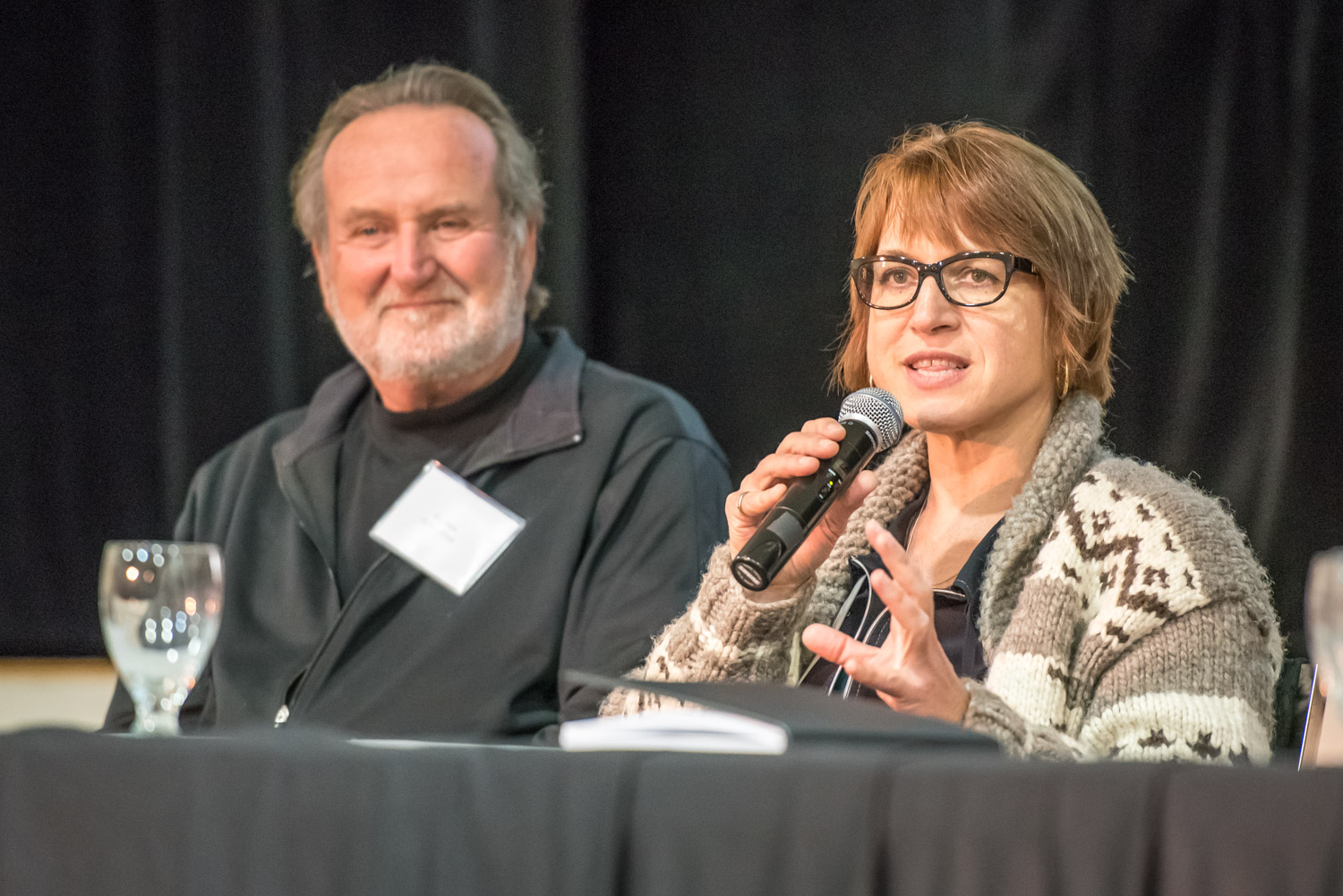
Anna Warwick Sears, executive director of the Okanagan Basin Water Board, speaks on a panel summing up the discussions of the first full day of the Osoyoos Lake Water Science Forum. On the left is Stu Wells, former Osoyoos mayor and former OBWB chair, who co-chaired the forum along with Sears and current mayor Sue McKortoff. (Richard McGuire photo)
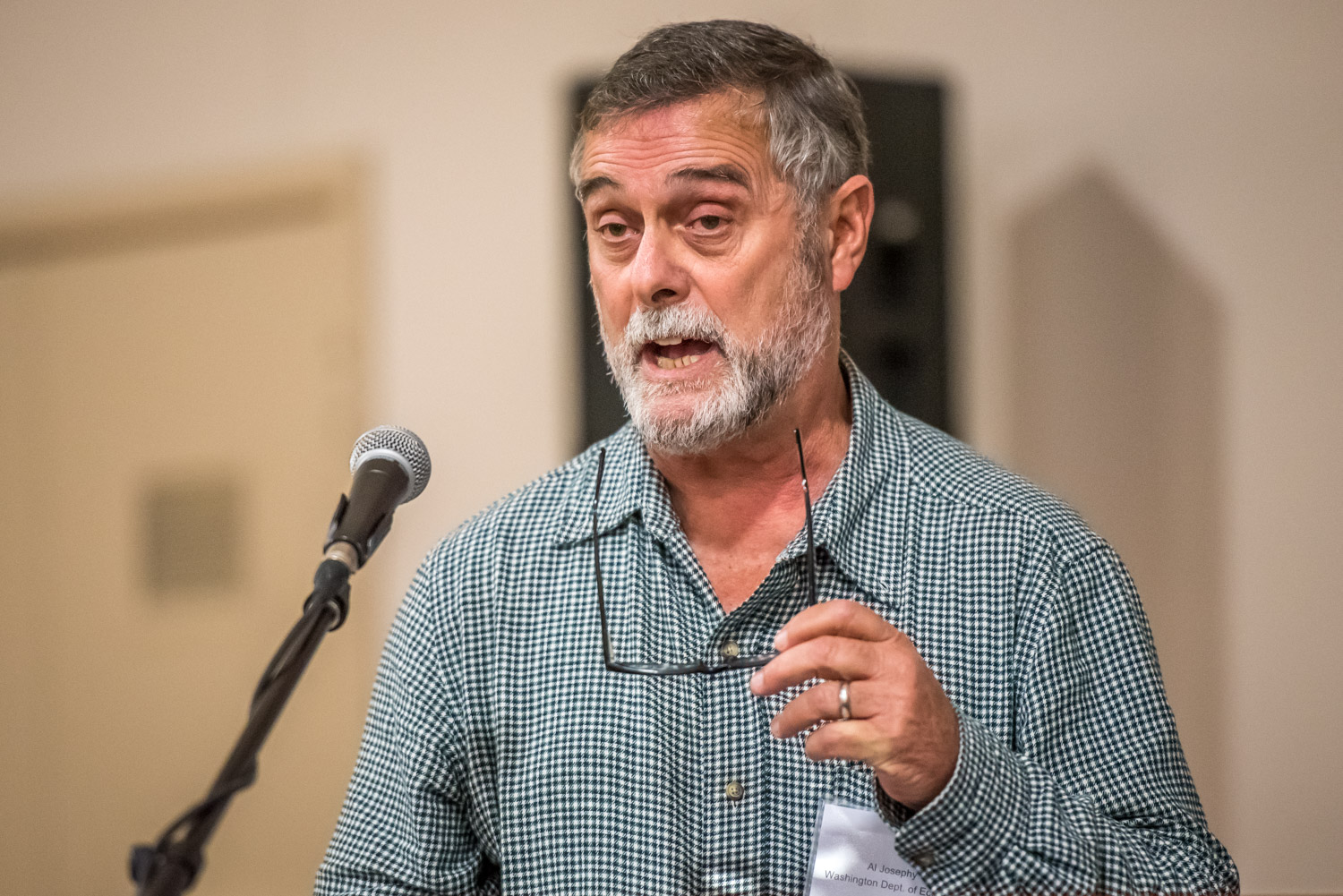
Al Josephy, of the Washington State Department of Ecology, introduces one of the discussion panels at the Osoyoos Lake Water Science Forum. Josephy oversees the operation of the Zosel Dam at Oroville, which helps to control the level of Osoyoos Lake. (Richard McGuire photo)
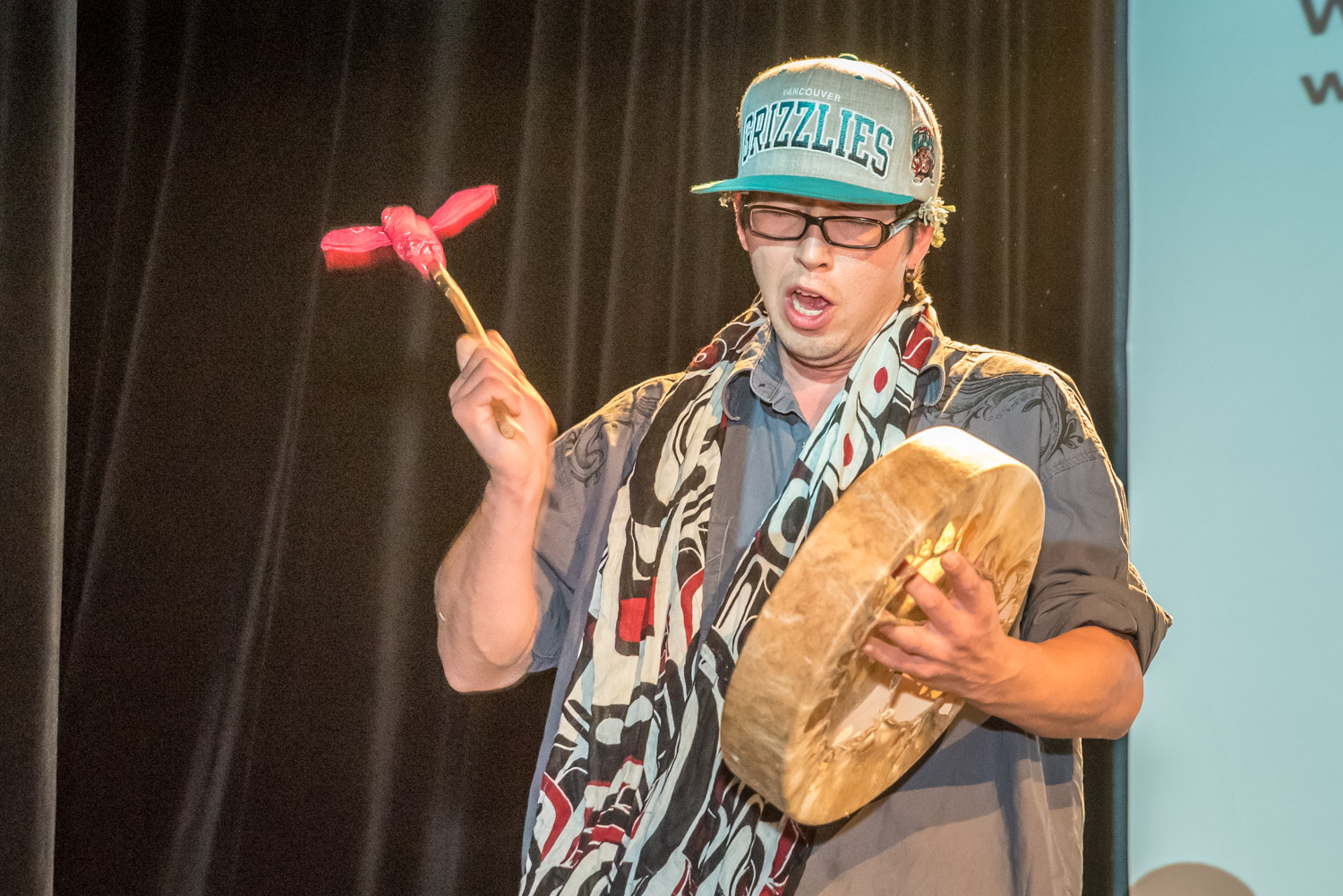
Osoyoos Indian Band member Kx Hall beats a drum at the welcoming ceremony for the Osoyoos Lake Water Science Forum at the Nk’Mip Desert Cultural Centre. (Richard McGuire photo)
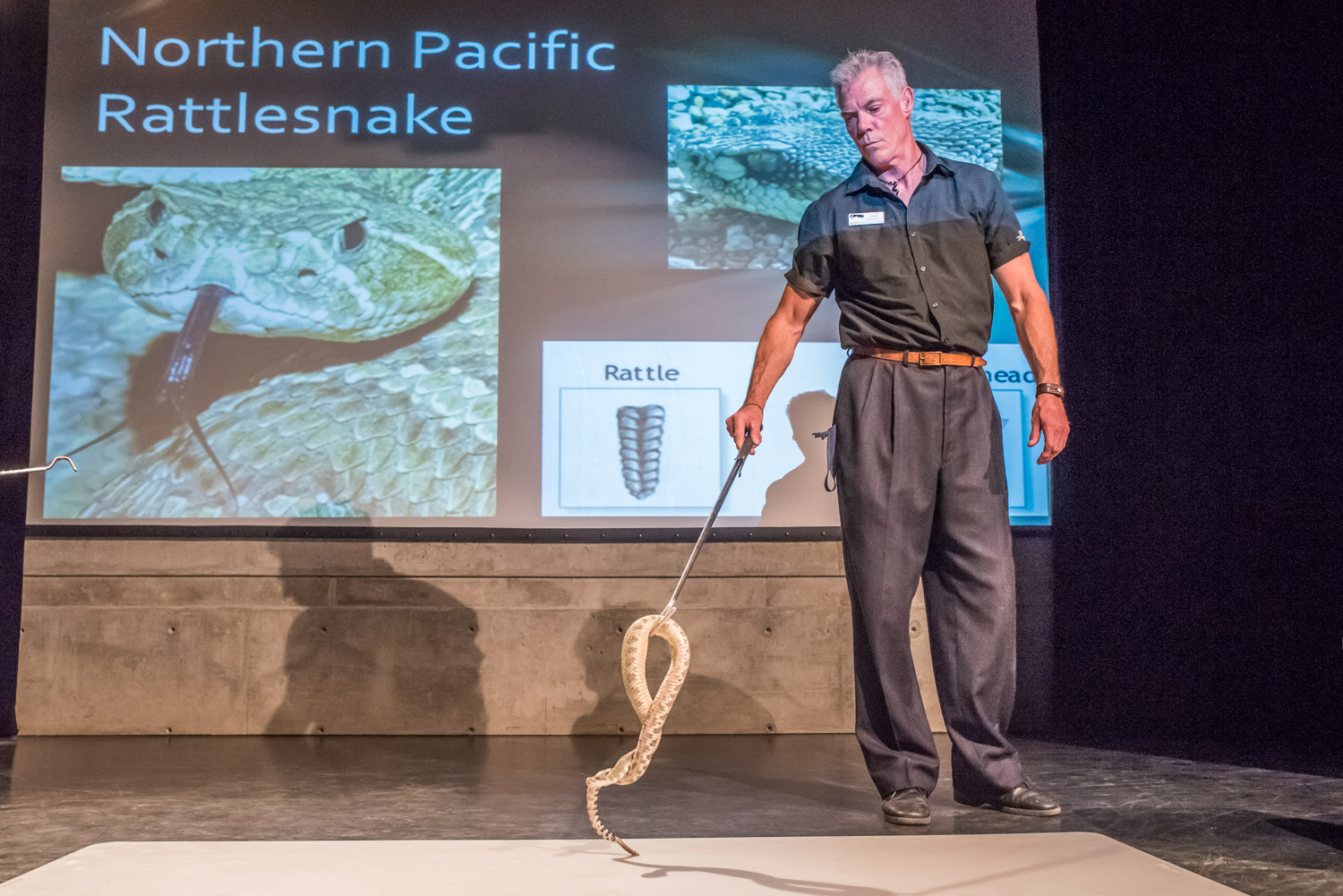
Visitors were treated to a showing of “Snakes Alive,” a presentation on snakes in the Osoyoos area, following the opening ceremony for the Osoyoos Lake Water Science Forum at Nk’Mip Desert Cultural Centre. (Richard McGuire photo)
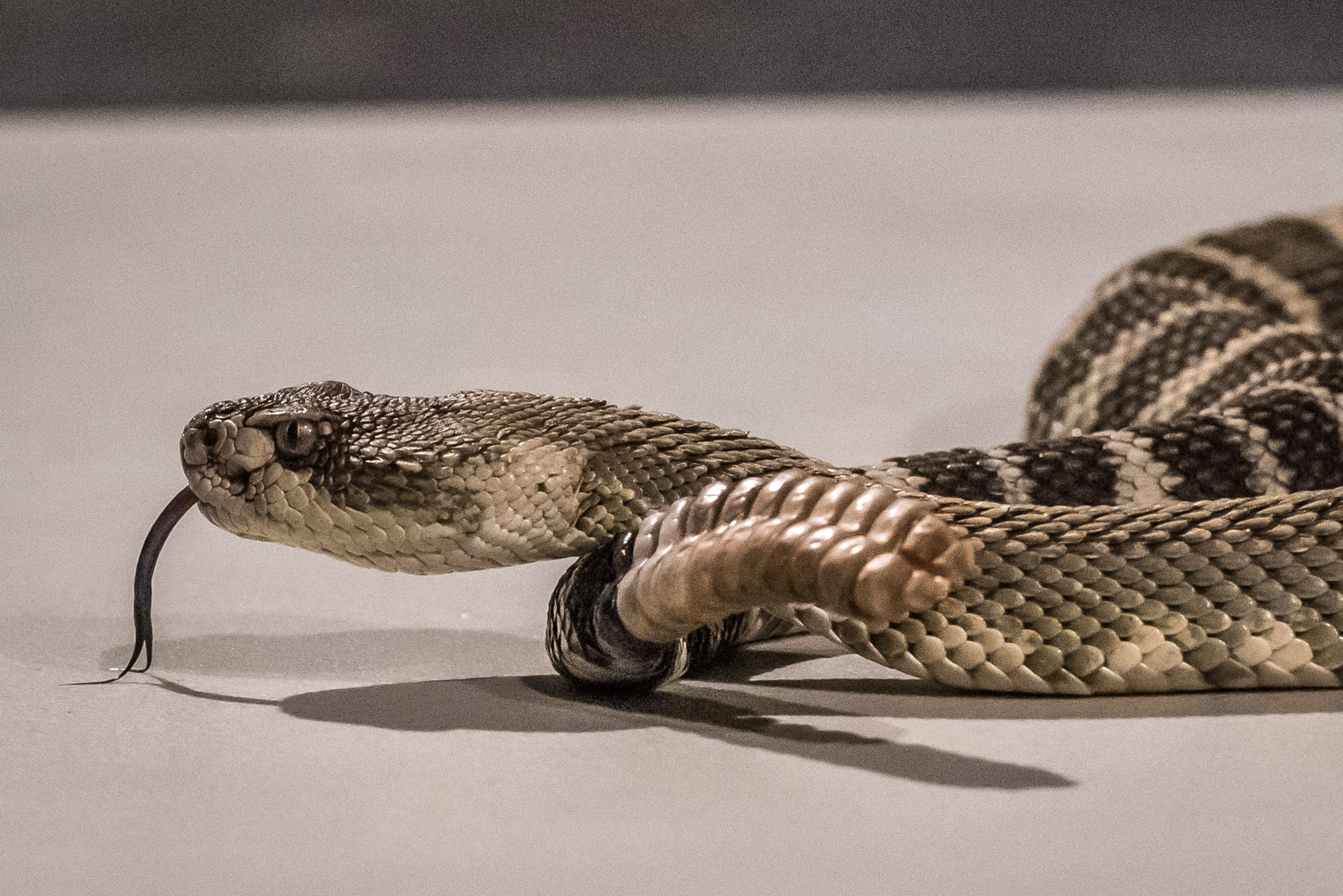
A Northern Pacific rattlesnake uses its tongue to sniff out possible prey during a demonstration at the Nk’Mip Desert Cultural Cente at the opening of the Osoyoos Lake Water Science Forum. (Richard McGuire photo)