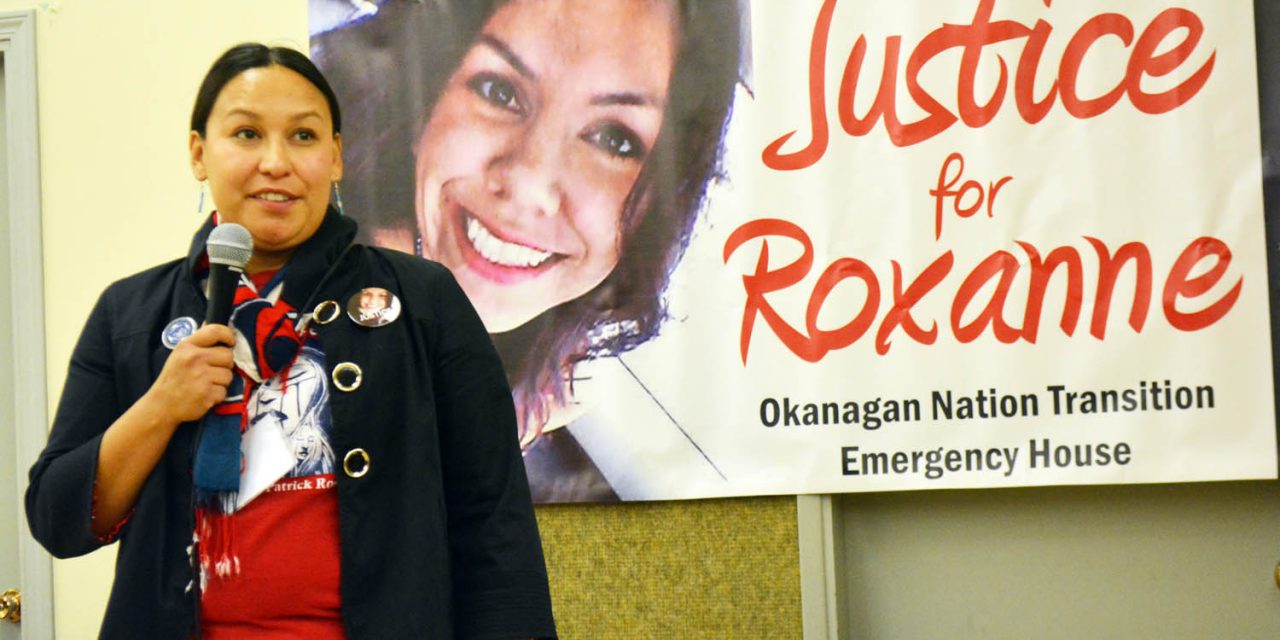
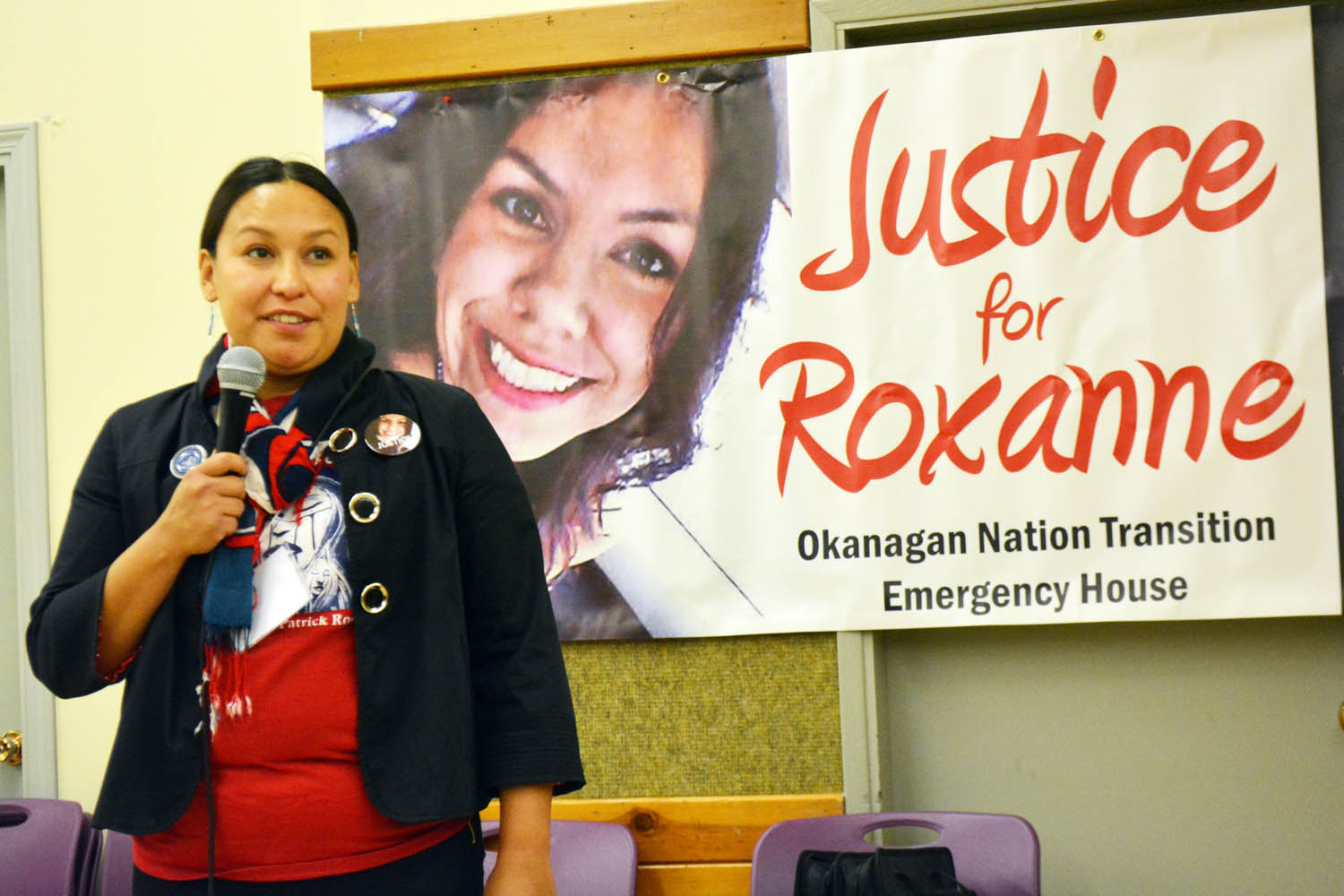
Coola Louis, women’s representative for the Union of BC Indian Chiefs, addresses the Sisters in Spirit Vigil at the Osoyoos Indian Band community hall on Sunday, Oct. 4. Louis is calling for a national inquiry into missing and murdered indigenous women. The poster depicts Roxanne Louie, a single mother who was murdered earlier this year. Louie was a member of the Osoyoos Indian Band. (Lyonel Doherty photo)
Seeing a woman beaten outside of a dance hall really bothered Dan Wilson when he was a kid. And that vivid scene still bothers him today.
“Nobody would do anything,” he recalled, while addressing the audience Sunday night during the Sisters in Spirit Vigil at the Osoyoos Indian Band community hall in Oliver. “To this day I don’t understand it (violence against women).”
Wilson spoke just prior to participants in the vigil taking their walk for justice on McKinney Road.
Wilson was one of several speakers at the vigil that attracted many supporters, including the RCMP, and friends and family of single mother Roxanne Louie, 26, who was murdered earlier this year.
Louie, a member of the Osoyoos Indian Band, was reported missing in early January. Her body was subsequently found in the woods near Naramata.
Grace Elinor Robotti and Pier Louis Robotti have been charged with second-degree murder in relation to Louie’s death.
Wilson said violence against women is a generational issue that most people don’t like to talk about. But it needs to be the point of focus, he stressed.
Wilson said men try to rationalize violence through jealousy or having a bad day, but there is no excuse for it.
Wilson, Roxanne’s uncle, said she was raised in a good, loving environment.
“I remember we were always waking up to laughter … Roxanne was just learning to crawl.”
Wilson said Roxanne was a really good person to be around.
One singer at the vigil said there is nothing people can do to change the past, but “we can change how much time we spend with each other.”
Laurie Wilson, Okanagan Nation Alliance spokesperson for missing and murdered women, said far too many aboriginal females are born into violence and constant struggle.
She recalled her younger days as a “fighter,” blocking roads and putting up barricades out of anger and rage because people were always trying to take something from aboriginals because their skin was brown.
Wilson said there was a time when aboriginals could not leave the reserve without a note.
“It gets really heavy for us sometimes … but together we are stronger.”
Wilson said there are women (daughters) whose children never see violence in the home and grandchildren who never see drinking in the home.
“Families are standing up. My boys will not be hitting their women, and women will not be abused,” she said.
Coola Louis, the women’s representative for the Union of BC Indian Chiefs, said the federal government is failing indigenous women who go missing or are murdered. Like many others, Louis is calling for a national inquiry into this “global tragedy.”
To this end, she is trying to create a space for women to speak for themselves.
“I’m looking for solutions back home in our communities; the women know what they need.”
New Democratic candidate Richard Cannings attended the vigil and said sometimes it takes a tragic event to bring a community together.
He said the NDP believes that change is necessary and stated the party will establish a national inquiry within 100 days of being elected on Oct. 19.
“We need to fix the broken relationship between the federal government and indigenous people … we owe it to Roxanne,” Cannings said.
During the walk down to the river channel, people saw red dresses hanging from trees. These dresses were a symbol of all the missing and murdered indigenous women in Canada. The red signifies the colour of a dress that a young woman was supposed to wear for her graduation before she went missing.
LYONEL DOHERTY
Special to the Times