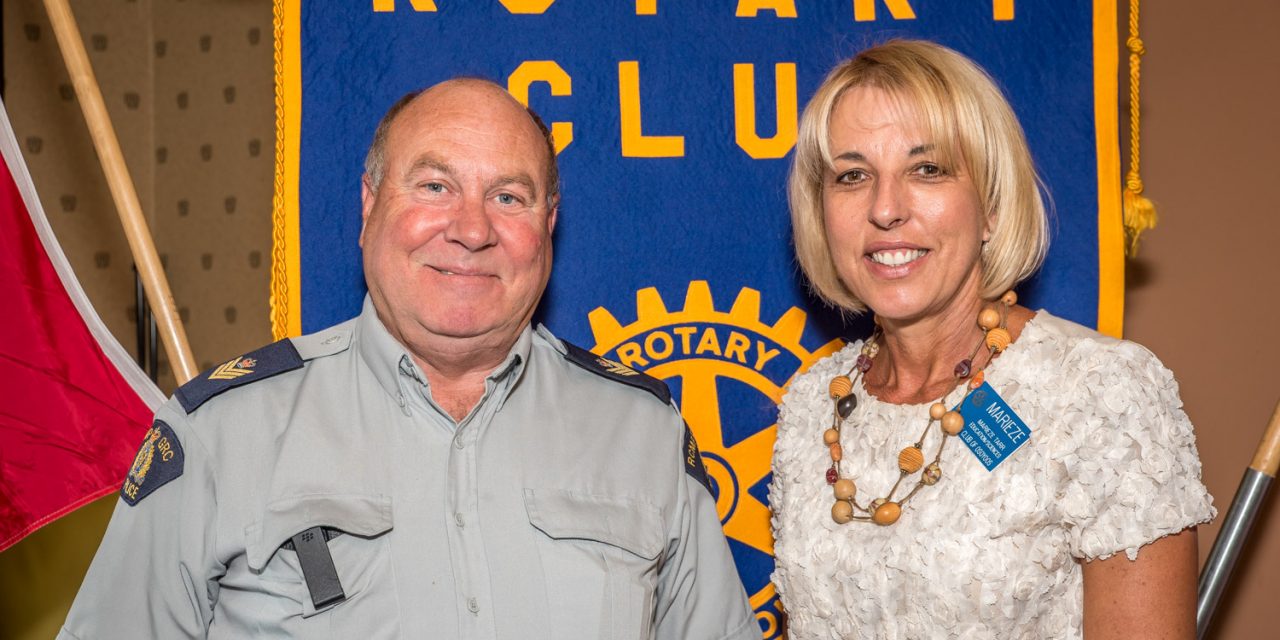
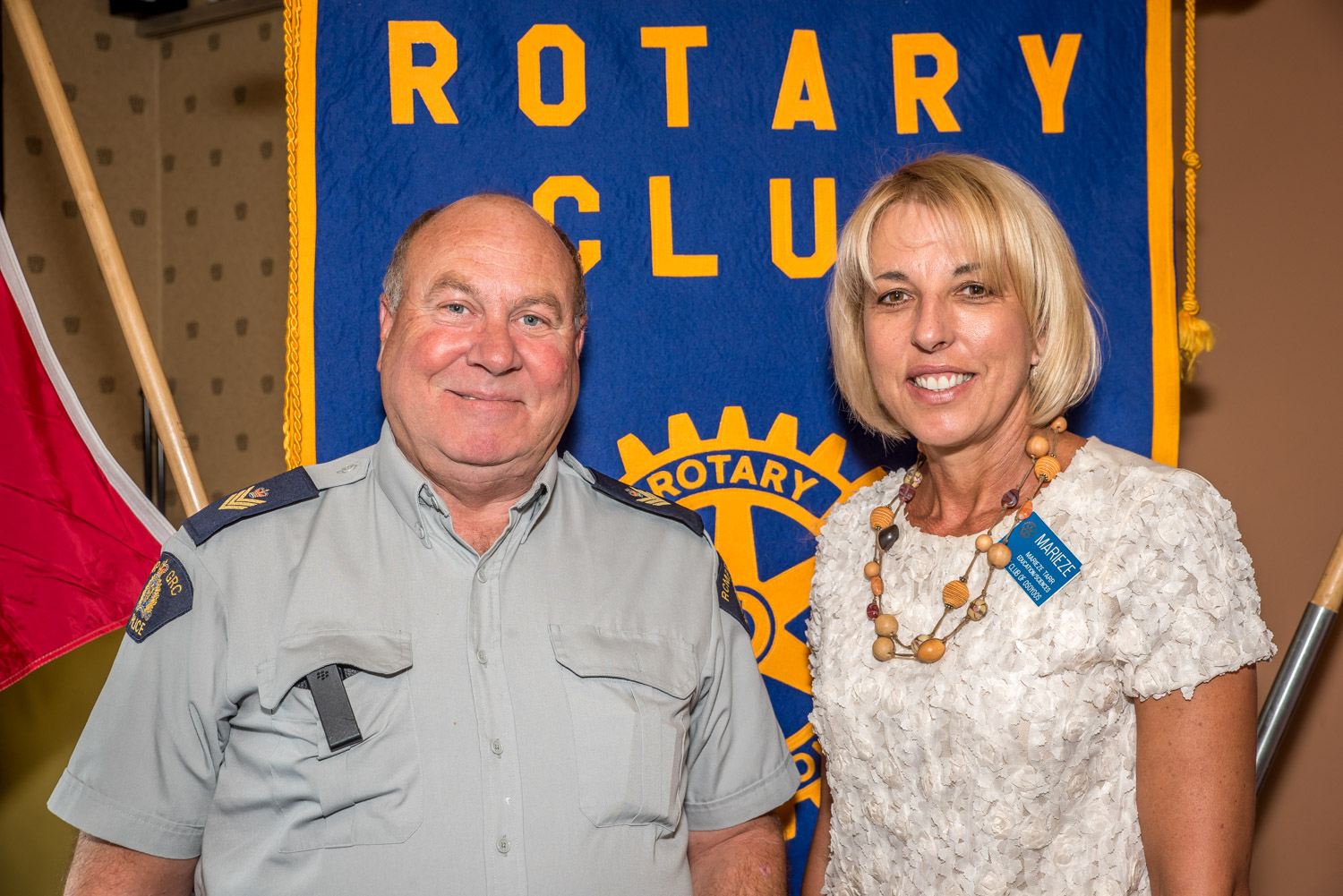
Sgt. Randy Bosch, who assumed command of the Osoyoos RCMP Detachment in June, was guest speaker at the Rotary Club of Osoyoos recently. He was welcomed by club President Marieze Tarr. (Richard McGuire photo)
Some of the Osoyoos RCMP members joke that they would like to send their new sergeant, Randy Bosch, back north because of what’s been happening since he took over command at the detachment in June.
“They think I brought a virus with me,” Bosch told a recent meeting of the Rotary Club of Osoyoos. “It just started out one thing right after another with planes falling from the sky, fires, busloads of kids in accidents. It’s just been crazy and what an experience for me.”
Since arriving in Osoyoos and starting his new job, things have proven to be very different from Bosch’s previous position.
For the past 10 years, he was based in Prince George, where his job entailed travelling much of the province to deal exclusively with homicides.
“Finally enough was enough and here I am,” Bosch said in his lunch hour talk to the Rotarians on Sept. 3.
But prior to working on homicides, Bosch’s 24-year career gave him experience in other areas, some of which were seen by RCMP brass as being especially relevant to recent problems in Osoyoos.
Bosch started his RCMP career in Williams Lake in 1992. He began in general duty handling basic calls, but after four years was moved into property crime and auto theft – experience he is drawing on today in Osoyoos.
“That was an awesome experience for me,” said Bosch. “I was rewarded for major reductions in the Williams Lake area of auto theft.”
He then moved into general investigations, which included major crimes that general duty members don’t have time to investigate – sex assaults, frauds, aggravated assaults and other serious crimes.
After almost 10 years in Williams Lake, he was transferred to Prince George, where he worked three years on the federal drug unit.
There, he was involved in B.C.’s first operation against the Hells Angels for drugs.
“I had a very major role in that one, dealing with agency sources,” he said. “It was very rewarding.”
Bosch said his experience investigating auto thefts is especially relevant to his Osoyoos position.
“I’m sure everybody knows that there’s a major auto theft issue here,” he said.
These crimes often originate in other areas in the Okanagan Valley, but they touch Osoyoos nonetheless.
“We get cars located here that are stolen at Kelowna and Penticton all the time,” Bosch said, adding he’s currently devoting attention to these files.
He notes one particularly brazen example of some people who came to Osoyoos to camp in a trailer, but then left it behind.
“We started checking and sure as heck the trailer was stolen,” said Bosch. “So they came for a vacation in somebody else’s trailer.”
Although the vehicles are often located, other stolen property is often harder to find.
Bosch said he’s also using his experience and contacts to investigate the handful of local drug dealers.
With the busy summer, Bosch admitted that at the time of his talk he had not yet had a chance to sit down with Mayor Sue McKortoff, though he hoped to do this soon.
One of the issues he planned to discuss was the impact of the upcoming national census in 2016, which could push Osoyoos above the 5,000-population threshold, greatly increasing the cost of policing to the municipality.
Under the B.C. Police Act, municipalities with a population of more than 5,000 must assume responsibility for police services within the town, usually by contracting with the RCMP. This means the town would have to cover 70 per cent of its policing costs, with the federal government paying the remaining 30 per cent.
The current formula has the town paying only 30 per cent of policing costs.
Bosch said he would like to see an increased number of officers to handle the high volume of calls, especially during the tourist season, with two members being permanently posted in the town.
“I want to talk to [McKortoff] before I start making any bold moves,” he said.
Currently the Osoyoos detachment has six constables in addition to Cpl. Jason Bayda and Sgt. Bosch. There are also two and a half support staff doing administration.
Rotarians asked Bosch about the hours when officers are on duty. He said there is always somebody on duty between 8 a.m. and 4 a.m., leaving a gap of just four hours.
During that time, somebody is available on an on-call basis.
That doesn’t, however, mean the detachment office is staffed after administrative staff leave, but some officers remain on duty.
“I prefer that they are on the road,” Bosch said of his officers. “If they’re not on the road, they’ve got to have an excuse why they are not. I try to run a fairly tight ship that way.”
When Bosch took the Osoyoos position, his wife, Rachel Cox, took a position as an officer at the Oliver RCMP Detachment.
For that reason, the couple chose to live in Oliver.
“It was my transfer, so I had to be a willow and bend a little,” Bosch said.
“I’m totally loving it here,” Bosch said of Osoyoos. “The people are just incredible. The business people are friendly. I’ve never seen anything like it. You go down the street with your dog and there’s a water bowl sitting out for them and pet friendly stores. Congratulations. You have built quite the community here. You can tell why people want to holiday here.”
RICHARD McGUIRE
Osoyoos Times