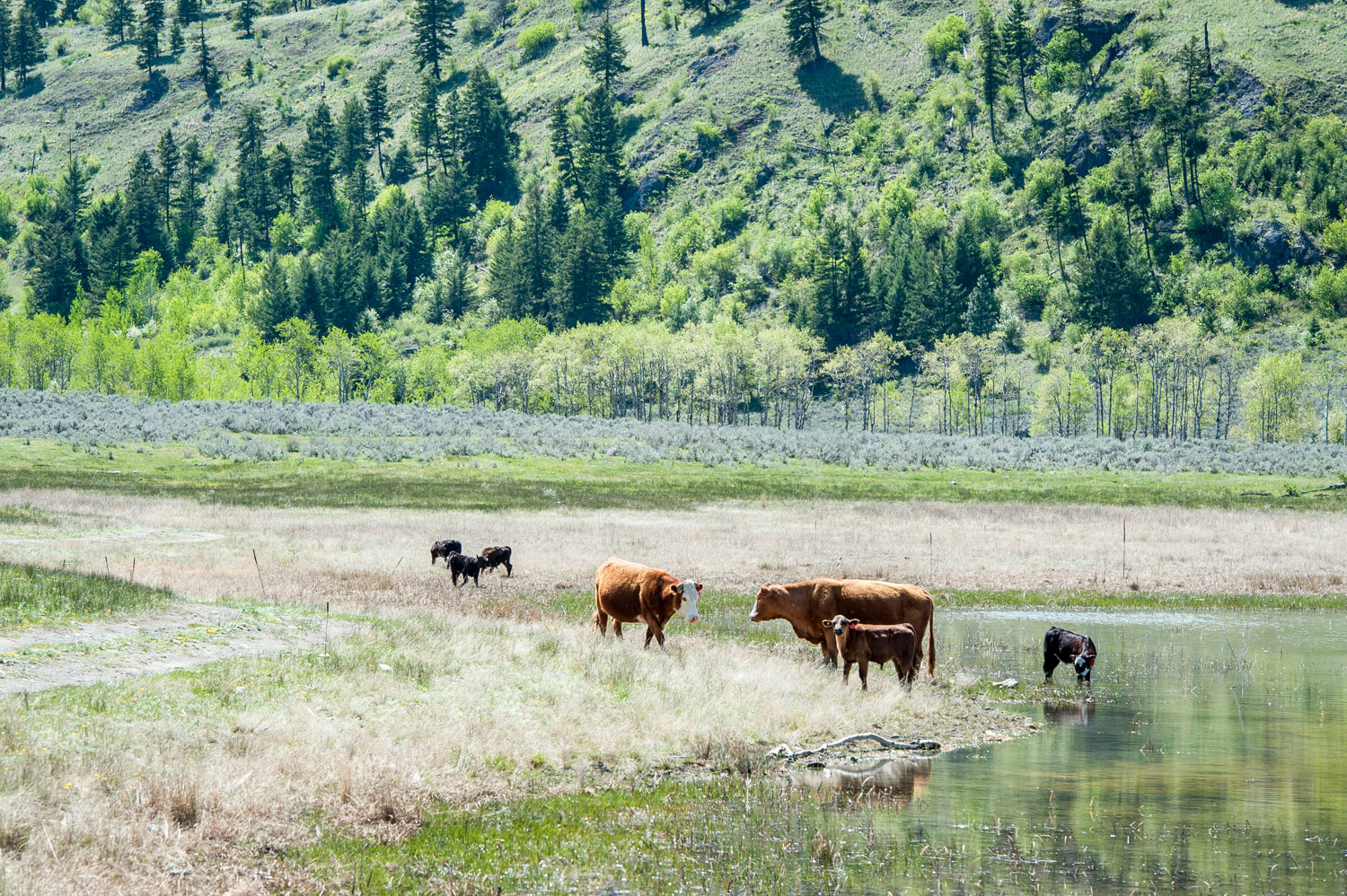
Cattle graze at Kilpoola Lake in the South Okanagan grasslands in the area under consideration for a national park reserve. (Richard McGuire file photo)
Parks Canada was concerned about the possibility that environmentally sensitive lands in the area of a proposed national park reserve might be sold for development or vineyards.
This was just one of the factors the federal agency considered as it discussed land acquisition strategy in a document obtained by the Osoyoos Times under the federal Access to Information law.
The agency recognized that its budget meant it had to prioritize each of the 12 privately owned properties based on ecological considerations, connectivity with other lands, willingness of the owner to sell and likelihood that the land might be developed if not protected.
The document, Building a National Park Reserve in the South Okanagan-Lower Similkameen (SOLS): Private Land Assessment for Acquisition/Land Stewardship, was just 25 pages of 126 pages recently obtained by the Osoyoos Times.
The document, prepared by a ranchland assembly working group, and dated March 6, 2011, was still in a draft version.
Despite the opposition of some of the 12 landowners to a park, and others who didn’t want to sell at that time, Parks Canada concluded that combined with provincial lands, and five willing sellers, the agency could acquire 82 per cent of the proposed national park reserve’s South Okanagan Grasslands component.
Some of the document is redacted to omit names of individual landowners and the amount of land they hold. Nonetheless, information not omitted along with other publicly available information, made it possible to determine who some of the landowners were and the size of their holdings.
Parks Canada was especially interested in obtaining all or part of the largest property, owned by Ace Elkink and measuring just under 4,000 hectares.
Discussions with Elkink were underway at the time the province put the park project on hold.
Elkink’s land was described as being “available,” but with concern that it could be broken into separate units if Parks Canada couldn’t obtain it.
Elkink, though not named in the redacted document, was described as a “very savvy business owner.”
Early in 2011, after the provincial government told Parks Canada there was no decision at the time on moving forward, Parks Canada officials discussed the need to keep Elkink apprised of the delay.
Elkink has since sold 743 hectares in 2013 to the Nature Conservancy of Canada.
The 12 deeded properties range in size from 36 to 3,971 hectares, but eight of the 12 are less than 500 hectares. Altogether, there are about 9,800 hectares of private land holdings, consisting of about 200 parcels, making up about 35 per cent of the South Okanagan Grasslands component of the proposed national park reserve.
Four other landowners appeared to be willing to sell to Parks Canada, including the third largest property, at slightly over 700 hectares, where officials noted that the landowner is “likely under considerable pressure to sell parts that are suitable for (non-ranching) uses like vineyards.”
A number of this landowner’s properties have already been sold, the document said.
In another case, the officials noted that a landowner was not ready to sell, but would likely be willing at the right time.
In the case of one property, just over 60 hectares near the Fairview-Cawston road, it was observed that the “owner is a well-respected member of community and also a member of grasslands coalition, which opposes national park establishment.”
The officials thought it wiser to “build a positive relationship with the family related to management of fire risk or grazing rather than trying to buy their property.”
Greg Norton, spokesperson for the anti-park Grassland Park Review Coalition, owns land in that area and has previously expressed concerns that failure to keep lands grazed could contribute to wildfires.
Despite the availability of some properties and not others, Parks Canada staff attempted to juggle different ecological, management and strategic concerns as they sought to prioritize the properties for purchase.
They also noted that the boundaries of the 284-square-kilometre 2010 Park Concept area were not fixed and could change according to land availability. Still, they were concerned about maintaining “ecological integrity” by ensuring that sizeable areas were well connected.
“In the absence of competition for properties, Parks Canada might choose to set priorities primarily based on their ecological values, with some consideration of management requirements during the interim,” the document said. “Given the complexity of the local real estate market, with its rising prices and increasing demand for lands suitable for vineyard conversion and urban/rural development, strategic planning is likely to depend on a broader consideration of both human and ecological factors.”
Parks Canada established eight land acquisition criteria for the national park reserve: representation of low-elevation ecosystems, presence of high-priority habitats, occurrence of species at risk, presence of water bodies, naturalness or degree to which the land has not been disturbed, educational and visitor experience opportunities, cultural and heritage value and management considerations.
The report was based on a number of assumptions, including that Parks Canada would acquire provincial Crown lands and protected areas through an agreement with the province.
Almost all the provincial land is currently grazed under a tenure system, which Parks Canada said it would maintain, while using an “adaptive management” approach to protect the most sensitive areas.
Parks Canada could provide forage lands to ranchers with the understanding that grazing pressures would be reduced on their own tenures, another document suggests. This would increase total productivity for participating ranchers.
“If Parks Canada Agency is able to provide additional support (infrastructure, water, range monitoring), the total benefit to the rancher is significant,” says a draft internal engagement plan. “This will yield tremendous support and co-operation from ranchers over time.”
Parks Canada was concerned, however, that many of the provincial holdings are fragmented, making it a priority to unite fragmented elements.
“Although Parks Canada would like to purchase all private properties within the boundary, all the funding to purchase properties will likely be provided over a period of years,” the report said. “Some properties may sell to developers before funds are available, creating management challenges for the park, especially if developments are within the centre of the park.”
Parks Canada reiterates its policy that land will be purchased on a “willing-buyer, willing seller” basis and that no land would be expropriated.
The report underlined the value of the area’s biodiversity and that it is home to numerous species and habitats at risk.
It also noted the exceptional visitor experiences, for example Mt. Kobau’s elevation spanning five different ecosystems with “magnificent” views of the dry plateau landscape and eastern Cascade Mountains by day and “world-class” stargazing at night.
It would allow visitors to learn about geological and human history, including First Nations, settlers, ranchers, farmers, recreational users and conservation organizations.
“With the potential to enhance an already well-developed tourism economy in the South Okanagan, a SOLS national park reserve would help local residents and all Canadians experience this area’s natural beauty and retain it unimpaired for future generations,” the report said.
RICHARD McGUIRE
Osoyoos Times