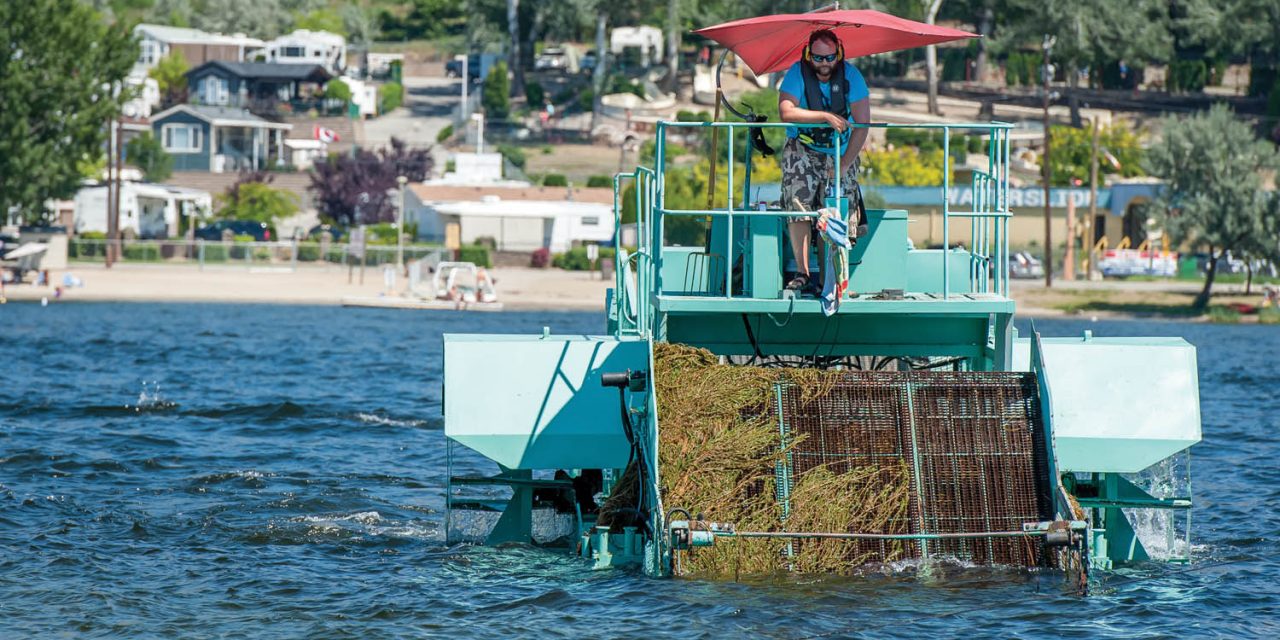
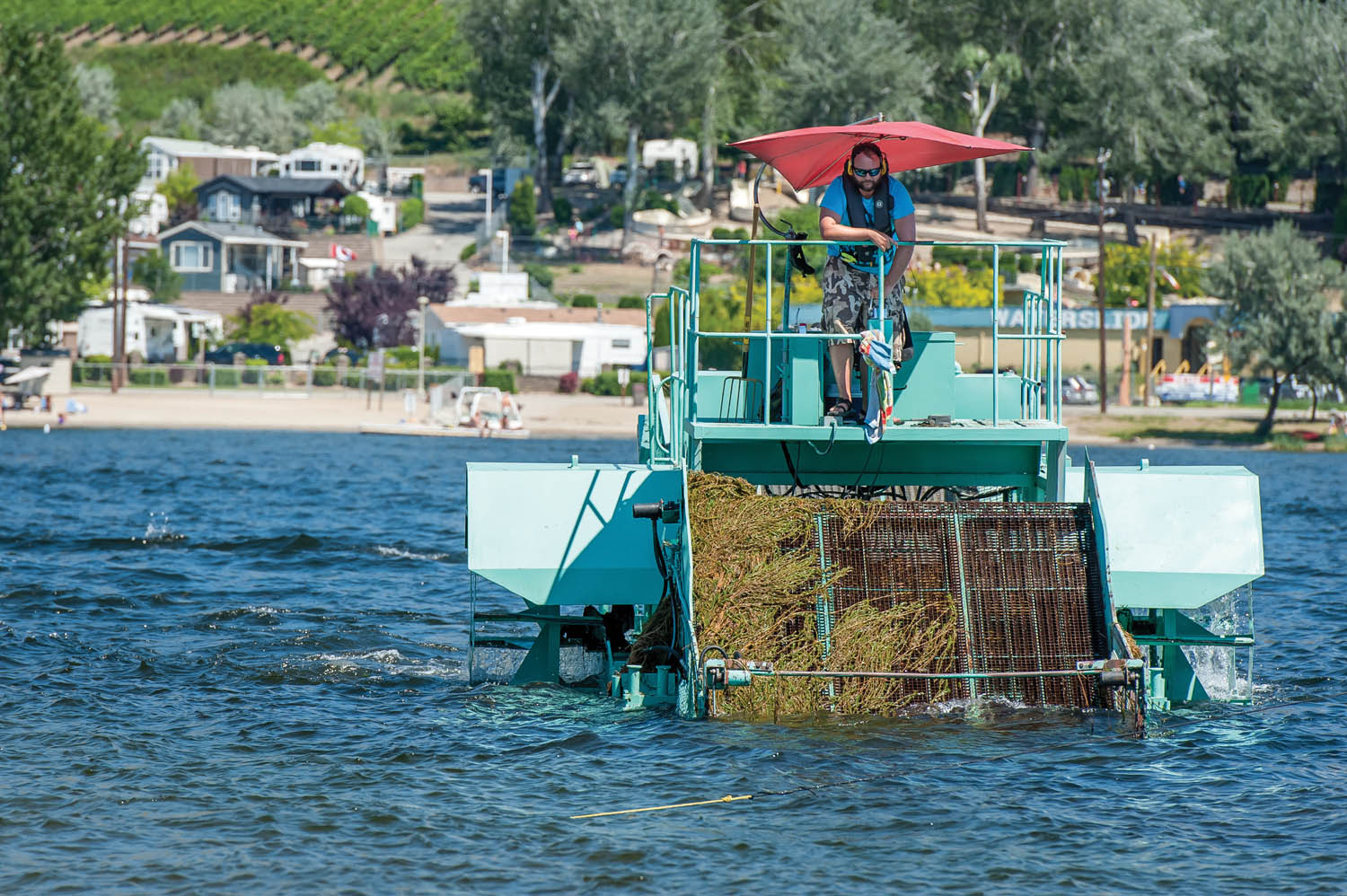
Dave Caswell of the Okanagan Basin Water Board harvests milfoil from Osoyoos Lake. In the past the OBWB has offered it as a rich fertilizer, but this year there were no takers. Unless people come forward to request it for gardens, it will have to be sent to the landfill. (Richard McGuire photo)
The Eurasian milfoil harvested from Osoyoos Lake makes an excellent garden fertilizer, but unless more people step forward to take it, it’s going to end up in the local landfill.
That’s the word from James Littley, operations and grants manager of the Okanagan Basin Water Board (OBWB), who oversees the milfoil control program in several Okanagan Lakes.
“We’re having a few issues finding compost sites for milfoil this year,” said Littley. “We have had the public accept loads in the past, but this year none of our usual takers want any. We prefer not to take it to the landfill.”
The invasive aquatic weed is harvested from the lake where it clogs the waterway for boats, swimmers and fish.
It can’t survive on land, so there is no danger of it spreading if it is used as fertilizer, Littley said.
The composted milfoil is excellent fertilizer, because it is rich in nitrogen and phosphorus, he added.
“It’s good for promoting water retention,” said Littley. “It’s good for adding to your compost because, of course, nitrogen isn’t generally occurring in most terrestrial plants. In your compost, it adds the nitrogen component that you would get with a commercial fertilizer.”
The smallest load people can request is a small dump truck load, but that can be shared among several neighbours, he said.
Also, because so much of its volume is water, it loses about 80 per cent of its volume in a couple days as it dries out.
As for an upper limit, the OBWB would be prepared to deliver all of it to a single person, for example someone with an orchard who could use a huge amount of the stuff, he said.
“That just depends on the volume we pull out of the lake,” Littley said.
This summer, the OBWB has good control over the milfoil on Osoyoos Lake because of the time spent working here in the winter and spring, he added.
On other Okanagan lakes, however, this year is turning out to be a bad year for milfoil control because with this year’s warmer weather it came early and in greater volume.
“The only downside is that it does smell fishy for the first few days until most of the water drains out,” he said. “Otherwise, it’s great for gardens.”
He also suggested it might not be appropriate for orchards that are certified organic because there is no guarantee that lake water doesn’t contain other substances.
Anyone wanting to get on a list for a delivery of milfoil can contact Littley at 1-250-469-6270.
RICHARD McGUIRE
Osoyoos Times