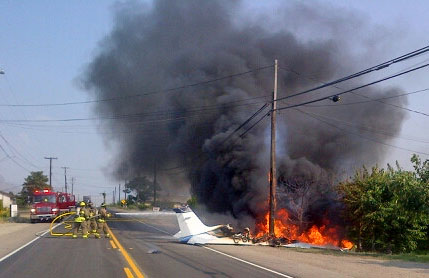
Firefighters work to extinguish the flames following a plane crash north of Osoyoos Tuesday afternoon. (RCMP photo)
Like a lot of people, veteran pilot Paul Dumoret is itching to know what happened in the cockpit of Todd Lewendon’s plane before it crashed near Osoyoos on Tuesday.
“Missing those power lines and poles was a tremendous feat … he probably did the best he could,” said Dumoret, manager of Oliver Municipal Airport.
Lewendon, from Surrey, made an emergency landing on Highway 97 at approximately 5 p.m. on July 7.
The 46-year-old operator of the single engine plane experienced a loss of power, but managed to clear utility lines, only to catch a wing on the rear of a transport truck.
The plane hit the ground and slid hard into a telephone pole, bursting into flames. Lewendon managed to extricate himself from the wreckage but suffered extensive burns to the majority of his body. He was airlifted to a burn unit in Vancouver where he is listed in critical but stable condition.
Dumoret said he spoke to Lewendon that morning because the pilot wanted to leave his plane in Oliver due to smoky conditions in Boundary Bay where he was heading.
“I believe he was an experienced pilot, he was working on his instrument rating,” said Dumoret. (An instrument rating allows pilots to fly in weather with reduced visibility.)
The airport manager said having engine failure or losing power in a small plane like that (a Beechcraft Bonanza A36) is rare.
“The reliability of these airplanes is incredible,” he commented, noting it takes a lot to bring them down. Dumoret said he used to have a Bonanza and flew it in all kinds of inclement weather.
“He (Lewendon) obviously had no power. Something happened to make him land there. He obviously had a critical problem.”
Dumoret said he previously researched the fatality rates related to single engine failure and discovered they are very low. He pointed out that some pilots experience a loss of power, or an engine stoppage, resulting in forced landings. He agreed you don’t have a lot of time to decide what to do.
Dumoret said the success of safely landing on a highway depends on how much control you have over the plane.
“If you can avoid the power lines and the traffic, all is good; you save yourself and the plane.”
Dumoret said sometimes you have to sacrifice your plane by landing in an orchard. He stated that an orchard might look cushy, but it can be a hard landing with all of the tree limbs, and hopefully you won’t get hurt by a branch through the cockpit.
The other option in this case is ditching the plane in the lake, but you’ll want to get out fairly quick before it sinks.
Dumoret said the fear that a lot of pilots have in any crash is burning alive in the cockpit. He expressed relief that Lewendon was able to escape the plane after impact.
The guy is very lucky, Dumoret agreed.
The Transportation Safety Board is currently investigating the incident to determine what exactly caused the crash.
LYONEL DOHERTY
Special to the Times