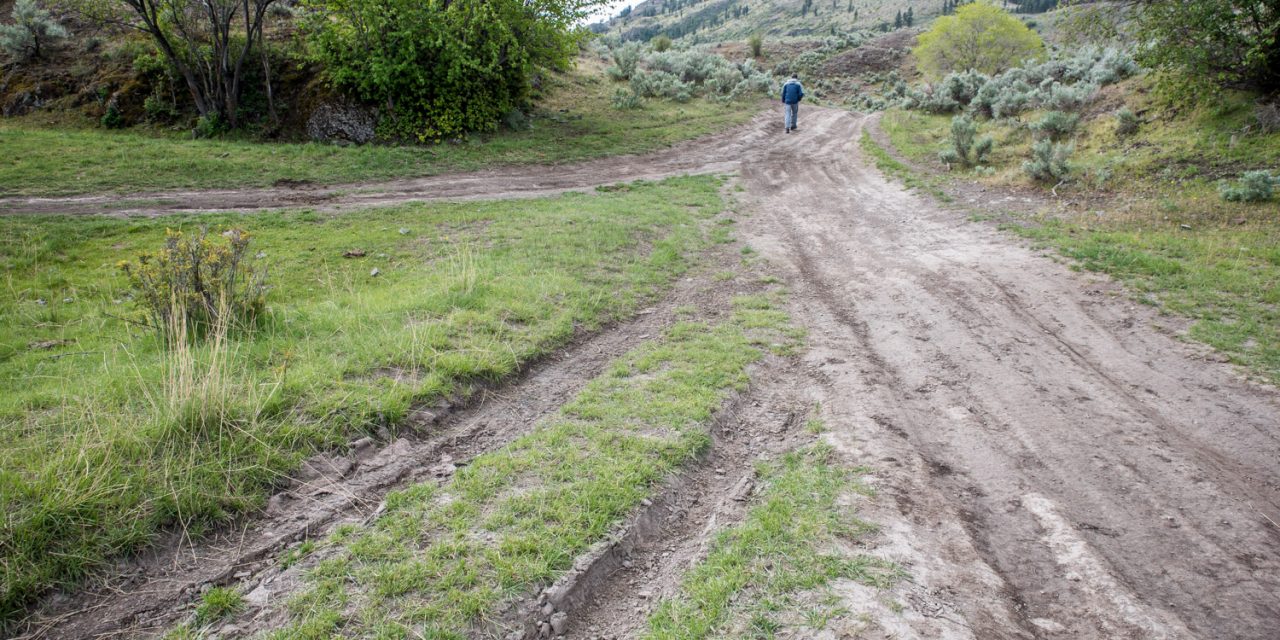
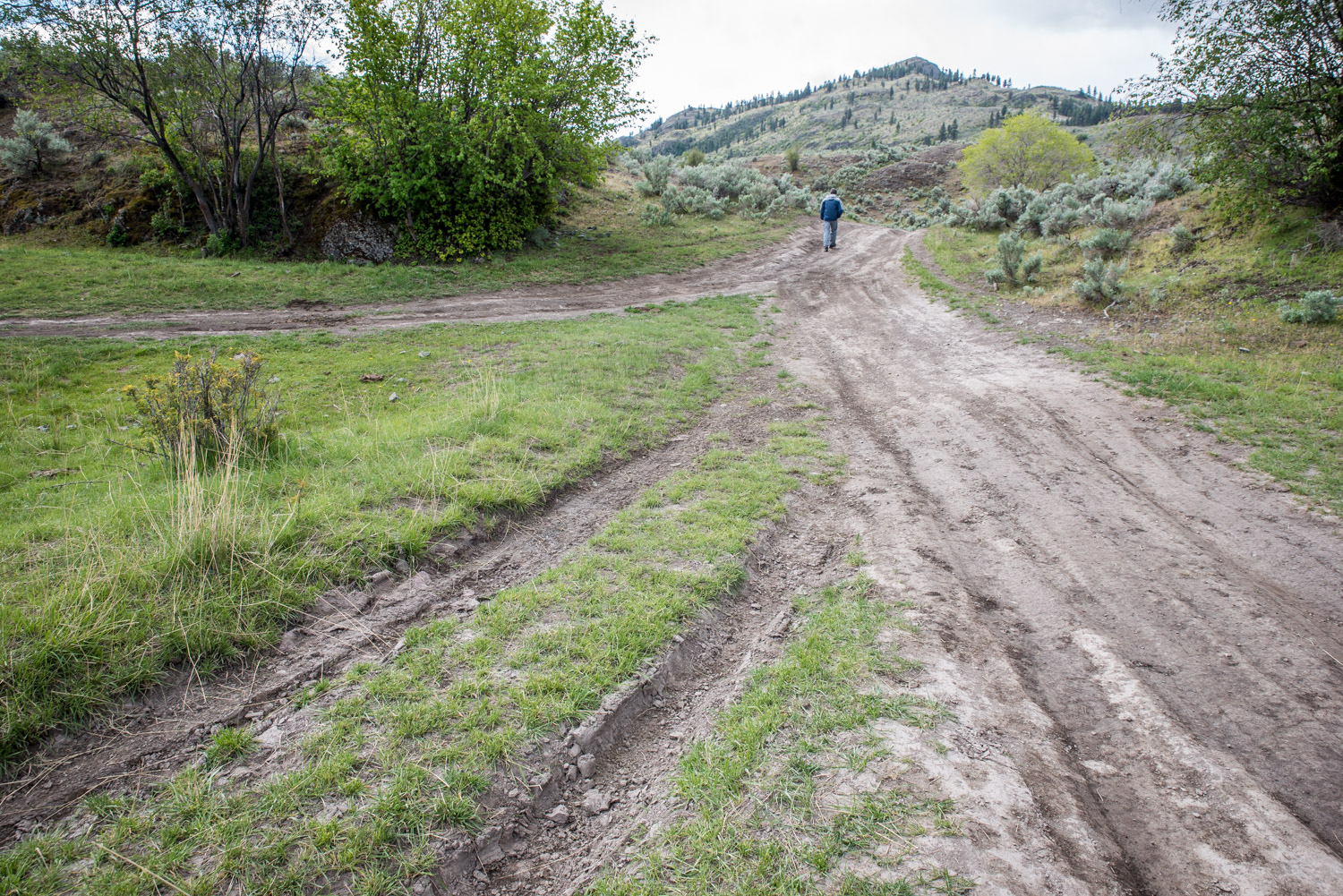
Users of off-road vehicles have created numerous roads running beside each other across sensitive environment. The Ministry of Forests, Lands and Natural Resource Operations urges ATVers to stay on the main road and not to create new roads. (Richard McGuire photo)
The Osoyoos West Bench is an area of wild grasslands above the Osoyoos Golf Course.
It was once a mining area. Now it’s popular with users of off-road vehicles, as well as hikers and others who enjoy being out in nature.
It is also one of the few remaining examples in Canada of two rare ecosystems – the antelope brush needle and thread grass ecosystem and the bluebunch wheatgrass and sagebrush ecosystem.
Recently, the Osoyoos Times had a tour of the area with a biologist from the provincial ministry of Forests, Lands and Natural Resource Operations (FLNRO).
FLNRO is increasingly concerned about the damage caused to this ecosystem by off-road vehicles. Many of the roads in the area are old mining roads that have been used since the old Dividend Mine extracted gold in the 1930s and earlier.
As the biologist, Orville Dyer, pointed out, however, in the past five years there has been a proliferation of new trails as off-roaders drive over virgin sagebrush or expand cow paths.
The destruction is very real. These trails zigzag across one another. Sometimes there are three or four trails running parallel to each other only a few feet apart. Often they are up steep embankments sensitive to erosion.
Perhaps most tragic is the destruction caused by mud bogging. Mud bogging is a sport where ATVers ride through wetlands to tear up the ground.
It’s illegal in sensitive areas and a few people are prosecuted, but they are rarely caught.
Dyer showed an area that is one of the few places in Canada where the rare plant, called annual paintbrush, grows. The mud boggers may come through when the plant isn’t in bloom, but they destroy it nonetheless.
There are, of course, many responsible off-road vehicle users who stick to the well-worn trails and don’t create new ones or engage in mud bogging.
The ministry hopes that by educating the destructive minority, everyone will follow best practices.
These include keeping to existing roads and trails, not creating new trails or using livestock trails, avoiding steep trails where erosion can occur and staying away from wetlands.
It is an offence under the law, the ministry reminds us, to create new trails or damage the environment.
People who have lived their entire lives in Osoyoos often don’t realize how unique this area is in Canada or even in the world.
There’s an environment and ecosystems here that are found nowhere else. Human settlement and agriculture have reduced the size of this unique environment to a few pockets that are increasingly threatened.
It remains to be seen if FLNRO’s approach of trying to educate off-roaders will be successful.
If it isn’t, the behaviour of a destructive few could cause the activities of the responsible majority to be restricted in the future.