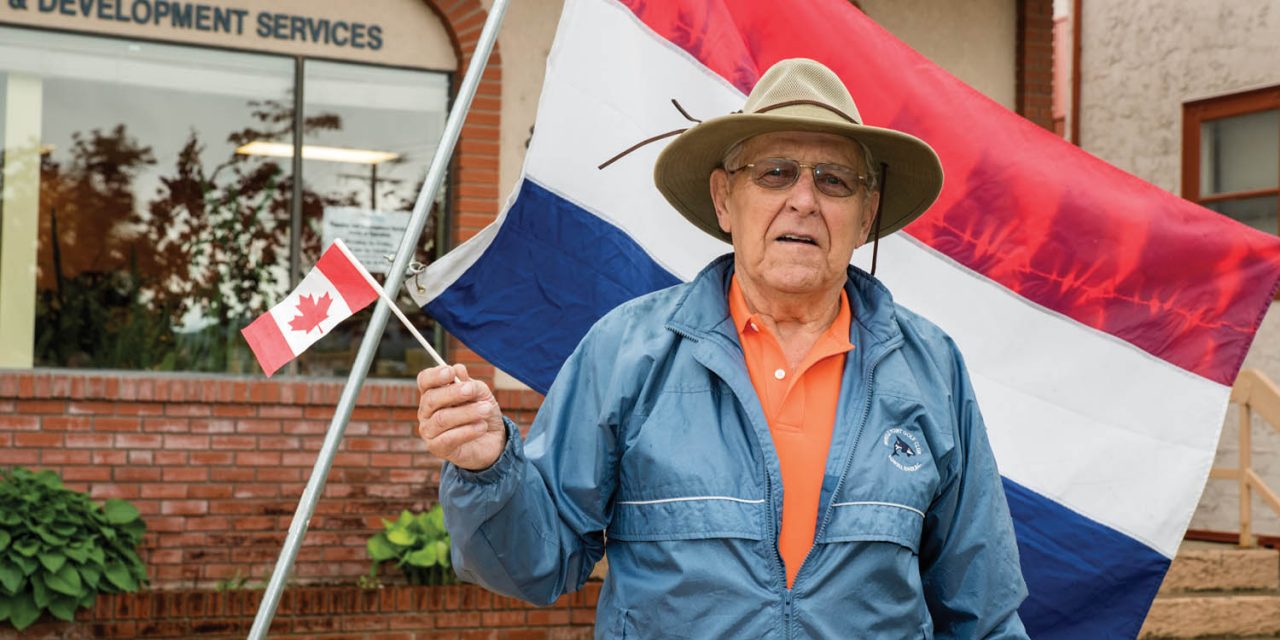
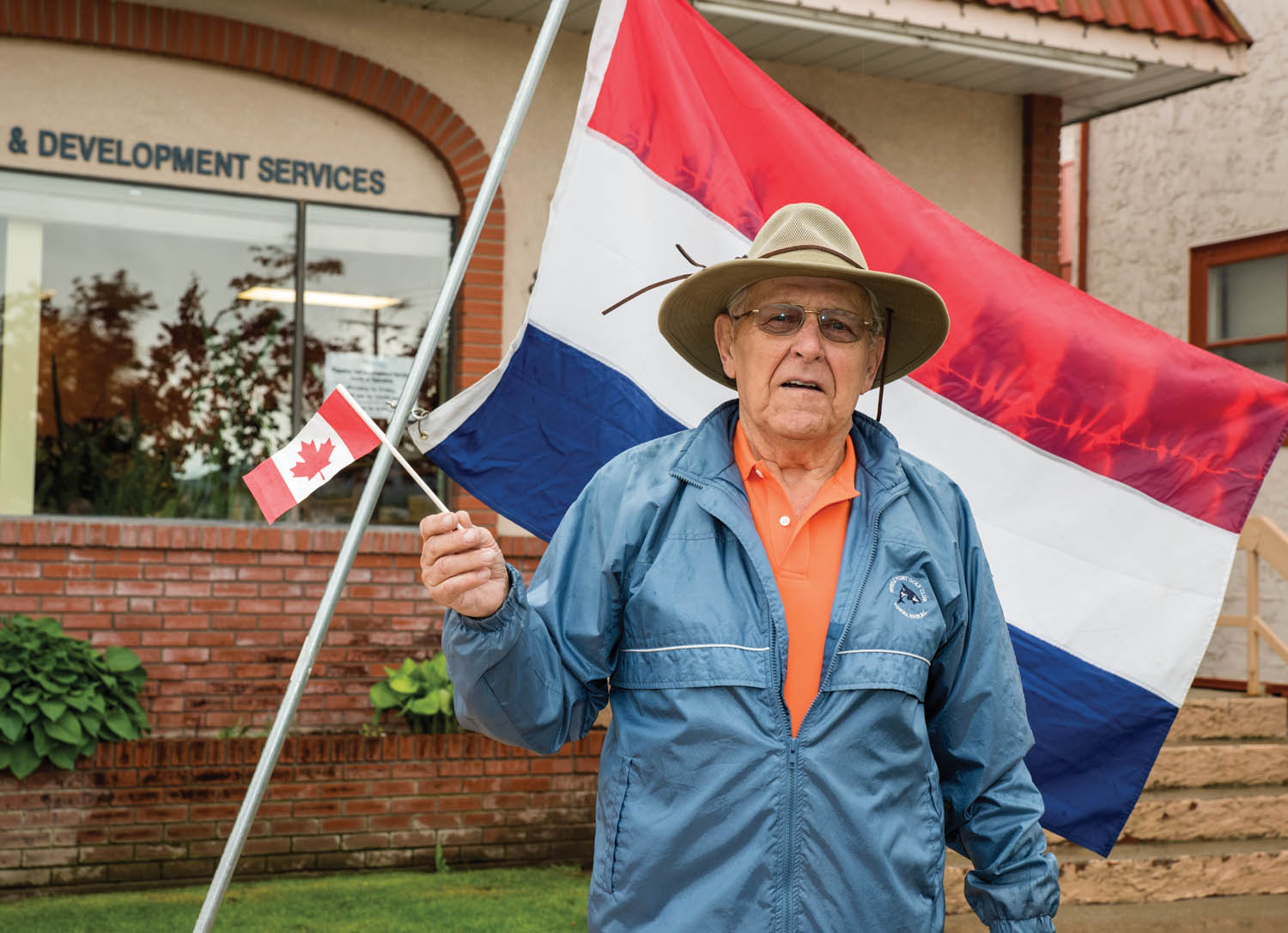
Longtime Osoyoos resident Art Molenkamp, who was born and raised in Holland, paid his respect to the thousands of Canadian soldiers who sacrificed so much during their participation in the Liberation of Holland back in 1945. Molenkamp still remembers being a young boy joyously celebrating in his hometown as Nazi soldiers were pushed out of the town square and Canadian soldiers filtered in minutes later. (Richard McGuire photo)
Canada will always have a special place in Art Molenkamp’s heart and the collective hearts of million of Dutch citizens.
One of the most cherished moments of Art Molenkamp’s life took place when he was a young and impressionable teenager in the small town of Haarlem in Holland.
That was the day when, at age 13, he gathered in the town’s square to celebrate the liberation of Holland from the Nazis during the Second World War.
A huge contingent of Canadian soldiers played a key role in pushing out the Nazis from across Holland and liberating the country.
Millions of Dutch residents from around the world celebrated on Tuesday as May 5 marked the 70th anniversary of the Second World War liberation of Holland.
Molenkamp, 83, who was born and raised in Holland before emigrating to Canada in 1966, paid his special tribute to Canada by bringing Canadian and Dutch flags to the Osoyoos Cenotaph outside town hall on Tuesday morning.
Molenkamp said he remembers that special day 70 years ago as if it happened yesterday.
“I was a boy of 13, but I very much remember the Germans being pushed from the town square,” said Molenkamp, who moved to Osoyoos to retire 10 years ago after a long career as an accountant in Cloverdale, B.C. “After the Nazis were pushed out, the Canadian soldiers rolled into town and there was an incredible celebration. To this day, we know it was the brave Canadian soldiers who liberated our town and our country and Dutch people will never forget that.”
Within an hour of being free after five years of Nazi oppression, thousands of local residents engaged in a celebration that lasted for days, said Molenkamp.
“There were literally thousands of Dutch flags flying in the town square … and a few Canadian ones too,” he said.
The brutal Nazi occupation ended on a very sour note, Molenkamp recalled.
“The driver of one of the last trucks transporting the Germans was angry because he was being booed and hissed at and wasn’t happy with the celebration going on, so he shot and killed a little boy,” he said. “The boy was five and the brother of one of my best friends at the time.
“That was a terrible experience and I’ve never forgotten it.”
The liberation of his country also resulted in his two oldest brothers and the two oldest brothers of his wife finally being freed after years of slave labour, said Molenkamp.
“Near the beginning of the Nazi occupation, my two oldest brothers and my future wife’s two oldest brothers were taken from the streets and forced into slave labour,” he said. “They were gone for four long years. Fortunately, once the war ended, they were allowed to return home.”
The horrors of war are a big reason so many Dutch people decided to emigrate from Holland to North America, Australia and other countries around the world, said Molenkamp.
Things were so bad during the war that millions of Dutch were forced to “eat tulips and onions” almost every day for months in order to survive, he said.
The biggest reason he decided to bring his wife and three children – they had a fourth after arriving in Canada – to this country was because of those childhood memories and what Canadian soldiers sacrificed for Holland and Dutch citizens, he said.
“When we made the decision to leave Holland, an official tried to convince me to go to Australia … and another tried to push me towards South Africa,” he said. “I knew I wanted to come to Canada. I had not forgotten what those soldiers did for our people and our country and I wanted to make my life in Canada.”
He and his wife, four children and 10 grandchildren are proud to be Canadian citizens and been able to grow up in one of the most beautiful and friendly countries in the world, said Molenkamp.
Going down to the cenotaph on the 70th anniversary of the Liberation of Holland was his small way of paying tribute to the 60,000 Canadian soldiers who died on Dutch soil while battling the Germans, he said.
KEITH LACEY
Osoyoos Times