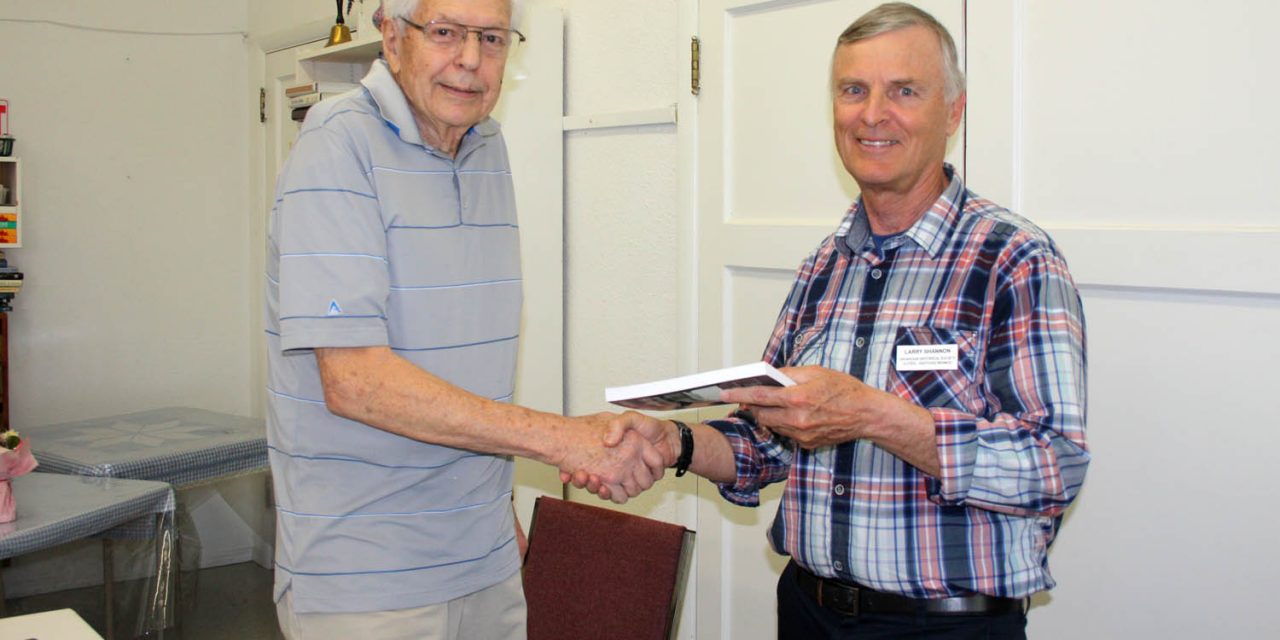
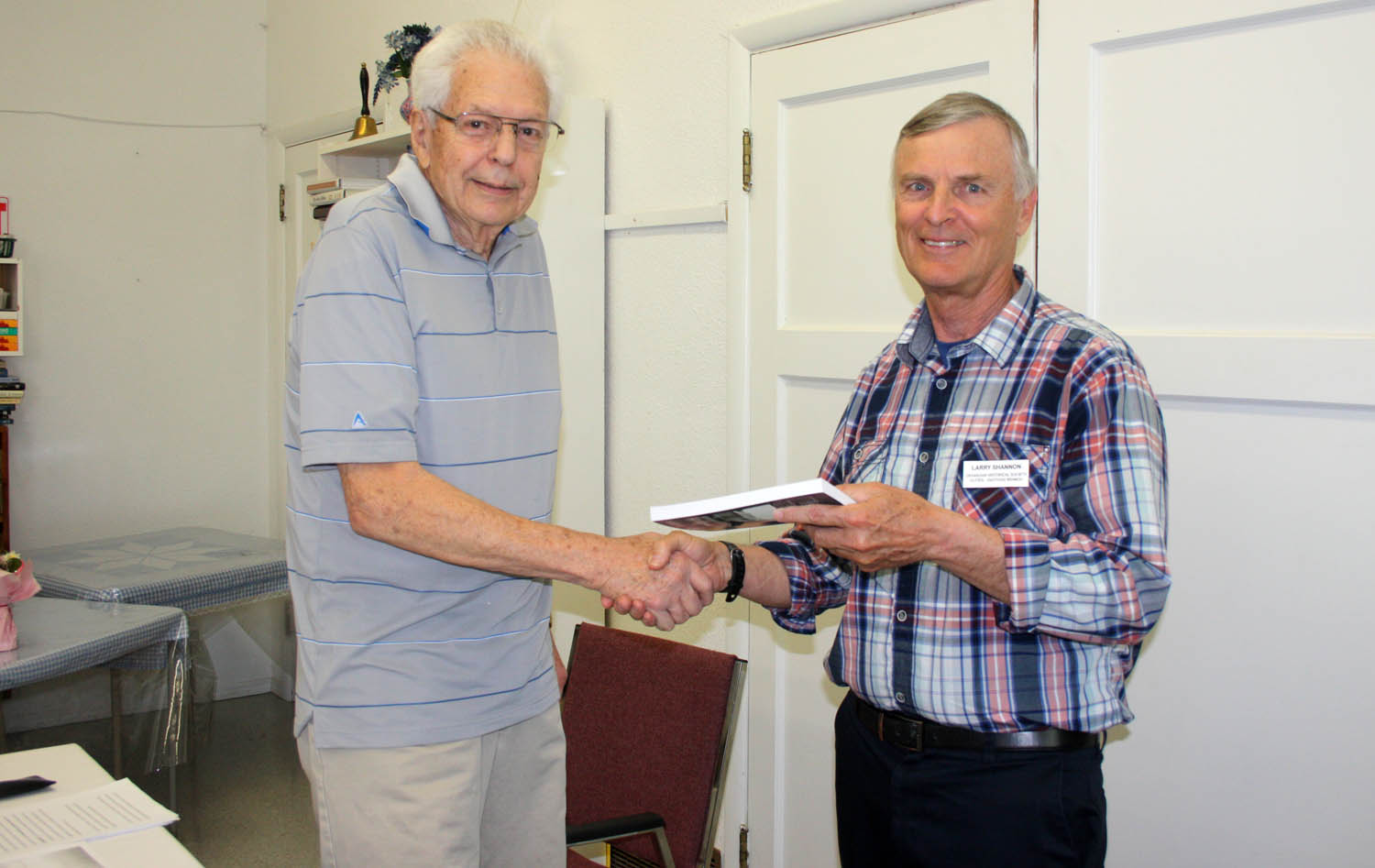
George Fraser (left) was the special guest speaker at the Oliver Osoyoos branch of the Okanagan Historical Society, which held its annual general meeting this past Sunday afternoon at the Osoyoos United Church. Fraser provided a humourous and heartfelt recollection of his early years growing up in Osoyoos. His family was one of the founding pioneers of this community. Larry Shannon, the president of the local chapter, presented Fraser with the society’s latest annual report as a gift. (Keith Lacey photo)
A member of one of Osoyoos’ first families took local residents who belong to the Okanagan Historical Society on a humorous and heartfelt trip down memory lane this past weekend.
George Fraser was the special guest speaker at the Osoyoos United Church as the Okanagan Historical Society held its annual general meeting Sunday afternoon.
A group of about 30 gathered to listen to Fraser talk about his family first settling in Osoyoos dating back to 1917 and his fondest memories of growing up as a youngster in a small town so few had heard of almost 100 years ago.
“When our family moved here … the population went from 13 to 17,” said Fraser with a smile.
His grandfather George Fraser Sr. first moved to Osoyoos back in 1917 and his family was one of the very first pioneers to settle here, he said.
Both his grandfather and his father Doug Fraser have written about their life as pioneers and their affection for Osoyoos and he couldn’t say no when Gayle Cornish from the historical society asked if he would be interested in being this year’s guest speaker, said Fraser.
The changes that have taken place in this community with only a handful of houses, no electricity and no amenities to a bustling community which has become one of British Columbia’s major tourist destinations has been astounding, he said.
His father reluctantly left Osoyoos to attend the University of British Columbia, where he met his mother Dorothy while attending school.
They married a couple of years after meeting and spent most of their 57 years of marriage in Osoyoos, where they became successful orchardists. George was an only child.
His father tried teaching for a few years on Vancouver Island, but missed the small town life and returned to Osoyoos in 1941 and planted his orchard, he said.
The first school he attended was extremely small and houses all local students between Grades 1 and 6 and woodstoves were needed to heat the classrooms, he said.
To keep themselves entertained, schoolchildren would play games like Red Rover and hopscotch and plenty of card games and board games “that were all hand me downs … we couldn’t afford to pay $35 for a board game like they do today.”
For several decades, students in Osoyoos who graduated from elementary school had to take a school bus to Oliver to attend secondary school, said Fraser.
The old school buses had long wooden benches and the older kids would sit in the back and purposely slide forward and collide with the younger students sitting at the front of the bus when the driver had to apply the brakes, he said smiling.
“The poor, skinny Grade 7s would take a lot of punishment from the big Grade 12 kids sitting in the back,” he said.
He remembers his father talking about having to board with families in Oliver so he could attend school during the week and return to Osoyoos on weekends.
“If there was no ride, he would walk home,” he said.
He also fondly recalled his father travelling to Sicamous in the 1940s in his rundown orchard trailer to buy a boat.
“It had a 2.5 horsepower motor and we had one of three motorboats on Osoyoos Lake,” he said.
He remembered his parents gathering huge blocks of ice from Osoyoos Lake during the winter months to use on their icebox to preserve food.
Osoyoos Lake used to freeze over for several weeks each winter and kids would spend endless hours playing ice hockey and other games, he said.
During the long winters months as a child, he and his friends would form makeshift ski hills near Anarchist Mountain and later near the Elkink Ranch up Old Richter Pass Road, he said.
With no machinery to groom the hills, he and other kids would use their creative skills to form towlines to get up and down the hills.
“We were so lucky to grow up in such an age of innocence,” he said.
During his early teenage years, he fondly recalled being part of the first minor baseball team in Osoyoos.
“We had one ball and one bat,” he said.
They challenged a team from Oliver one year after forming and lost their first exhibition game 33-0.
Eventually, a league was formed with teams from Oliver and Osoyoos.
“We had no coaches, no uniforms … we had one bat and one ball,” he said. “Needless to stay, there has been a great deal of change. People ask me if I’m nostalgic. You bet I am. There have been so many changes. Some positive and others not so positive.”
When he grew up in Osoyoos, you didn’t have to worry about traffic, the deterioration of Osoyoos Lake or ATVs causing damage to pristine wilderness trails, he said.
The good news is Osoyoos has maintained much of its natural beauty and he’s still proud to call this town home, he said.
KEITH LACEY
Osoyoos Times