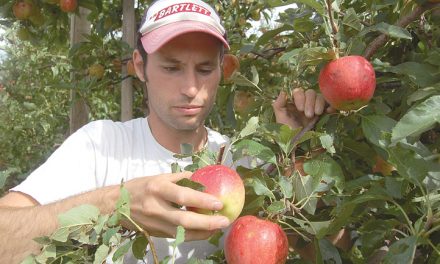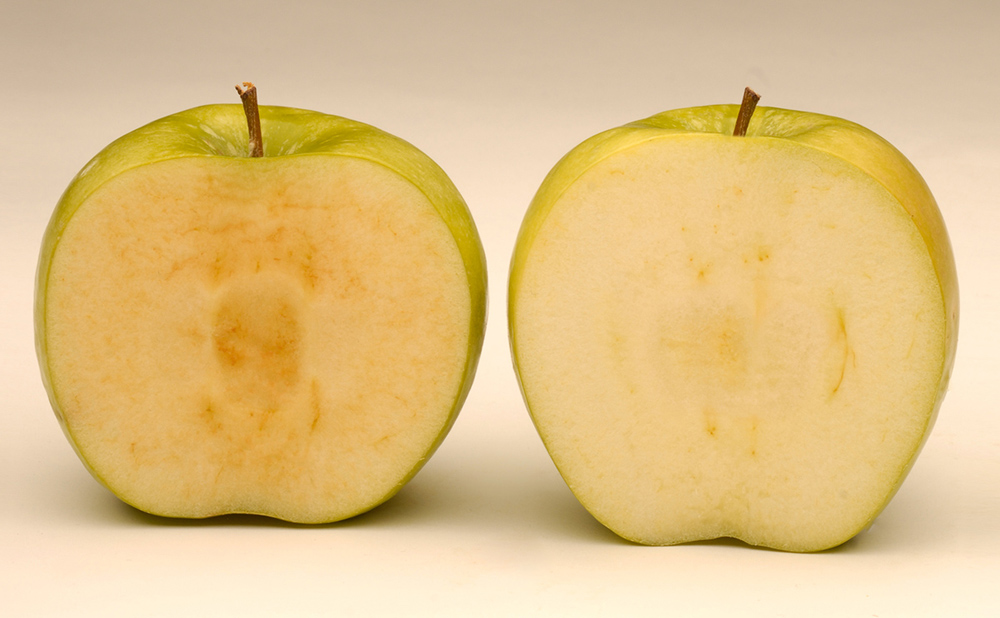
Local MP Alex Atamanenko has joined the B.C. Fruit Growers Association in asking the federal government to reject approval of the genetically-modified Arctic Apple. The Arctic Apple, which doesn’t brown due to genetic modifications, was recently approved for the United States market.
PHOTO SUPPLIED
Arctic Apple that doesn’t brown has been subject to plenty of controversy on both sides of the border
BC Southern Interior MP Alex Atamanenko has joined B.C. fruit growers in asking the federal government to reject approval of the genetically-modified Arctic apple in Canada.
“There is absolutely no need to grow GE apples in Canada. Both the BC Fruit Growers Association (BCFGA) as well as the Similkameen Okanagan Organic Treefruit Growers Association strongly oppose this approval,” said Atamanenko last week. “There is a very legitimate fear that public backlash would wreak havoc in the marketplace. Customers do not support the genetic tampering of fruit and vegetables for the benefit of patent holders, especially when the genetics of their products cannot realistically be prevented from cross-pollinating with neighboring varieties.
In July 2012, a Leger Marketing Survey found that 71 per cent of consumers favored having a special category of foods that should not be genetically modified or contain genetically engineered contents, such as fruit, vegetables, milk and baby food.
The Union of BC Municipalities also recently passed a resolution asking the provincial government to, “Legislate the prohibition of importing, exporting and growing plants and seeds containing genetically engineered DNA, and raising GE animals within B.C., and to declare through legislation that the province of B.C. is a GE Free area in respect to all plant and animal species.”
“The bottom line is that neither our fruit growers nor the public see a need for this “non-browning” apple. I strongly urge the federal government to protect our farmers and not approve the GE apple”, concluded Atamanenko.
The BCFGA instantly stated its ongoing opposition to the approval of genetically modified (GM) apples in Canada, despite the approval of the GM “Arctic” Granny Smith and GM “Arctic” Golden Delicious in the United States last week.
When cut, the apple does not brown, mainly resulting in cosmetic benefit and enhancing the efficiency of fresh cut apple processors. Other apples are available which are naturally slow to oxidize, or brown, when cut.
The fruit grower association, which represents 520 commercial tree fruit growers in the Okanagan, with B.C. annual farm gate value of apples of $45.3 million, has opposed the approval of GM apples in Canada due to possible market backlash that could impact all apples.
“We regret that the U.S. is approving the Arctic Granny Smith and Arctic Golden Delicious,” said BCFGA president Fred Steele. “The apple is considered a pure, unadulterated product, similar to milk. In a 2012 national survey of consumers,
71 per cent said they agreed that there should be categories of food that should not be genetically engineered. Our members would like the apple market to remain free of GM apples.”
The BCFGA notifies the Canadian public that the Arctic Apple is not approved in Canada at this time and it would take at least four years before any significant volume of arctic apples were available in the marketplace.
Even then the volume would be very limited, said Steele.
“If consumers want to be perfectly assured that they are not eating a GMO apple, then avoid purchase of U.S. Granny Smith and Golden Delicious apples,” said Steele. “We will advise the public when the product is approved in Canada, and seek to isolate any damage that the apple will cause in the marketplace by advising consumers how to continue purchasing apples while avoiding the Arctic Apple, if they so desire. We would prefer if the Canadian government would place a moratorium on the Arctic Apple, until we see the result of the market experiment in the United States.”
The BCFGA and Quebec Apple Producers’ Association commissioned a national survey in 2012 on the public perception of GMO fruit and the Arctic Apple.
The poll asked six questions about genetically engineered food.
In response to the question “Are you in favor or the approval of this (genetically engineered) apple by Health Canada?”, 69 per cent of respondents were not in favour.
Of the 1,501 respondents in the national survey, 76 per cent said that the Canadian government has not provided adequate information about genetically modified food.
A further nine per cent said they had not heard of genetically modified food prior to the survey.
The survey asked some of the same questions as a Consumers Association of Canada (CAC) Survey from October 2003.
The CAC survey, conducted by Decima, found at that time that 88 per cent of respondents agreed that “a genetically modified food label be made mandatory by the Canadian government”, rather than the current voluntary labelling of genetically modified food.
In the present survey, 91 per cent of respondents agreed that mandatory labelling of genetically modified food should be required by the Canadian government.
If the food were clearly labelled as being genetically modified, 14 per cent of respondents would purchase the food without hesitating, 45 per cent said it would depend on the type of food being purchased, and 35 per cent said that nothing could convince them to purchase genetically modified food.
Finally, 71 per cent of the survey respondents indicated that they are in favour or having a special category of food (e.g. milk, apples, pablum, fruits and vegetables) that should not be genetically engineered or be free of genetically engineered ingredients.
The poll was conducted between June 26 and June 29, 2012 by Leger Marketing. The LegerWeb panel was polled, with 1,501 responses, designed so that the proportion of respondents, when grouped by region, gender, age, and language, are representative of the Canadian population.
For more, visit www.bcfga.com.
SPECIAL TO THE TIMES
Osoyoos Times