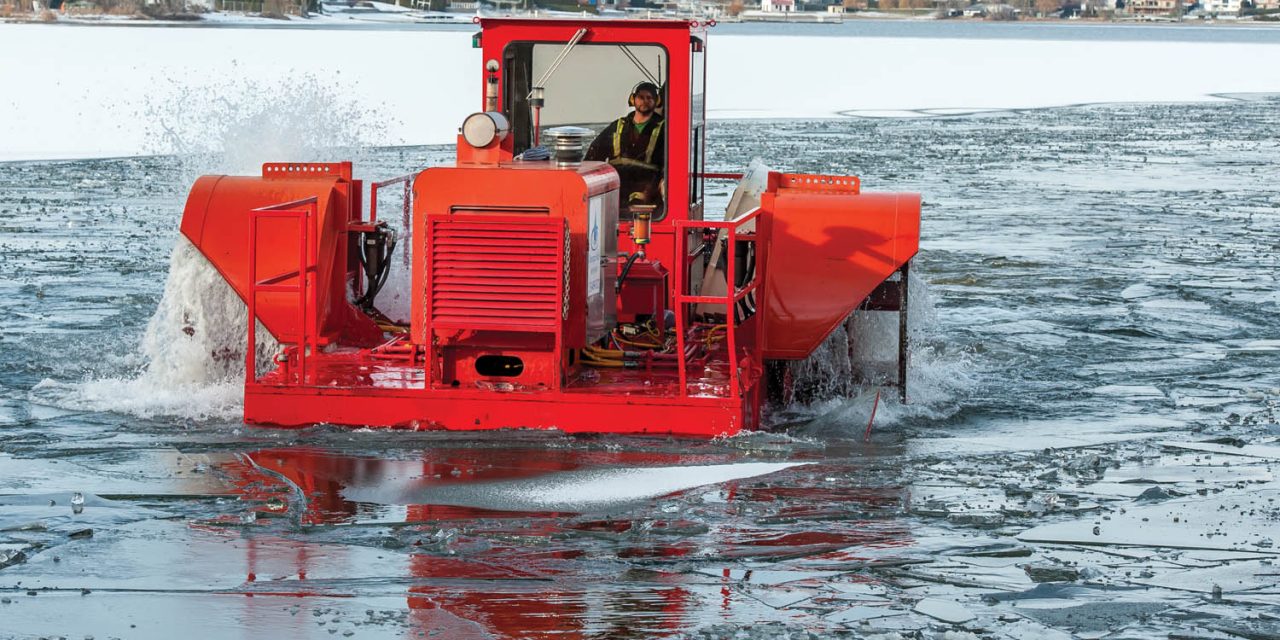
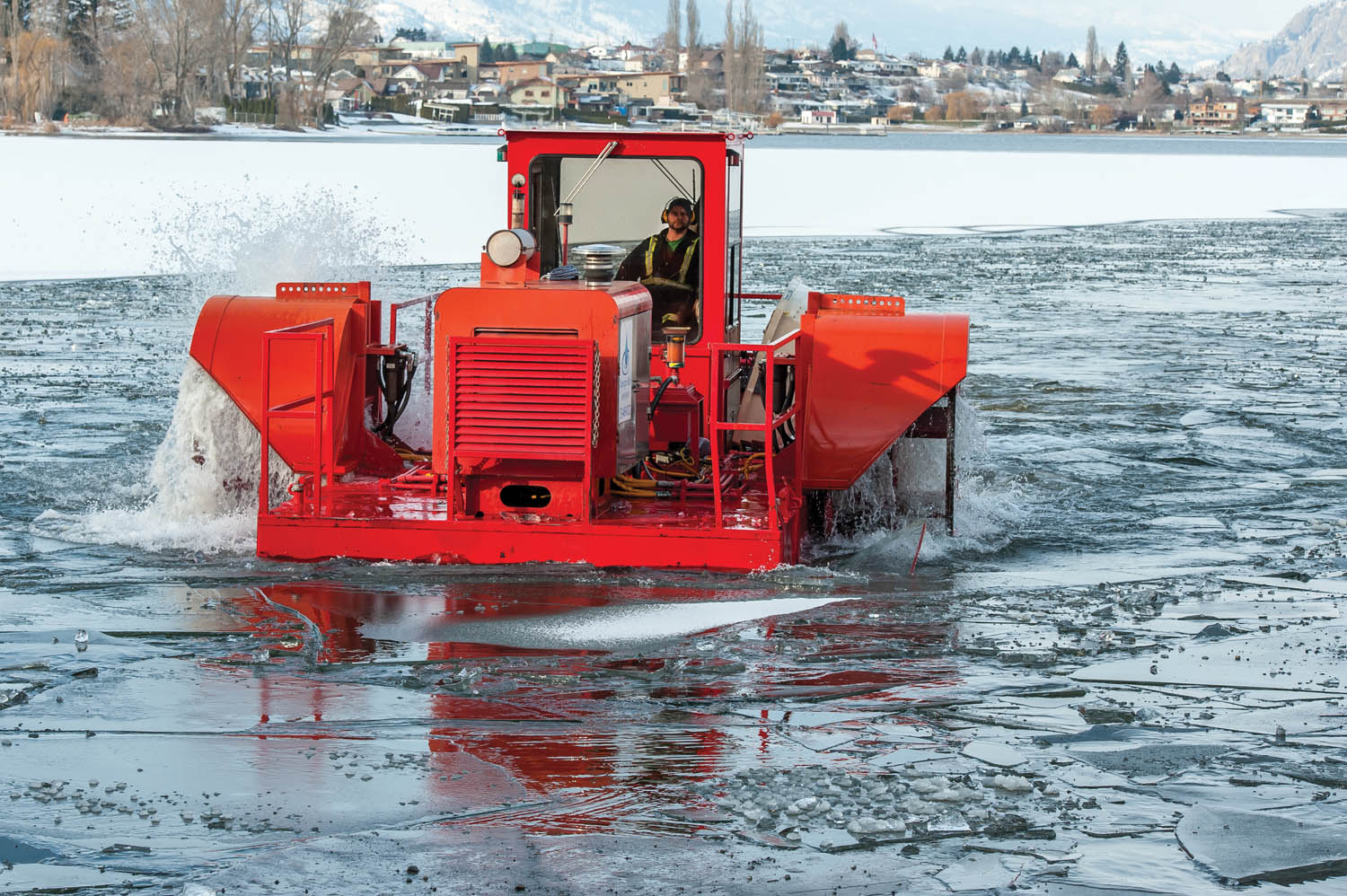
Two years ago the milfoil machine was operating in January on Osoyoos Lake despite some ice. This year it was moved north to Okanagan Lake after Dec. 3 because a freeze up was anticipated on Osoyoos Lake. (Richard McGuire file photo)
The large area of open water on Osoyoos Lake this winter hasn’t been a boost to this year’s milfoil control program because the machine moved up the valley in early December.
James Littley, office and projects manager with the Okanagan Basin Water Board (OBWB), which operates the milfoil control program, said operations concluded on Osoyoos Lake on Dec. 3.
“There was that stretch of below freezing weather and we thought the lake would get a good freeze up,” said Littley, explaining why the rototilling machine was relocated to Okanagan Lake, which doesn’t freeze over.
“We normally start back in Osoyoos in late February and work until April 1 in areas where we can,” he added. “We hope that if the weather stays nice and the lake does not freeze, he (operator Dave Caswell) may be able to get back into Osoyoos earlier this year.”
The milfoil control program lost five important days of work on Osoyoos Lake after the machine was vandalized and equipment stolen in November, Littley said.
Before moving to Okanagan Lake, Caswell was able to complete winter rototilling in the portion of Osoyoos Lake south of the bridge and he was able to get a start on the northern portion.
In the winter program, the rototilling machine uproots the invasive aquatic weed by the roots and the plant floats and dies.
This is different from the summer program when only the tops of the plants are cut to make it easier for boaters and swimmers to use the lake. Uprooting plants when the water is warmer would not kill the milfoil and instead it would spread and reestablish.
When operations resume, likely in February, Caswell will focus on the 1.5 km stretch from the bridge to Lacey Point off Crab Apple Court, Littley said.
After that, for the remainder of the season the focus will be on the north end of the lake.
“We have calculated the milfoil bed at the north end to be about 84 acres in area,” Littley said. “Because there is no way to treat an area that large with the time available, we will be treating a large swath close to shore and around docks, etc. to try to address boating and swimming areas.”
OBWB is not allowed to rototill within 500 metres of the river channel, which accounts for about half the total area, he added.
Last year the OBWB received a number of calls because of boats getting caught in the milfoil.
This year, some of the restrictions on the control program have been lifted, allowing it to continue after April 1.
The program will have to stop, however, once the lake temperatures warm up too much to kill the pulled plants.
Littley is unsure how much the five days lost to the vandalism will affect the operation.
“We can never get to every area every year, so at the least it means there is five days worth of milfoil removal that didn’t happen for someone,” he said. “If the weather stays mild and we can get back in early, then we may be able to treat all the priority areas and it won’t matter much. However, if the weather gets bad, or if we have other issues like a breakdown, we might not be able to get all of those areas and it will make for a less enjoyable tourist season on the lake this summer.”
Eurasian milfoil is an invasive aquatic species that first spread into the Okanagan lakes in the 1970s.
RICHARD McGUIRE
Osoyoos Times