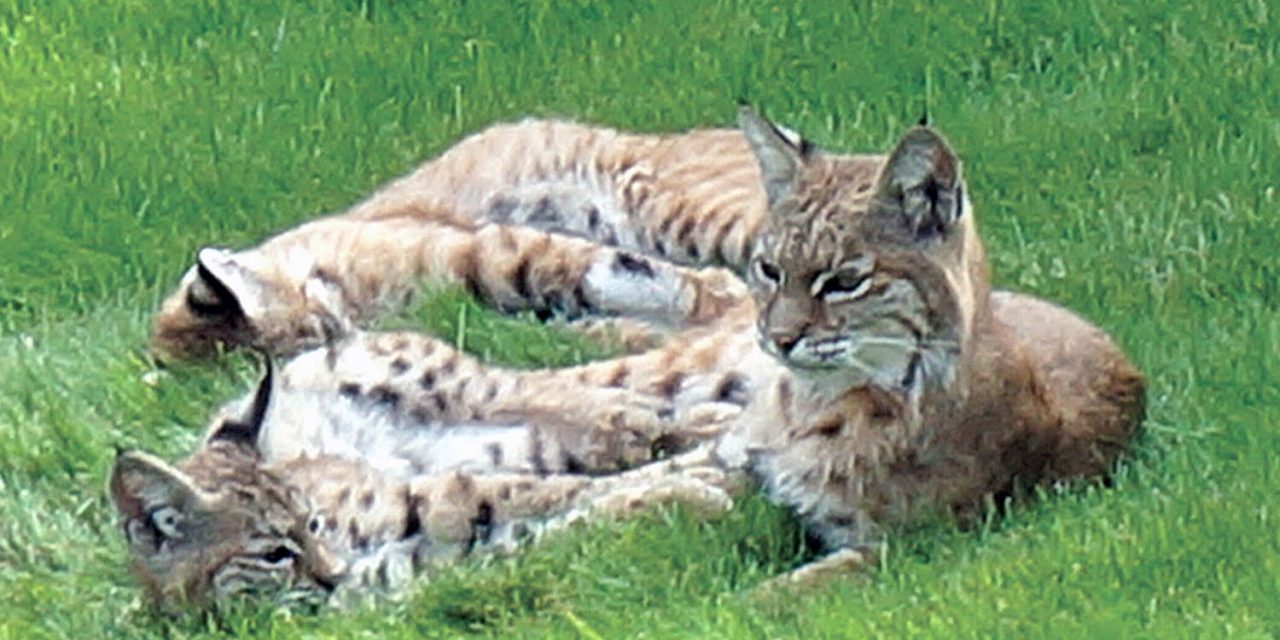
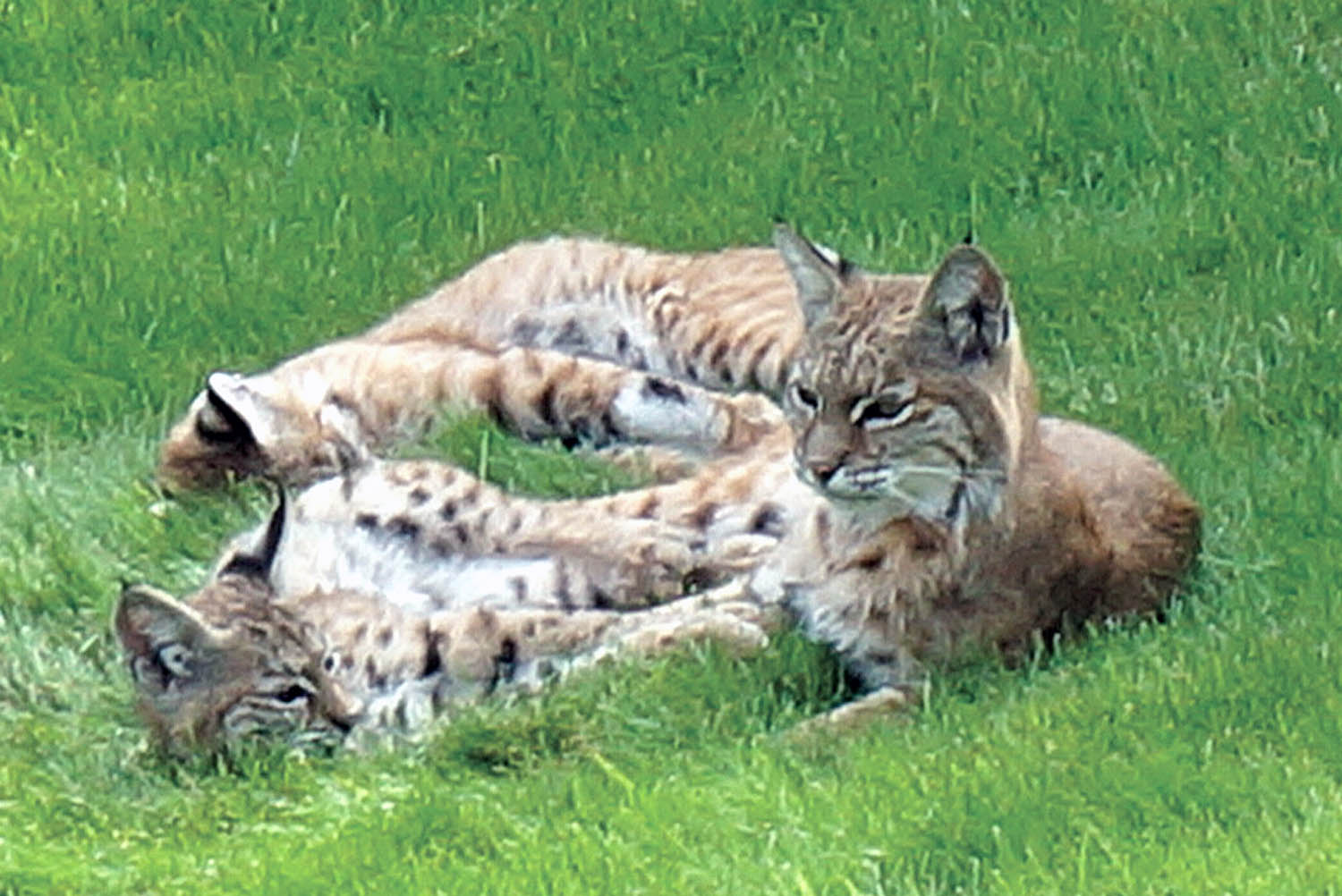
Greg and Anne Marie Reely were surprised early last week when they looked outside a window in their home and observed this female bobcat and her two kittens playing in their front yard. Several other neighbours up near Osoyoos Golf Club have also observed the bobcats in their yards. While they don’t pose much of a risk to humans, bobcats have been known to attack domestic cats and small dogs. (Anne Marie Reely photo)
They are adorably cute and pose virtually no threat to humans, but residents of the subdivision on the town’s West Bench near Osoyoos Golf Club should use precaution with their family pets if they observe a female bobcat and her two kittens strolling in their neighbourhood.
Greg Reely and his wife Anne Marie were surprised and amused when they looked out their front window early last week and saw a female bobcat playing with her two kittens.
Their domesticated family cat was making strange sounds because the bobcat and kittens were playing on the grass in their front yard, said Anne Marie.
“I had to rescue our cat from the bobcat … when I looked outside our cat was in a big ball and hissing and I knew something wasn’t right,” she said. “I went outside and sat there and the bobcat was only a few feet away.
“Once they saw me, they waited a few seconds and walked quietly away.”
Reely took some pictures and a short video of the three bobcats playing in her yard.
Within a matter of three days, they observed the mother and two kittens in or near their yard on four separate occasions.
“We have been here for six years and this is the first time we’ve ever seen a bobcat in our yard or in this neighbourhood,” said Greg. “We’ve seen a lot of deer and other wildlife, but never a bobcat or any kind of wild cat.”
While they are certainly not aggressive, Reely said he and his wife know these are wild animals and it would be a good idea to keep cats or small dogs inside until the bobcats leave the neighbourhood.
“They are very adorable and the little ones do nothing but play, but we are keeping our cat inside for the time being,” he said. “A few of our neighbours have seen them as well and while no one is afraid, we all agree it’s probably a good idea to keep our pets inside just in case.”
Mike Stern, a veteran conservation officer from Penticon with the Ministry of Forest, Lands and Natural Resource Operations, said “it’s extremely rare for a bobcat to be found in a residential neighbourhood. It just doesn’t happen very often.”
Because they are extremely cute, Stern said some people might be tempted to feed these animals, but that would be a big mistake as it would encourage them to stay and not go back to the mountains, where they usually live, he said.
“Please don’t feed them,” he said. “They are cute, but they are still wild animals and don’t belong in residential neighbourhoods.”
The Penticton office would receive roughly half a dozen calls per year about nuisance bobcats across the region, said Stern.
The favourite meal of choice for an adult bobcat are rabbits and rodents, but they would easily become aggressive towards an inquisitive cat and he recommended cat owners keep their pets inside until this mother and her two kittens retreat back into the wild, said Stern.
Anyone with concerns or who wishes to report a nuisance bobcat or other wild animal should call 1-877-952-7277.
Bobcats were once found throughout most of North America from northern Mexico to southern Canada. In the early to mid 1900s, bobcat populations in many Midwestern and eastern states of the United States were decimated due to the increased value of its fur. However, international laws began to protect the world’s spotted cats in the 1970s, and populations have rebounded since then.
Today, populations are stable in many northern states and are reviving in many others. Bobcat habitat varies widely from forests and mountainous areas to semi-deserts and brush land. A habitat dense with vegetation and lots of prey is ideal. Bobcats are excellent hunters, stalking prey with stealth and patience, then capturing their meals with one great leap.
Usually solitary and territorial animals, females never share territory with each other. Male territories, however, tend to overlap. Territories are established with scent markings and territory sizes are extremely varied – generally 25-30 square miles for males and about five square miles for females.
Each bobcat may have several dens, one main den and several auxiliary dens, in its territory.
The main den is usually created in a cave or rock shelter, but can be a hollow log, fallen tree, or some other protected place. Auxiliary dens are often located in less-visited portions of the home range and are often brush piles, rock ledges or stumps. These are also called shelter dens.
Females are pregnant 50 to 70 days and kittens are usually born around early spring. The litter size ranges from one to six kittens. The kittens begin eating solid food at around two months and begin learning to hunt at five months.
KEITH LACEY
Osoyoos Times