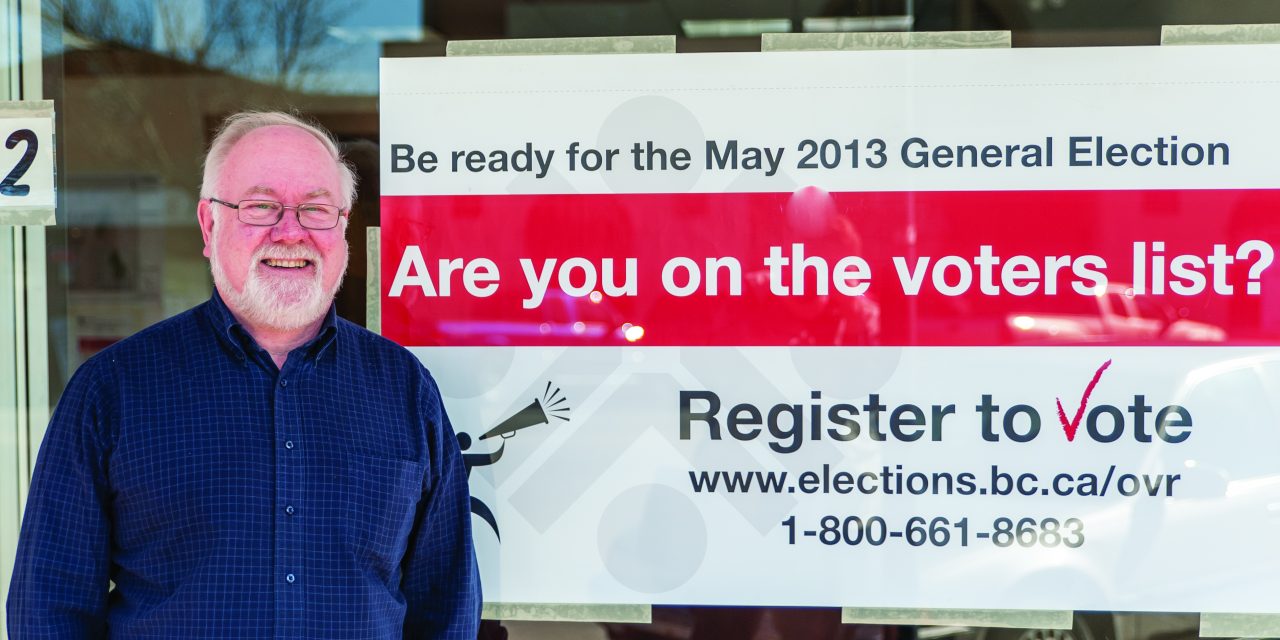
Peter Beckett, district electoral officer for Boundary-Similkameen, says there are many ways to cast a ballot in the upcoming provincial election. Photo by Richard McGuire.
Local residents have numerous ways they can vote in the provincial election and they can even vote right now.
The writ was dropped April 16 kicking off an election period that runs until general voting day on May 14.
Although roughly three quarters of electors cast their ballots on general voting day in the last election, an increasing number of people are choosing to vote in advance, said Peter Beckett, district electoral officer for Boundary-Similkameen.
As of Monday, four candidates had filed nomination papers. These are Linda Larson (Liberal), Sam Hancheroff (NDP), Mischa Popoff (Conservative) and Doug Pederson (independent). Green Party candidate John Kwasnica is also expected to file papers prior to the 1 p.m. Friday deadline.
Residents of Osoyoos, Oliver and area may find it convenient to vote at the Boundary-Similkameen district electoral office at 8322 Main St. in Osoyoos next to MacDonald Realty.
This option is available any time up to general voting day and the office is open Monday to Friday from 9 a.m. to 5 p.m.; Saturday from 10 a.m. to 4 p.m. and on May 14 from 8 a.m. to 8 p.m.
Advanced voting is also held at six locations throughout the electoral district on May 8, 9, 10 and 11.
These wheelchair-accessible locations are in Osoyoos, Oliver, Keremeos, Okanagan Falls, Rock Creek and Grand Forks. The advanced voting location in Osoyoos is at the Sonora Community Centre.
B.C. residents may also vote at any polling station in the province, regardless of where they live, using an absentee ballot, Beckett said.
Residents of Boundary-Similkameen who vote in another part of this electoral district will vote on a regular ballot, while those voting in a different electoral district from where they reside will be given a write-in ballot where they can write either the name of the candidate or party they wish to vote for.
Those away from the province have the option to vote by mail-in ballot.
Beckett said a number of local residents currently in the U.S. or in other provinces have already requested voting packages, which are mailed to them.
As long as the ballot is returned before the end of general voting day, it counts.
Those in care facilities such as hospitals and Mariposa Gardens will be able to vote in mobile polls that visit those facilities. Staff of those facilities may also vote in the mobile polls.
Osoyoos residents who cast a regular ballot on general voting day will be voting at one of 20 polling stations at the Sonora Community Centre. Polls are open from 8 a.m. to 8 p.m.
Beckett advises people to take their where-to-vote cards that they receive in the mail to the polling station, although this isn’t mandatory.
“When they come to the poll with their where-to-vote card it will expedite the process tremendously,” he said. “They’ll go straight to their poll rather than having to go somewhere to locate the proper poll.”
The card also can be used as one piece of identification, although voters should have photo ID and ID indicating their address.
Most people use a driver’s licence or B.C. ID card, but an Indian status card and other identification can also be used.
It’s even possible for people with no identification to vote by having an accompanying family member vouch for them under oath, Beckett said.
To be eligible to vote, a person must be a Canadian citizen aged 18 or older as of May 14 who has been a resident of B.C. for at least six months.
Having been absent from the province, for example as a snowbird, doesn’t disqualify someone as long as their principal residence is in B.C.
Boundary-Similkameen has 28,775 eligible voters based on the first draft of the voters list, Beckett said, but that number will likely change as the list is revised.
The riding is one of the biggest in southern B.C. and reaches from west of Hedley in the west to east of Christina Lake in the east. In the north it extends to Big White and Beaverdell and in the south to the U.S. border. Beckett said the size of the riding and isolation of some parts of it pose challenges. For example, polls in Big White and Beaverdell require three staff at each who must be trained for every eventuality.
“Because the processes are very detailed, they have to really be on the ball even though they don’t get a lot of voters,” Beckett said.
B.C. has fixed dates for its provincial elections every four years. The next election is Tuesday, May 9, 2017.