Three commissioners with the B.C. Utilities Commission (BCUC) heard last week that allowing companies like FortisBC to introduce smart meters “in the amoral search for increased profits”, while risking human health must be stopped.
Joan Moffet of Penticton, who worked as a physical therapist for more than four decades and has a Masters Degree in Education, made one of the most impassioned presentations during one of two public hearings held at the Spirit Ridge Spa and Resort last Wednesday.
The BCUC is the independent government agency that will make the final decision on whether or not to grant a license that would allow FortisBC to proceed with its advanced metering infrastructure (AMI) – more commonly recognized as smart meters – project to customers in the South Okanagan.
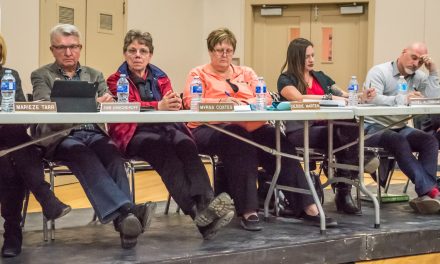
“I ask that these things never be considered for installation,” said Moffet to BCUC commissioners Norman MacMurchy, Len Kelsey and David Morton.
A group of 30 area residents attended an afternoon session before the BCUC commissioners, while another 30 attended the evening session.
There wasn’t a single presentation made in favour of the FortisBC application throughout the public hearings in Osoyoos.
During more than a dozen presentations by members of the public, each and every one of them detailed their fear relating to the effects of electro-magnetic radiation (EMR) emitted by these devices, with several presenters giving personal anecdotes about how they believe wireless devices have already compromised their personal health.
Kelsey told the audience that these public hearings are a key part of the process in determining whether or not the BCUC will grant or deny the FortisBC application to bring smart meters to its thousands of customers in the Southern Interior.
“We must make a decision on all of the evidence presented … nothing more and nothing less,” said Kelsey. “These public input sessions are all part of the evidence we will be considering.”
In order to present submissions, members of the public had to be customers of FortisBC and presentations were limited to a maximum of 15 minutes.
Moffet said “any Grade 10 high school physics teacher” would confirm there are serious risks to human health whenever an EMR signal is emitting a constant signal 24 hours a day.
The only reason FortisBC is making this application is to try and increase corporate profits and it’s up to the BCUC to make the right call and deny the application, said Moffet.
“I wish it wasn’t this way (trying to increase profits) in this province, in this country or in the world, but we all know this isn’t the case,” she said.
The radiation generated by smart meters has caused irreparable damage to the physiology of human beings, animals and all life forms, she said.
Canada is a democratic country where people have the right to protect private property and companies like FortisBC should not be allowed to force customers to use these devices against their will, said Moffet.
“Our choice is removed when wireless technology is imposed on us,” she said. “There is no reason great enough to jeopardize the health of the general population.”
Many people who made presentations at the hearings were speaking about the negative impact of all wireless devices on their personal health, but this meeting was about the BCUC having the power to deny FortisBC’s application to install smart meters and the commissioners have a moral obligation to do the right thing and reject the request, said Moffet.
“Smart meters may be very small in the pile of wireless devices out there … but these meters are under your jurisdiction,” she said.
Judy Nicholas of Oliver, who has founded an organization called the Smart Meter Awareness Group, told the commissioners she worked as a laboratory technologist for more than 20 years and is convinced constant exposure to EMR signals are the biggest reason she had to quit her job and has had suffered numerous serious health problems.
“In a sense, I was a lab specimen,” said Nicholas, talking about working around EMR signals for more than two decades.
A physician in Vancouver diagnosed her many medical problems as being directly related to her job and the doctor said workers compensation claims suggesting EMR exposure were causing health problems were automatically rejected by the province, said Nicholas.
“I worked in a high EMR environment … and I got sick because I couldn’t fight the big fight any longer,” she said.
She contracted viral mononucleosis several years ago, which started a tailspin of serious health problems, she said.
“It took me six months to realize my symptoms were caused by my workplace environment,” she said.
She still suffers from a “constant and continual burning sensation” over many parts of her body and has little stamina or strength, she said.
The effects of smart meters and many other wireless devices are going to increase, in her opinion, which gives her great concern for the health and wellbeing of her children and grandchildren, said Nicholas.
If the FortisBC application is approved, she will sell her home and move to another location where smart meters aren’t allowed, said Nicholas.
“I will have to move … I won’t accept smart meters,” she said.
Susan Zita of Oliver told the commissioners she suffers from Multiple Sclerosis and she’s worried smart meters will negatively affect her health.
“There is no proof smart meters are safe,” she said. “I have MS and I want to stay healthy. I’m afraid my child is going to be negatively affected by EMR.”
Charlotte Burbeck of Oliver said she doesn’t allow any wireless devices in her home and she doesn’t believe companies like FortisBC should be allowed to force her to use a smart meter if she doesn’t want to.
“I feel we should have the right to say no,” she said.
Skip King of Oliver said utility companies should be looking at safe alternatives like using fibre optics instead of pulsing devices that emit a constant EMR signal.
The current analog meters used by Canadians for years work just fine and there’s simply no need to allow these smart meters into this area, he said.
Reports that electricity bills have skyrocketed in jurisdictions where smart meters have been installed is also very worrisome, said King.
Kelsey ended the hearing by saying all of the presentations will be carefully considered by the BCUC before a final decision is rendered in the coming months.
Written submissions are also considered and are still being accepted, he said.