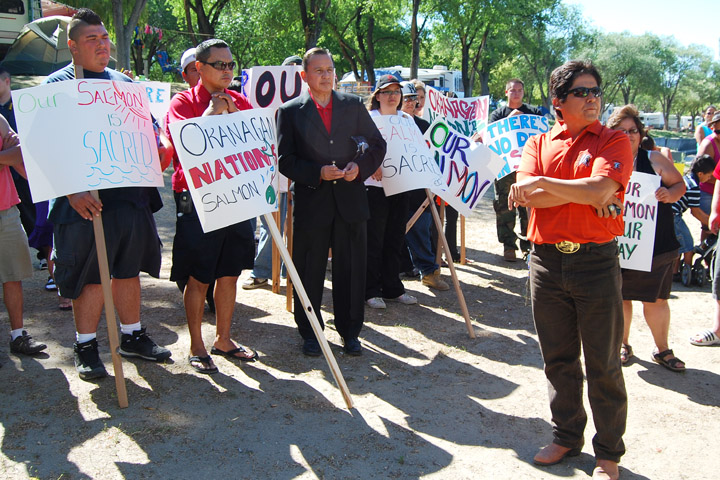
Members of the Okanagan Nation Alliance (ONA) gathered on Aug. 13, to express their anger at the Canadian Department of Fisheries and Oceans for making a “unilateral decision” to open Osoyoos Lake for recreational sockeye fishing between August 13 and 22. Photo by Laurena Weninger - Click on picture for larger image
OSOYOOS TIMES-August 18, 2010
By Laurena Weninger – Osoyoos Times
“We have no interest in picking a fight with recreational fishermen,” said Grand Chief Stewart Phillip, chairman of the Okanagan Nation Alliance (ONA). “They’re not at fault here.”
But anyone taking advantage of the rare opportunity to fish for sockeye salmon on Osoyoos Lake between August 13 and 22 will likely be approached by members of the ONA and told loud and clear why the group is in opposition of the federal government’s decision to allow the temporary salmon fishery on the lake.
The federal Department of Fisheries and Oceans’ (DFO) decision to open the fishery was received by the Osoyoos Times on Aug. 12.
“As of July 25th, the estimate of sockeye past Wells Dam was 250,000,” states an email from DFO to Osoyoos Mayor Stu Wells, which was forwarded to the Times.
“This return exceeds the 60,000 sockeye past Wells Dam indicated in the South Coast Integrated Fisheries Management Plan for meeting spawner objectives, providing for First Nations food, social and ceremonial fisheries and allowing a recreation fishery opportunity.”
Wells Dam is located in Washington state near the point where the Okanogan River meets the Columbia River.
The return of salmon in the Okanagan River system in the South Okanagan is the highest on record since 1938, states the email.
As a result, recreational fishing for sockeye opened Aug. 13 and is allowed until Aug. 22 during daylight hours in the waters of the north basin of Osoyoos Lake from the Hwy. 3 bridge to a line from the east side of the lake, starting at the mouth of Inkameep Creek, to the west side at the Inkameep Lodge Pier.
The decision to allow the fishing opportunity caused uproar in local First Nations communities.
“They announced this with no consultation,” said Phillip, who asked for an immediate meeting with DFO on Aug. 12. “We demanded they rescind the order.”
But DFO said it was too late in the day, said Phillip.
“We expressed our deep concern and anger with respect to the unilateral manner in which DFO brought forward the recreational fishery.”
He said the ONA and DFO have worked together for years to rebuild the Okanagan sockeye salmon run and are currently involved in a pilot project to release salmon in Penticton’s Skaha Lake.
“The reason why any fishery is possible this year is because of the long-term efforts by the Okanagan Nation to rebuild the sockeye fishery, which was virtually destroyed in the 1930s by a series of dams which were built without recognition or respect for the importance of the salmon fishery to the Okanagan Nation,” states Phillip in a media release.
“We do not oppose sharing the sockeye fishery with non-Aboriginal neighbours. But, we are fundamentally opposed to DFO’s announcement of this recreational fishery.”
Phillip said the decision should have been made together and after a process of careful consideration.
“It’s all about stewardship and respect and proper consultation,” he said.
The ONA members are stating their position loudly, holding protests throughout the South Okanagan.
On Aug. 13, the group met on the beach at the Nk’Mip Campground and RV Resort where almost 100 people gathered with protest signs.
Osoyoos Indian Band elder Modesta Betterton opened the meeting with a prayer that the protests remain calm, cool and collected.
“We all have feelings because of this,” she said. “We are showing in a nice, friendly way, this is our salmon, this is our food. Don’t let the white people sell it.”
On Aug. 16, about 50 ONA members showed up at the Penticton branch of the B.C. Ministry of Environment, Phillip said.
They were there to reinforce their message of unhappiness with DFO’s decision and the provincial ministry’s involvement in the matter.
The ministry is issuing fishing permits for the fishery.
This is a contentious issue because the province receives the revenue from the licences directly without any revenue sharing arrangement with the ONA.
“It is important to clarify that direct action is aimed at Canada,” states ONA information. “Our goal is to bring attention to (Canada’s) failure to fulfill its legal duties and obligations.”
Dean Allan, a spokesman from DFO, stated via email that the salmon currently in Osoyoos Lake have migrated up the Columbia River and are destined to spawn in the Okanagan River.
Most of the spawning occurs in the natural and semi-natural section of river about eight kilometres downstream of McIntyre Dam.
The fish cannot currently pass the dam at Okanagan Falls.
The Aug. 22 cutoff for the fishery was established because “this is a new recreational fishery” and the government “is taking a conservative approach.”
The fishery will be monitored and information collected will be used to determine any possible future openings.
Allan said Columbia River sockeye stocks have been experiencing better-than-average marine survival and at this time they don’t know why.
The larger fish population may also be related to a fish release project at Skaha Lake.
Anglers interested in fishing the lake should consult the B.C. Freshwater Fishing Regulations and the British Columbia Salmon Supplement for rules regarding the fishery. These regulations can be found at www.pac.dfo-mpo.gc.ca/recfish.
There is a limit of two sockeye per day, a possession limit of four and a monthly limit of eight per person.
Barbless hooks are required and anglers need to ensure they are properly licensed.
[email protected]