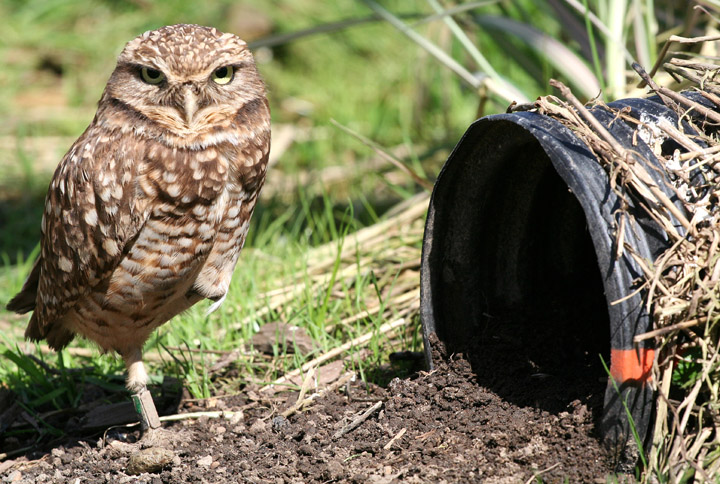
Six weeks ago, four pairs of burrowing owls were released into artificial burrows constructed on Ace Elkink’s property west of Osoyoos. One pair currently remains. Photo submitted - Click on picture for larger image
OSOYOOS TIMES-June 23, 2010
By Laurena Weninger – Osoyoos Times
There is now at least one more family of burrowing owls in the South Okanagan.
“It’s a numbers game,” said Jim Wyse, a volunteer with the Burrowing Owl Conservation Society of B.C.
About six weeks ago, society volunteers released four pairs of burrowing owls into artificial burrows built in natural grasslands on Ace Elkink’s property west of Osoyoos.
Only one of the pairs has remained, producing a nest of about seven offspring.
“We’ve got a lot of land, so they approached us,” explained Elkink, about how the group came to release the owls. “It’s a good area for all kinds of birds. A minimal amount of people.”
That’s the optimal situation for the owls, explained Wyse.
“The birds don’t do well if people are poking around,” he said.
That’s why the group doesn’t want to publicize the exact location of the birds, instead leaving them to some isolation.
The birds are bred in captivity in two facilities – the B.C. Wildlife Park in Kamloops and another location at Port Kells in Surrey.
There are eight breeding pairs at the Kamloops facility and 12 at the Surrey facility. Another facility is under construction north of Oliver near the South Okanagan Rehabilitation Centre for Owls.
The DNA of the offspring is tested, sex is determined and the birds are matched into “breeding pairs.”
Each spring, one-year-old breeding pairs are released into artificial burrows, but until this year the release was limited to the Merritt and Kamloops areas.
The burrows on Elkink’s land were built last fall and replicate the owls’ natural burrows, which are usually abandoned gopher or fox holes.
“They don’t burrow, they renovate,” said Wyse. “They should be called ‘borrowing owls.’”
The artificial burrows are made from a large bucket and a length of piping.
The owl builds its nest at the end of the pipe in the bucket area.
There is a secure lid attached, allowing program volunteers to monitor the mated pair.
“That’s their protection, to go underground,” Wyse said.
When the birds are released into the burrows, the burrows are covered with a large net structure for a couple of weeks to try to encourage them to nest there.
At the two-week mark, the net covers are removed and the birds are free to move about.
After 10 days, the four pairs released on the Elkink property were still there, but at the two-week mark, only one pair remained.
This nest has now produced seven offspring, which will be mature at the age of one month.
The family is checked every four days and supplemental food is given while they learn to hunt for themselves in the wild.
They will be banded and then monitored in the future.
The group built 25 burrows on the Elkink property so hopefully the offspring will continue to migrate back here each year and populate the area.
According to the Parks Canada website, burrowing owl populations have been declining steadily since the 1930s.
In 1995 the status of the burrowing owl declined from threatened to endangered due to habitat loss and fragmentation, road kills, pesticides, food shortage, fewer burrow providers and mortality on migration and wintering areas.
[email protected]