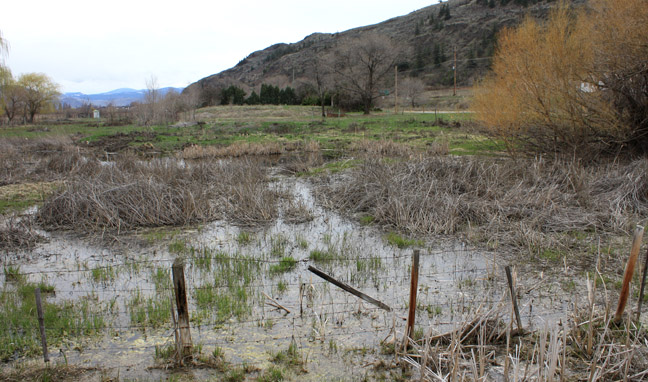
Sara Ashpole, an ecologist with the University of Waterloo in Ontario, said it’s crucial to protect this wetland near the intersection of Hwy. 97 and Road 22 when highway expansion work begins later this year since the Okanagan Valley has lost as much as 90 per cent of its wetlands. Photo by Paul Everest - Click on picture for larger image
OSOYOOS TIMES-March 31, 2010
By Paul Everest – Osoyoos Times
An Ontario-based ecologist who has worked to build 16 wetlands throughout the South Okanagan is hoping plans to expand Hwy. 97 north of Osoyoos won’t damage a small wetland area that is home to tiger salamanders and Pacific tree frogs.
Sara Ashpole, a researcher with the University of Waterloo, is acting as a consultant to the B.C. Transportation Ministry as it prepares to build four new lanes of highway between Graveyard Hill and Dead Man’s Lake.
Part of the highway expansion plan includes having an intersection off the new roadway at Road 22, right next to a small wetland.
Ashpole said the wetland is on a small portion of provincial land and is a “remnant” of a larger wetland that has since been lost.
Since the wetland is an area where endangered tiger salamanders breed, Ashpole recommended to the ministry that every precaution be taken to limit the amount of disturbance to the area when highway construction begins.
In 2007, she teamed up with Ducks Unlimited Canada, which owns a neighbouring property, to build two new large wetland areas for the salamanders.
Ashpole said amphibians such as the salamanders use the same habitat every year, but once in a while they disburse.
Since the wetland near the Road 22 intersection is isolated, the wetlands she built with Ducks Unlimited will serve as “insurance wetlands” should the salamanders decide to move.
Part of the ministry’s plan to prevent any species living in the wetland near the intersection from being disturbed is to build yet another wetland area away from the construction site.
While Ashpole said having a “complex” of wetlands in the area could help the salamanders, she added that there is a difference between digging a hole in the ground and creating a functioning ecosystem.
Between 80 and 90 per cent of the Okanagan Valley’s wetlands have been destroyed, she said, so it is vital to protect those that remain.
Right now, there are only five wetlands south of Penticton where the salamanders breed.
Along with providing habitat for amphibians, birds and invertebrates, wetlands also filter fresh water.
Ashpole has studied the wetland in question extensively and she said that during a summer she can see between two and 10 salamanders and there is no evidence to suggest they have migrated to another area.
She said she has worked with officials from the ministry and they are making efforts to ensure the wetland is not disturbed.
Concerns about runoff from construction near the intersection and runoff from the roadway have been passed on to the ministry, Ashpole said, adding she has recommended that a spillway be directed away from the wetland.
She has also asked the ministry to support two graduate students who will be monitoring the wetland and animal activity in the area this summer.
It is likely, she said, that the salamanders, which live in sandy slopes, cross Hwy. 97 to breed in the wetland near the Road 22 intersection.
Tunnels under the highway for animal migration, signage indicating that endangered amphibians live in the area and fencing around sensitive areas are all ways that the effects of the highway expansion can be mitigated, Ashpole said.
The public can get involved in monitoring the wetland by participating in Frog Watch and Turtle Watch programs where people can record where they see living and dead animals and report the information to conservationists.
For more information on these programs, go to www.env.gov.bc.ca/wld/frogwatch/ or contact the Okanagan Similkameen Conservation Alliance at 1-866-699-9453.
Ashpole said people can also contact her at [email protected] to find out how they can help protect the wetland near Road 22.
The Osoyoos Times was unable to reach a spokesperson from the Transportation Ministry for comment on how the province intends to protect the wetland in question.
The property neighbouring the strip of land where the new leg of highway will be built to the east belongs to Ducks Unlimited Canada (DUC).
Ken Johnson, a habitat specialist with DUC, said the land that will be used for the new highway was purchased from his organization by the province in 2006.
Last week, work began on clearing trees to make room for the new roadway and Johnson said DUC will replant some of the trees and vegetation being removed away from the highway site on DUC property.
Much of the vegetation being removed, he added, is not native to the Okanagan Valley.
The Transportation Ministry will be contributing $10,000 to the replanting costs, Johnson said, and DUC will be using native tree and shrub species for restoration efforts on its lands, which extend from Road 22 almost to the Willow Beach property.
[email protected]