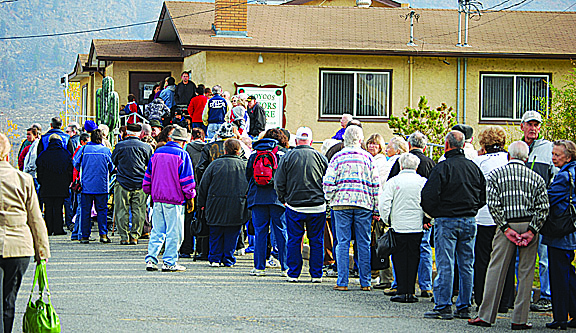
Approximately 100 people were waiting outside the doors of the Osoyoos Seniors Centre on Nov. 4 for the mass vaccination against H1N1 and seasonal flu. Photo by Laurena Weninger - Click on picture for larger image
OSOYOOS TIMES-November 11, 2009
By Laurena Weninger – Osoyoos Times
“They did very well (at dealing with the crowd), even with all the hype,” said Adele Jenkins from the Osoyoos Seniors Centre, who was involved with coordinating last week’s H1N1 and seasonal flu shot clinic.
The first few people in line said they arrived at about 8 a.m. on Nov. 4, the day Interior Health came to Osoyoos to give out the first round of H1N1 vaccinations to those who qualified.
The clinic opened at 9:30 a.m. to a line-up of approximately 100 people.
According to Jenkins, the number of people through the clinic went in waves throughout the day and the lineup never got very long.
At 3:30 p.m., when the doors closed, there were only two people waiting and they both got their shots.
It was worth it, to those in line.
“If this takes half-an-hour, it’s a small price to pay,” said Osoyoos’s Bev Ritchie, who joined the lineup shortly after 9 a.m.
She has asthma and that puts her into a “high risk” category for H1N1 complications.
“It’s hard enough to breathe if you get a cold,” she said, adding she is totally in favour of the mass vaccinations.
“We’ve eradicated small pox.”
The Osoyoos clinic administered 300 doses of the H1N1 vaccination, said Lannea Parfitt, Interior Health’s public health communications officer.
But 300 doses doesn’t equal 300 people, as children only get a half-dose.
“I don’t want to put her at risk for not surviving the flu, I guess,” said Heather McClure, about her 16-month-old daughter, Megan, as they stood in line.
She said giving the vaccination to her daughter was a tough decision.
“It hasn’t been around very long. It just got approved,” she said. “But we would rather her be not sick.”
Children between the ages of six months and five years were part of the “priority group” that was given the shot.
Others in that group include:
- pregnant women in the second half of pregnancy;
- persons residing in remote communities including all Aboriginal populations;
- healthcare workers involved in responding to pandemic influenza;
- household contacts and care providers of infants from birth to six months of age when the contact/care provider is under the age of 65;
- household contacts and care providers of persons who are immunocompromised when both the immunocompromised person and the household contact/care provider are under 65 and those under age 65 with chronic health conditions.
While the seasonal flu vaccine was given to those over 65 at the clinic, even those over 65 with health issues were turned away if they wanted the H1N1 vaccine.
“They just told us we couldn’t get the H1N1,” said Muriel Gushue.
She and her husband, Wilfred, are both 89 and joined the lineup until they found out they didn’t qualify for the shot.
“My husband and I both have compromised immune systems,” Gushue said, adding she has leukemia.
Wilfred has chronic obstructive pulmonary disease and wheels an oxygen tank with him to help him breathe.
“We’re not complaining,” she said. “We have to wait our turn.”
Kerry Koppang wasn’t in line at the clinic, but was walking nearby.
“I think that they’re making too much out of it,” referring to the media hype that seems to surround the H1N1 flu. “I think they’re scaring everyone. I don’t think it’s as serious as they’re letting on.”
Regardless, it’s got her convinced to get the shot, when it is available to her.
“I wasn’t going to do it, but you keep hearing it on the news – you better.”
A media release from Interior Health explains there has been a Canadian shortage of H1N1 vaccine, which is resulting in a reduction in the number of public health mass clinics that will be held in the near future.
Parfitt said the shortage is from a lack of supply, not from excess demand, and the health authority is waiting on the manufacturer to send more.
Approximately two-thirds of the available vaccines have been distributed to doctors, meaning some may be available through the doctors’ offices.
“Given the reduced vaccine availability, Interior Health will only be offering combination H1N1 and seasonal immunization clinics in four communities—Lillooet, Nakusp, Sparwood, and Princeton (this week),” stated the release.
The decision to offer clinics in these communities was based on available vaccine supply, their proximity to larger clinics in their geographic area and because they have not yet had a flu clinic in their community.
Again, the clinics will only be for high-risk individuals who meet the eligibility criteria for H1N1 vaccine and seasonal vaccine.
Interior Health was not able to indicate when another combined flu shot clinic will take place in Osoyoos.
“If significant vaccine re-supply does recommence by mid-November, then we would once again re-establish public health mass immunization clinics across Interior Health,” the release stated. “If vaccine supply is adequate and if indicated by B.C.’s provincial health officer, these clinics would be available for all the general public to be immunized, not simply high-risk individuals.”
At the Osoyoos clinic, 450 doses of the regular seasonal flu vaccine were also given.
According to the B.C. Ministry of Healthy Living and Sport, since Oct. 27 there have been 183 new severe cases of H1N1 identified in B.C. – 79 in Fraser Health, 50 in Vancouver Coastal Health, 38 in Interior Health, eight on Vancouver Island and eight in Northern Health.
There have been three new deaths: two in Fraser Health and one in Vancouver Coastal Health.
The majority of lab-confirmed cases in B.C. have been mild or moderate in severity, with the patients either having already recovered or are currently recovering.
In total, the B.C. Centre for Disease Control has confirmed 399 severe H1N1 cases in British Columbia since April, 2009, including 86 cases and three deaths in Interior Health’s coverage area.
To date, 15 people with laboratory-confirmed H1N1 cases in B.C. are reported to have died.
In 14 of those cases, there were underlying medical conditions.
[email protected]