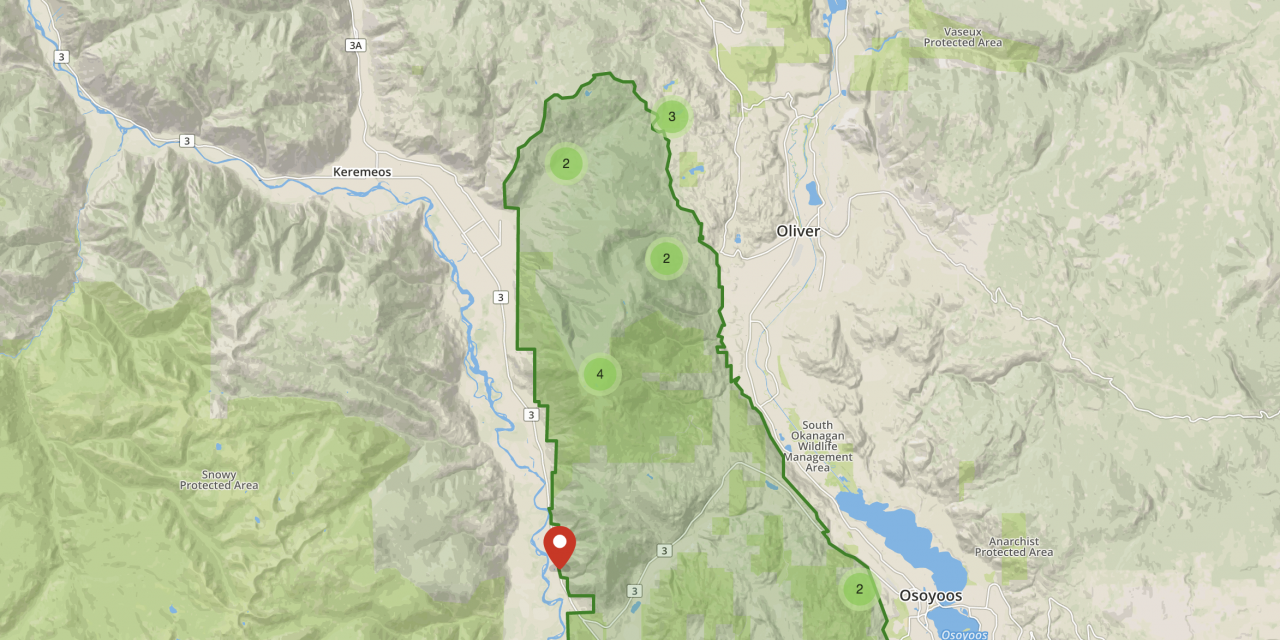
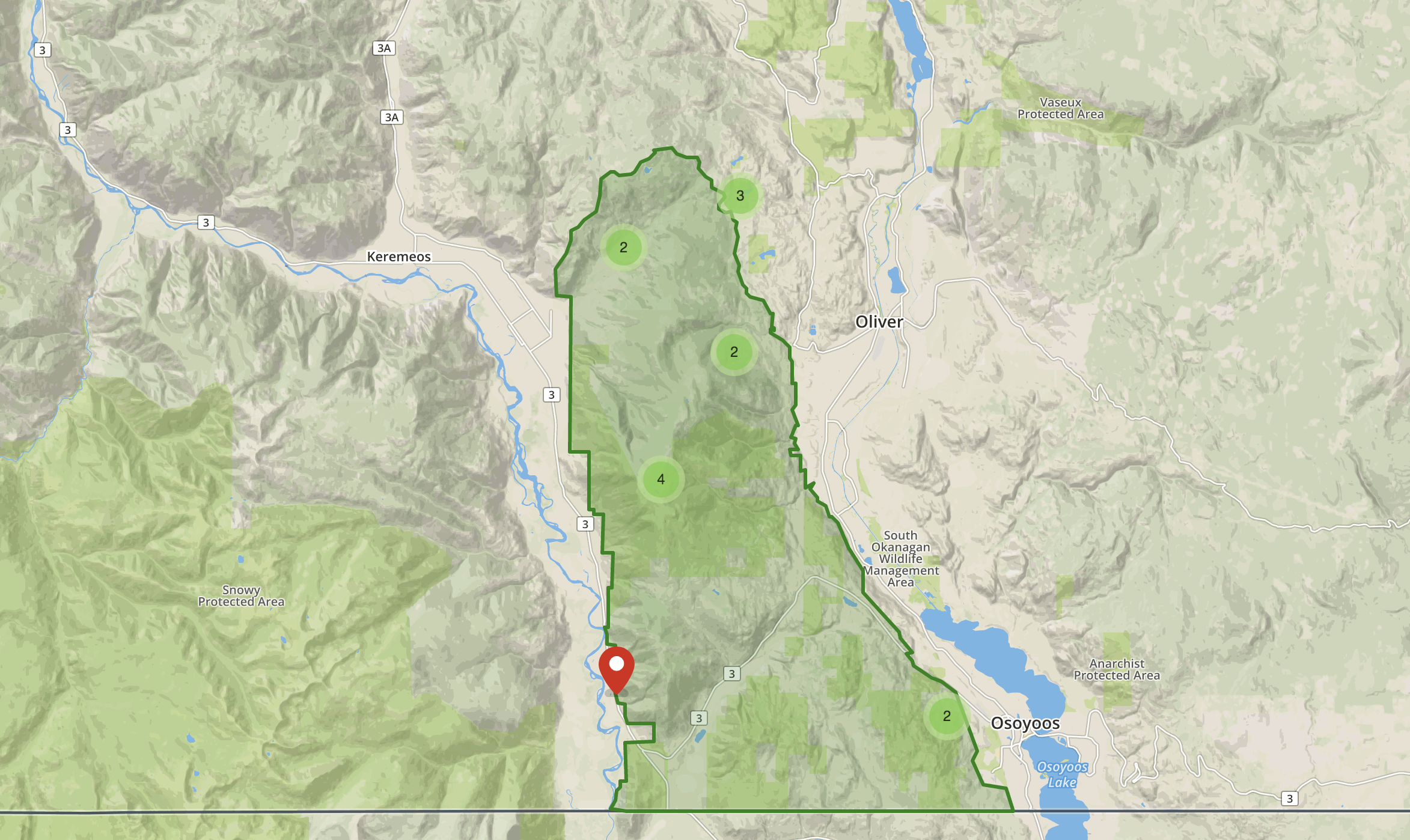
Parks Canada has released a working boundary for its proposed national park reserve. The boundaries include areas between Highway 3 and Highway 97. (Parks Canada)
By Vanessa Broadbent
Osoyoos Times
A new public survey shows that the majority of residents in the South Okanagan want a referendum on the area’s proposed national park reserve, according to the South Okanagan-Similkameen Preservation Society (SOSPS).
The phone survey, commissioned by the society and completed by the Innovative Research Group, includes feedback from 305 randomly selected people, and has a margin of error of 5.7 per cent.
South Okanagan residents 18 years of age and older from Osoyoos, Oliver, Cawston and Keremeos were asked five questions between Dec. 12 and 19.
Of those polled, most – 76 per cent – were in support of a referendum.
However, Parks Canada has not shared plans for the national park reserve to go to referendum.
The organization launched its online public consultation for the reserve in December and Kevin McNamee, director of protected areas establishment for Parks Canada, said the process is not intended to act as a referendum.
“The consultation process is not a referendum or a vote on the idea of a national park reserve but rather what is more important, we believe, is for people to participate in this process to help shape what the national park reserve will look like in its boundary and use of lands,” he said in a media call at the time.
• Read more: Working boundaries released for national park reserve
The SOSPS is hoping to see Parks Canada rethink their stance on including the public in the decision via a referendum.
“This is politics and for someone to shut down the debate on any subject relative to spending public money is unfair,” society spokesperson Lionel Trudel said.
The society’s survey also asked residents if they opposed or supported the creation of a national park reserve in the area.
Of those polled, 45 per cent said they opposed and 41 per cent said they were in support, with 35 per cent strongly opposing and 27 per cent strongly supporting.
A previous poll completed by McAllister Opinion Research in 2010 reported that 63 per cent (out off 405 polled) were in favour of the national park reserve.
Trudel credits the difference in findings to how the questions were structured.
The 2010 poll, which included residents from as far north as Summerland and west as Tulameen, asked if participants felt it is “important to protect the natural ecosystem, plant and wildlife species in the South Okanagan in order to maintain our quality of life here.”
The following question stated that Parks Canada’s proposal would “help protect the waters, wildlife and natural systems of this area from population and development pressures.” Participants were then asked if they favoured or opposed protecting a portion of the South Okanagan-Similkameen in a National Park.
“There wasn’t a lot of chance for people to say anything negative about a park,” Trudel said. “They still came out with a billboard north of Oliver saying 70 per cent wanted a park.”
• Read more: Parks Canada launches website and survey for public consultation on proposed national park reserve
Now the SOSPS is planning to host a public meeting in February with Parks Canada representatives, moderated by a third party.
The society is hoping the forum will give the public a platform to voice their concerns about the national park reserve, as well as have their questions answered.
“To say ‘No National Park’ is kind of negative,” Trudel said. “We’re saying let’s answer a bunch of questions before we move forward; let’s get a dialogue happening, then make a decision on what’s best for the community and environment.”
Participants in the SOSPS’ survey were also asked if they thought the federal government has done a good or poor job on local consultation. Fifty-nine per cent said poor while 24 per cent said good.
More (47 per cent) said that a national park reserve would increase environmental protection, compared to 41 per cent who felt the existing provincial protection was very high and additional visitors would cause more environmental harm.
As for the increase in visitors the park would attract, 49 per cent said it would be a net positive because of the increase in tourism revenue, while 43 per cent responded that it would be a net negative because the stress on roads, infrastructure and health care could lead to higher local taxes.
The full results of the new survey are available online.
Parks Canada did not respond to a request for comment on a referendum, but said the organization is focussing on consultations, and the views of indigenous communities and local residents will “play a key role” in the parks’s establishment.