By Lyonel Doherty
Oliver Chronicle
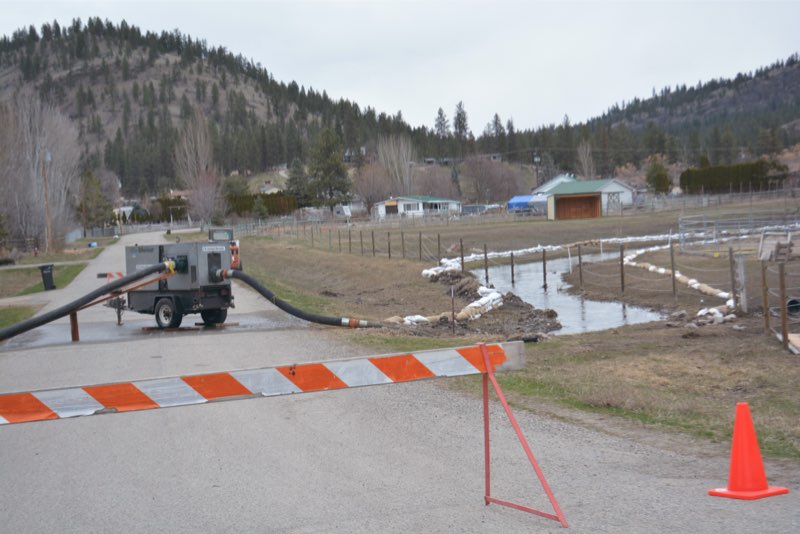
As flooding continues in Willowbrook and rural Oliver, three dams have become a “thorn in the side” for the regional district.
Working in emergency management, Zoe Kirk updated the Chronicle on Monday regarding the flooding situation.
She noted that Willowbrook remains under a state of emergency, adding that water in the Kearns Creek (Pringle) dam has been lowered and is “stabilized.”
The second dam, a private reservoir above St. Andrews by the Lake (golf course), continues to be drained into Little Prather Lake, and then on to Prather Lake, which is being drained into Kearns Creek that runs through Willowbrook. This has exacerbated the flooding problem in that community, which had to take out a section of another road (Carr Crescent) to ensure proper drainage.
Several residents have questioned the justification of pumping out Prather Lake at the golf course, saying the protection of homes is more important than a game of golf.
But Kirk clarified that the Ministry of Forests gave the order to do this.
“Some people are inadvertently blaming the golf course . . . it’s not their fault,” Kirk said, reiterating the dam is above the golf course and the ministry is drawing down the water to avoid a breach.
But residents like Gail Blidook are not convinced this is the right decision.
In an email to the regional district, Blidook questioned the justification of emptying Prather Lake and sending more flood waters into the Willowbrook and Park Rill areas.
“There is talk of a class action lawsuit already,” Blidook said.
She noted her neighbours already have flooded basements on Island Road and are desperately using sump pumps to prevent further damage.
“Please, please, please stop pumping water from a lake that is not impacting homes in order to flood us all out even worse than we are.”
In response, Willowbrook resident Rick Knodel said he and Area C director Terry Schafer strongly disagree with the procedure at Prather Lake.
Knodel said utilizing the White Lake bowl would take a great deal of pressure off Kearns Creek, noting it is enormous and could possibly take the rest of the spring runoff.
Knodel pointed out that if this was a forest fire, never-ending resources would be used.
“It is time for the province to put flooding in the same category.”
To accomplish these goals, residents have to start becoming demanding and tenacious, he pointed out.
The third dam that the province is contending with is an unauthorized one (west of Willowbrook) owned and operated by Doug Cotter. Because the water level was very near the top, the ministry ordered him to drain it, which has caused flooding on Sportsmen’s Bowl Road, part of which has eroded.
As a result, residents were given an evacuation advisory on the weekend.
Kirk said this was a precautionary measure and advises residents to be ready for an evacuation.
“There may not be time for an alert,” she pointed out.
According to the Ministry of Forests, the water in this unauthorized dam was within an inch of spilling over.
But Cotter told the media that there was nothing to worry about, saying he’s been working around the clock to drain the reservoir.
Kirk said the most important thing is to take pressure off these dams, which she admitted have been a thorn in their side.
“There’s a lot of stressed folks out there at the moment.”
But she noted the good news is it’s very heartwarming to see how communities are pulling together by helping with sandbagging efforts.
Kirk also gave kudos to the ministry for lowering the water levels in the dams.
In the meantime, the regional district continues to urge flood-prone residents to prepare for the worst. This means having an emergency kit (with food and water) to sustain the family for 72 hours, and making plans to have livestock and pets cared for in case you have to evacuate.
Kirk said some people might be stranded in their homes if flooding takes out their driveways.
She also encourages people to check on the welfare of elderly neighbours who may not have access to the media.
Kirk said conditions could change immediately with sudden warm temperatures impacting snow melt.
Meanwhile, snowpack levels in the Okanagan are reported at 152 per cent of normal, which means increased flood risk.
But according to Jonathan Boyd from the BC River Forecast Centre, an extreme snowpack doesn’t necessarily mean huge runoff problems.
Boyd said they are waiting to see what the weather does this spring.
In Penticton, officials have been lowering Okanagan Lake by approximately half a centimetre a day to prepare for the snow melt.
Too much outflow from the lake has an impact downstream, which could result in more erosion and flooding issues.