By Lyonel Doherty
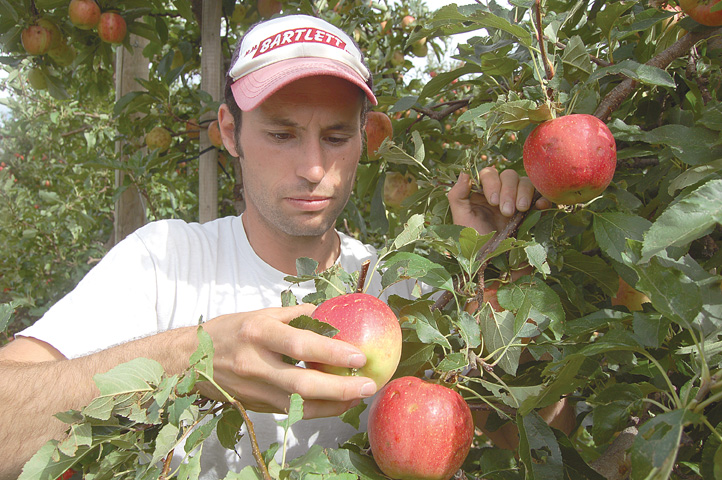
Fruit harvesting will definitely be a challenge for farmers in Oliver and Osoyoos this summer, according to one local grower.
David Machial was contacted by the Chronicle and asked what he thought about the pandemic and how it will affect harvesting operations this season.
“It will definitely be a challenging year for farm labour,” the apple grower said.
Machial noted that temporary foreign workers (TFWs) are permitted to come to the Okanagan, but the new protocols and a shortage of flights will make it more expensive to bring them here.
“I was planning on having three TFWs from Mexico, but due to the extra expense and regulations, I have decided to only bring in two.”
Machial said he won’t need help until the end of May so he’s really hoping that COVID-19 will be less of a threat by then and life can return closer to normal.
The grower pointed out some of the changes in acquiring TFWs to work this season.
When they come here, they must be isolated from the public for 14 days. During this time, they cannot work, even if they are isolated within an orchard, Machial said. But the employer is required to pay the worker during these 14 days, and many farmers cannot afford this, he lamented.
Machial explained that housing must be large enough so that workers can maintain a two-metre distance from each other.
“Consequently, workers cannot share bedrooms, so farmers may no longer have suitable housing for all the workers they require.”
Machial said if a farmer has TFWs arriving at different times, the newer arrivals have to be housed at a separate location than workers who have already completed their 14-day isolation. Therefore, finding additional accommodation will not be easy.
“My neighbour is currently experiencing this problem. He has new TFWs arriving next week. To help him out, I’ve agreed they can stay at my worker housing since they will be gone by the time my workers arrive.”
Machial said one major positive is workers are being screened for COVID-19 before their flight in Mexico and immediately after their arrival in Canada. Anyone suspected of being sick will be put into quarantine and not be allowed to travel to their employer until they are healthy.
“As a result, the likelihood of a TFW bringing COVID-19 to the farm and community is low,” Machial said.
In addition to the TFWs there are other labour concerns, he pointed out.
Many fruit harvesters come from Eastern Canada or have international youth work permits.
“If the COVID-19 situation doesn’t change, I suspect many of these workers or travellers will stay at home, causing harvest problems for all farms.”
Machial is hoping to see people from other sectors (that are currently shut down) try their hand at farm work since it’s very easy to maintain social distancing in an orchard.
Machial noted the harvesting situation is similar in the United States.
“I read in a recent farmer magazine that 70 per cent of U.S. harvesting is done by international workers who may not be able to enter the U.S, raising serious concerns about produce shortages.”
Machial is sincerely hoping the situation improves by harvest time.
“You might want to plant a garden,” he said.