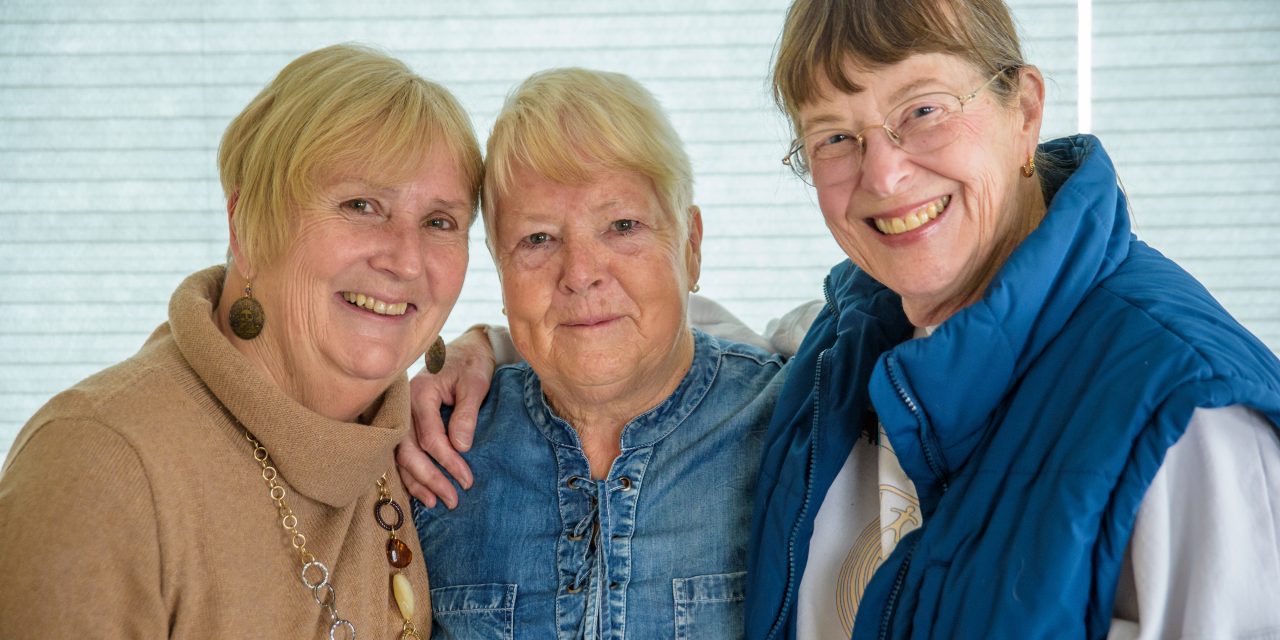

Karen Brant, Lorna McKay and Maureen Parriott started The Grapevine as a group to help others and themselves through the process of grieving the loss of a loved one. (Richard McGuire photo)
By Richard McGuire
Osoyoos Times
Death is a universal experience, but in our culture we find it difficult to talk about.
But for someone who has lost a loved one, talking is part of grieving and grieving is part of healing.
“In our culture, you’re supposed to get over it as quickly as possible,” says Maureen Parriott, a social worker with a long career in family therapy. “Maybe three months, maybe six months. So if you’ve lost your husband or your child or your sibling or your parent, you’re really, really supposed to just get on with it pretty quickly.”
The problem, she says, is that doesn’t fly. Grief can last years, even decades.
In September, Parriott along with two other women, all at different stages of their own grieving, formed a group, The Grapevine, to help others with grief.
They meet weekly in the boardroom at Desert Sun Counselling and Resource Centre in Osoyoos. Although The Grapevine isn’t a Desert Sun program, Parriott said Marieze Tarr, Desert Sun’s executive director, contacted her to offer space.
“They are our angel,” she said.
Parriott earlier this year worked as a program coordinator at Desert Valley Hospice Society (DVHS) where she was involved in their one-to-one volunteer grief support program.
Karen Brant, one of the women involved with starting The Grapevine, said she contacted DVHS after her husband died in the spring and she realized she needed to talk with someone. She connected with Parriott and they made an appointment.
“I spoke to her a few days later and I felt much better,” said Brant. “Yes, there was a lot of crying, but I felt better.”
“You don’t tell people, you don’t interpret people to themselves. You listen, you understand and if this is something you’ve experienced, you let them know.”
When Brant called to make a third appointment, Parriott told her she was no longer with DVHS. Nonetheless, she came to Brant’s home to talk with her.
“We were just talking away and all of a sudden Maureen said, ‘I don’t want to be your grief counsellor,’” Brant recalls. “And I looked at her and she said, ‘I want to be your friend.’”
Also at Brant’s home was Lorna McKay. She and Brant had become friends in recent years when they walked their dogs together. McKay was also dealing with grief, but it wasn’t a recent loss like Brant’s.
Together, they decided to form the group.
McKay had lost her son years ago, in 1988, in a bicycle accident. She and another woman started a group in Penticton, a chapter of the worldwide organization, The Compassionate Friends, which offers grief support to those who have lost a child.
McKay ran that group for 10 years before coming to Osoyoos in 2011.
She realizes now that she was so absorbed with helping other people with their grief that she didn’t take the time to resolve her own.
Like Parriott and so many others, McKay experienced the societal pressure to just move on in the early days after her son’s death.
“I would say we had planned a birthday party,” McKay recalls, as she tried to celebrate the birthday of her late son. “I got comments like, ‘It’s been a year. Why are you doing this?’”
Parriott recalls her own experience with this societal pressure after her husband died 25 years ago.
“When my husband died, the compliment I got was, ‘You are such a brave soldier,’” she remembers.
Why did she feel that was inappropriate?
“Because when you’re grieving and someone is complimenting you on holding it together, without validating the fact that you’re grieving, it isn’t appropriate,” said Parriott. “You’re getting validated for not making them uncomfortable. They don’t want you hurting. They don’t want to see you in pain. So if you can move on, you’re doing everybody a favour.”
• Read more: Local Woman Raises Awareness Of Debilitating Disease
Paradoxically, allowing yourself to grieve is part of the process of moving on,
Parriott has gathered many inspirational sayings for the group, which she’s mounted onto a folding board.
“One of the inspirational sayings we have is, “A grief unwept is a grief unhealed,’” she said.
The Grapevine began meeting in mid-September and Parriott said there are about 10 people, though some have now gone south for the winter. They are at different stages of the grieving process.
Some manage well to talk about their feelings. Others are more reticent, which is natural.
“There are a couple of members of the group who are really able to share their feelings,” said Parriott. “Other people understand that they can do the very same thing. It’s encouraged them.”
The meetings start with a “check-in” where people around the table are given a chance to speak about how they are doing.
“Nobody asks questions,” said Parriott. “It’s strictly you.”
Parriott and the group draw inspiration from the “companioning” approach advocated by Alan Wolfelt of the Center for Loss and Life Transition in Colorado.
“Companioning” is about listening with the heart and being supportive of the grieving person. It’s not about taking away the pain, analyzing, judging or giving advice.
“You don’t tell people, you don’t interpret people to themselves,” said Parriott. “You listen, you understand and if this is something you’ve experienced too, you let them know.”
Parriott normally brings some material that she invites participants to read and see if they want to discuss it.
“She tries to lead us down a path, which is not necessarily what we always do,” said Brant, admitting that the group sometimes pursues its own tangents. “Sometimes she has to bring us back.”
• Read more: Lois Brummet, President Of Desert Valley Hospice Society, Receives Provincial Award For Years Of Work In Hospice And Palliative Care
Sometimes those discussions are brief, but group members go home and reflect on the topics on their own terms, Brant added.
Recognizing that everybody has different belief systems, Parriott said one topic was an afterlife and what that might look like.
Some topics are harder.
A particularly difficult topic is dealing with the mixed feelings we may have about the person who died.
“None of us had perfect relationships,” said Parriott. “There may be things you wish you had said. Or you wish you had done. One of the things that sometimes benefits people is if they write a letter to the person saying what they didn’t get to say.”
Especially when someone dies suddenly, there are often feelings of unfinished business and regrets about things that were never said.
The group currently is mostly women, though Parriott said there is one man. Men are welcome, she emphasizes.
“I think there’s not nearly as much acceptance of a man talking about his feelings,” she said. “In some groups there are more men. I’m hoping that as word gets out that guys will begin to understand that it’s not a sob fest, although we cry, but it’s safe.”
Brant said participating in the group helps people to realize that they’re not alone and that what they are feeling is normal.
“When you don’t share with somebody, you think it’s terrible and that nobody else has ever suffered like you,” she said. “When you’re in the group, you find out we’ve all been there – differently – but we’ve all been there and it’s normal. I think that to me it feels better that I’m not alone.”
To learn more, Maureen Parriott can be reached at 250-495-6464.