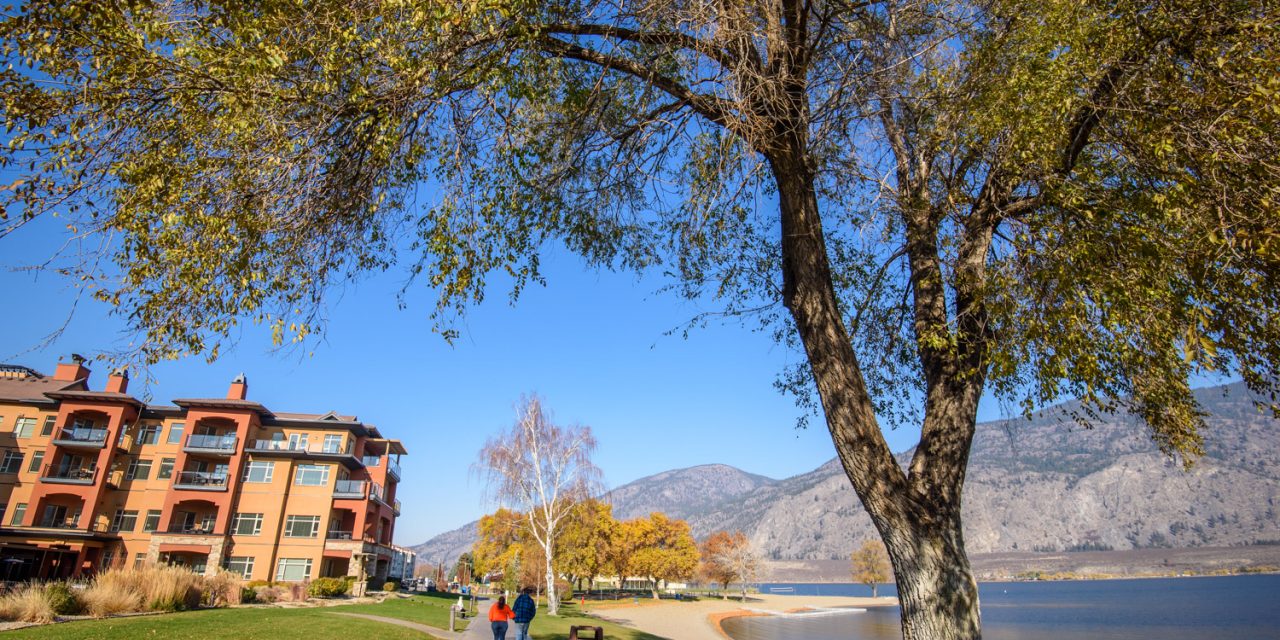

This Siberian elm tree next to the walkway by the Watermark Beach Resort in Gyro Park is cited in the study as an example of a tree providing value to the community. Siberian elms are an introduced species and this past year they’ve contributed to the spread of invasive elm seed bugs. (Richard McGuire photo)
Trees are everywhere in Osoyoos – along boulevards, in parks, schoolyards and, more than anywhere else, on private property.
They provide shade, they screen the winds and they provide homes to birds and other critters. They even help with flood control and mitigation, they combat erosion and they filter smoke from the air.
The importance of this “urban forest” is recognized in a 45-page consultants’ report that was received by town council without any fanfare at the beginning of October.
The report sets out a sample inventory of some 272 trees in Osoyoos, lists their species and in some cases sizes, and makes recommendations for managing them.
Gina MacKay, Town of Osoyoos director of planning and development, believes the Urban Forestry Plan is a first for Osoyoos.
Like other planners, she says she’s been very conscious of the role of urban forestry throughout her career.
And she’s been champing at the bit to get started on a new official community plan (OCP) for Osoyoos early in the new year, a plan that she says will incorporate elements of the Urban Forestry Plan.
“The first step, and one of the key components of this is actually around education,” said MacKay, who hopes to raise awareness about the importance of trees. “[The urban forestry report] is very timely because we’re starting our OCP review in 2019, so this is kind of a predecessor to that process. This guides us for the public realm and also for new development proposals.”
And that’s the key. At this time, the town really only exercises control over trees on public property, such as along boulevards and in parks.
The town also can work with landscape architects on new developments to guide the planting of trees. But for the majority of trees that are on private property, the town has little say.
But MacKay thinks that trees chosen for new developments can influence people to plant similar trees on their own properties.
“Hopefully it gets that trickle-down effect into the community,” she said. “Education is a key component of it – increasing public awareness about the benefit of trees.”
The Urban Forestry Plan highlights numerous benefits – environmental, social and economic.
“While aesthetic and recreational value of trees is often well understood, the social, environmental and economic value of urban forests is not,” the report says.
Of the many environmental benefits, trees store carbon, thereby reducing the carbon dioxide emissions that contribute to global climate change.
Trees also reduce heat, filter pollutants, improve soil and water quality, prevent erosion by stabilizing soils and they soak up water from heavy rains and floods.
Among the social benefits, they “can have a profound impact on the physical and mental health of humans,” said the report.
They instill community pride, increase aesthetic value, improve the experience of pedestrians, reduce noise pollution and even reduce stress.
“Shade is a big thing,” said MacKay, also noting the “horrible particles for your body are sucked out of the air” by trees after wildfires.
The aesthetic value of trees has actual economic benefits, said the report, noting higher visitation and the attraction and retention of business and industry.
“Generally, properties with trees have a greater property value in the real estate market,” the report said. “Typically people perceive retail streets with trees as being better maintained. People also perceive stores on streets with trees as carrying higher quality goods and they are willing to spend more money.”
The report also makes practical recommendations about the planting and replacement of trees in town, noting, for example, the root zone damage to green ash trees along Main Street.
“Green ash are generally poor candidates to retain in high traffic areas and the green ash along Main Street should be removed and replaced,” the report said, pointing to a list of appropriate replacement trees.
In other places, roots of trees have created tripping hazards.
In several parks – Osoyoos Park north of Cottonwood Drive and Legion Park – some trees are flagged as potentially hazardous and in need of signage or risk assessment.
MacKay said the town is responding to some of these recommendations based on their urgency. It can, however, become challenging with trees next to the lake because of riparian regulations, she said.
Many of the trees in town are introduced species or even invasive species.
MacKay noted that an earlier version of the report recommended elms as a good tree for this area, but in the final report, that recommendation was removed.
An invasion of elm seed bugs this summer led some residents to call for the removal of elms.
“Not all the elms carry the elm bugs, but we did remove it from the appropriate tree species list because we thought someone is sure to pick up that it is maybe not the greatest idea,” said MacKay.
She said that some communities where she has worked have brought in tree bylaws that actually restrict the number of trees per acre that people are allowed to remove from their lot. Or they need to get permits to remove trees.
“We’re not at that stage here in our community,” said MacKay. “I’m not even sure that we’re going to go down that road. We’re not in the same situation with trees on our properties as you are say in a coastal community.”
MacKay noted that in some communities where she’s worked, even starting to talk about a tree bylaw has the perverse result of leading people to cut down trees in anticipation.
“So to me it’s more important to have the education process come first,” she said.
MacKay hopes to start a discussion in the community about trees.
“We bring these things to council, and it’s all very well and fine and as planners we talk about them, but at some point we need to talk about them in the community,” she said. “I think everybody understands the benefit of having a tree in your backyard to sit under in the summer.”
RICHARD McGUIRE
Osoyoos Times