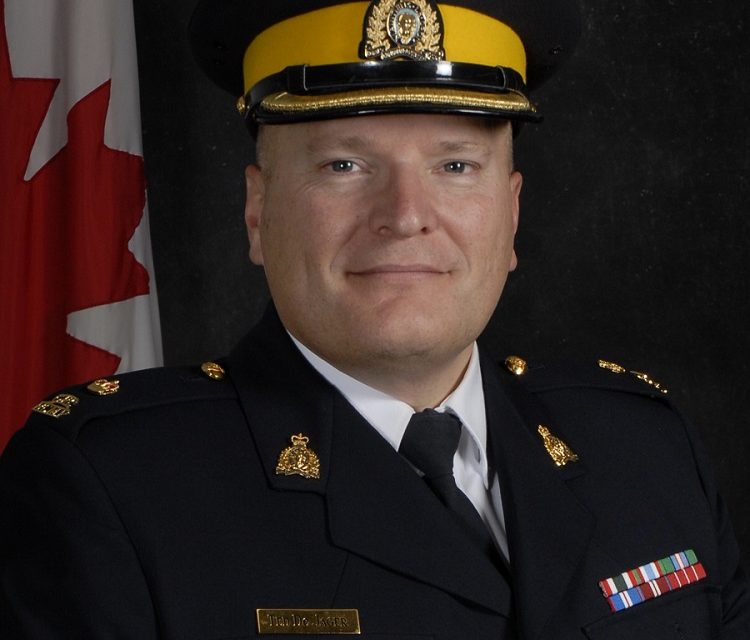

RCMP Superintendent Ted de Jager presented a quarterly report on crime last week to the Regional District of Okanagan-Similkameen. (RCMP Photo)
The South Okanagan’s top cop says police are “making progress” in reducing property crime in some communities.
Superintendent Ted de Jager talked about this at Thursday’s regional district meeting in Penticton, where he delivered his quarterly report (from April-September 2018).
“But as always, we need your (the public’s) help to be our eyes and ears and to look after your hard earned property.”
De Jager said they have deployed a Target Enforcement Unit in areas where property crime is a problem.
For example, property crime in Osoyoos increased 152 per cent from the first quarter of 2018 (69 files) to the second quarter of 2018 (174 files).
Incidents of auto theft also skyrocketed, from one file in the first quarter of this year to 23 files in the second quarter.
Residential break-ins this summer also kept the Osoyoos RCMP busy.
The number of year-to-date calls for service in Osoyoos exceeds 2,400.
Although property crime leads RCMP calls for service in terms of sheer numbers, the prevention and prosecution of violent crime must remain a priority, de Jager said.
“The good news is that by targeting prolific offenders, violent crime has again been reduced in our communities. In that regard, we need to address perceptions that the South Okanagan is a dangerous place or that crime is out of control.”
Although there are a few examples of random violence, the reality is that almost all of the violent crime is committed by an offender known to the victim or is the result of a certain lifestyle, de Jager pointed out.
Theft from auto is still the single highest crime type over last year and is growing, he added.
“We continue to respond to these types of crimes despite inaccurate reports to the contrary, however, you can stop them in their tracks by locking your doors and removing valuables from your vehicles.”
The superintendent noted that fraud has also gone up significantly due in part to theft of credit cards and identification from wallets left in vehicles.
De Jager said the vast majority of crime in the South Okanagan is committed by a small group of prolific offenders. But dedicated targeting has led to a significant reduction in property crime in certain areas, he stated.
The officer reiterated that over 60 percent of their calls for service do not involve charges or a solution by the RCMP. That’s why a special program was created to connect at-risk individuals with service providers that can help them deal with their mental health or addiction problems.
The Community Active Support Table (CAST) is a response model that identifies risks before incidents occur. Training began in June and already several referrals have been made to connect people at elevated risk.
“Many of these people are the very same that you see in the downtown core (Penticton) or suffering from illnesses or addictions,” de Jager said.
He explained that, in many communities, this model has been instrumental in reducing child protection cases, violent crimes and emergency room admissions.
Developed in Penticton, this program will ultimately provide service throughout the South Okanagan.
De Jager said housing is a significant part of the success of CAST.
“It is great news that housing initiatives are moving forward, which will have a large impact on the perception of homelessness and vulnerable populations.”
The officer encouraged people to look out for each other through programs such as Block Watch and volunteer patrols.
“I implore you all to call in crime or suspicious occurrences when they are happening.”
De Jager said he often hears statements such as “crime is getting out of hand in our neighbourhood.” But when police check that area, they often see no significant increase, he pointed out. He added that calls result in police targeting the area.
“To be frank, if several neighbourhoods are experiencing issues, it is the one which calls the police that will trigger a stronger police response,” de Jager said. “Call us. We will come as quickly as possible.”
LYONEL DOHERTY
Special to the Times