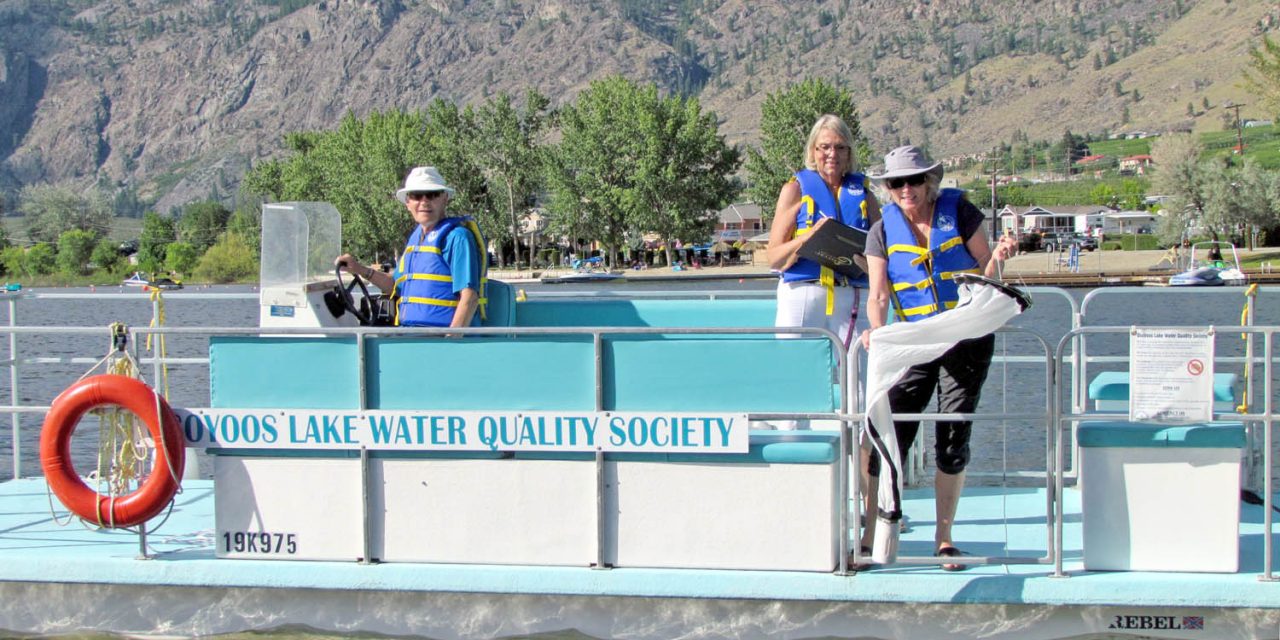

The Osoyoos Lake Water Quality Society has begun sampling for invasive mussels in Osoyoos Lake. From left are Captain Bob Sherwood, President Birgit Arnstein and Director Deb Sherwood, who is holding a plankton net.
The Osoyoos Lake Water Quality Society (OLWQS) has started testing the lake for the larvae of invasive zebra and quagga mussels.
The Osoyoos group is partnered in the testing of Okanagan lakes with the Okanagan and Similkameen Invasive Species Society (OASISS), which received a $17,500 grant from the Habitat Conservation Trust Foundation to support the testing.
OASISS is testing Skaha, Okanagan, Wood and Kalamalka lakes and is collaborating with OLWQS in testing Osoyoos Lake.
Birgit Arnstein, president of OLWQS, said volunteers will be conducting two tests for mussels at the four locations in Osoyoos Lake where they test the water every two weeks.
The testing began in early July.
One test measures levels of calcium in the water. A decline in calcium would indicate an established mussel population because they draw calcium from the water for their shells.
The other test uses a plankton net to determine if larvae, known as veligers, are in the water. This could detect a more recent contamination.
Arnstein said the difference in the testing is that OLWQS is doing it from a boat at different regular locations on the lake at different depths, whereas OASISS tests from docks.
OLWQS has long been doing other tests including temperatures, oxygen levels, acidity and turbidity (suspended particles) that don’t relate directly to invasive mussels. They’ve been testing on Osoyoos Lake since the early 1990s.
The non-profit society is acquiring a Hydrolab 4, a state-of-the-art device that will provide consistently accurate data. This device will test for temperature, dissolved oxygen, specific conductance and pH (acidity) at varying depths.
The purchase of this device was made possible with donations and grants from FortisBC, the Town of Osoyoos, the United Church Thrift Shop, and local fundraising activities.
The group also purchased a GPS (global positioning system) from the Habitat Conservation Trust Foundation funds, which will pinpoint testing sites more easily. Previously the group used a combination of depth measurements and visual location of landmarks on shore to return to the same testing sites.
OLWQS is collaborating with OASISS on mussel detection by providing them with the samples obtained from the tests for veligers and calcium. OASISS has also trained the Osoyoos group’s volunteers.
This summer, OLWQS has reduced the frequency of its water testing to once every two weeks instead of weekly, and it has also reduced the number of testing sites to four from five.
Arnstein said the reductions were made at the suggestion of Dr. Mike Sokal, the Ministry of Environment water quality limnologist in Penticton who receives their data.
Invasive zebra and quagga mussels proliferate rapidly, and they encrust themselves onto objects in the water such as boats, docks, water intakes and hydro equipment. Their razor-sharp shells cover beaches, making them hazardous for swimmers.
The mussels are spread, often in the larvae stage, usually by recreational boaters who fail to properly clean, drain and dry their boats after using them in infested waters.
Zebra mussels have spread as far west in Canada as Manitoba and both mussel species have now become established in the southwest United States.
Once mussels become established in a body of water, they are virtually impossible to get rid of. The Okanagan Basin Water Board has estimated that the cost to mitigate an infestation in the Okanagan would be at least $42 million a year.
RICHARD McGUIRE
Osoyoos Times