By Rachael Lesosky, Local Journalism Initiative Reporter
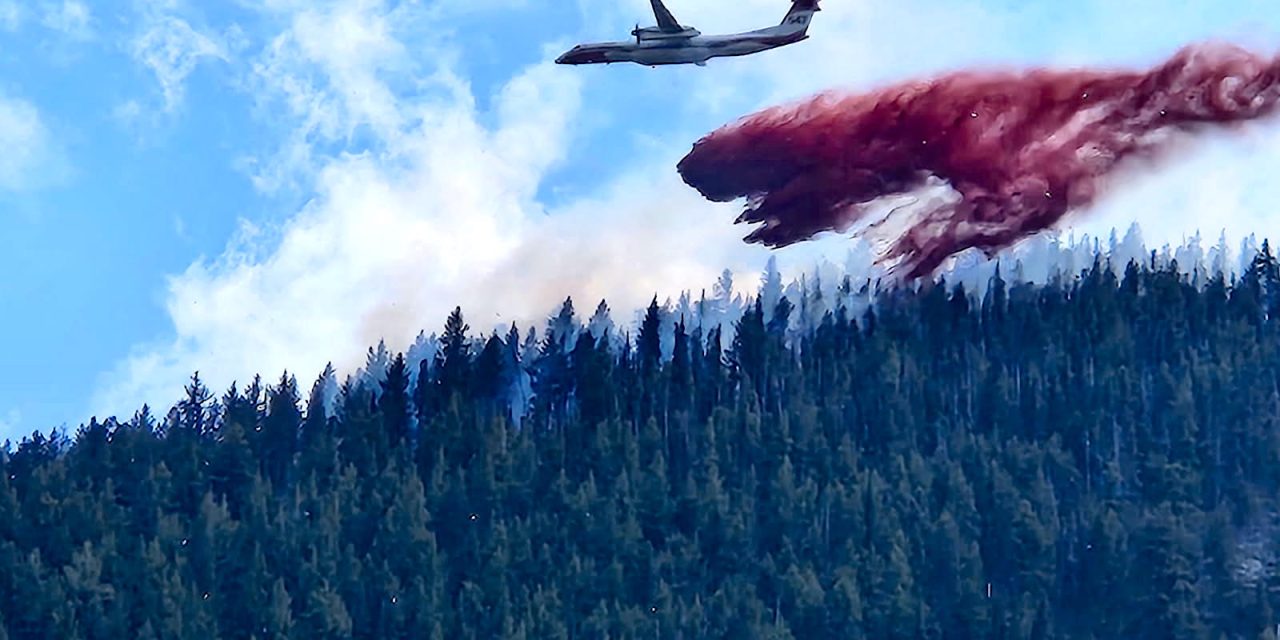
A new documentary is turning the spotlight on the state of BC’s wildfire crisis – and what can be done to help.
BC is Burning was shown to a large crowd at the Arrow Lakes Theatre in Nakusp on August 26. The 45-minute film was followed by a Q&A with Murray Wilson, retired forester, writer, and producer and Russ Laroche, Kootenay Boundary Regional Executive Director with the Ministry of Forests.
Wilson has premiered the film throughout the region this summer – in Vernon, Kelowna, Kamloops, and Castlegar – with a showing coming up this fall during the Union of BC Municipalities’ annual convention in Victoria.
“I’m hoping it will make people ask questions,” said Wilson during the Q&A. “Doing nothing is giving us a certain result. Are we happy with that result? I don’t think we are.”
Since 2017, over seven million hectares of BC’s forests have burned, emitting over 1.2 billion tonnes of CO2 and costing billions in suppression, community recovery, and timber losses.
“It’s easy to feel powerless, to believe this is just the way things are now. But what if it doesn’t have to be?” asks the film’s narrator.
Wilson’s documentary turns in a hopeful direction to find the opportunity hiding in the crisis. He travels around BC, and beyond to California, to speak with experts and explore science-based solutions to protect BC’s forests, communities, and future; he finds that forest management and policy change is key.
To set the stage before the film began, Wilson explained the fire triangle, or what’s needed for a fire to burn: fuel, heat, and oxygen. There isn’t much to prevent heat and oxygen from fanning the flames, but we can do something about fuel, he said.
Wildfire fuel is combustible biomass like grasses, shrubs, branches, dead leaves, and fallen needles and trees. Excess fuel can cause wildfires to burn hotter, larger, longer, and faster.
Retired Professional Forester Bruce Morrow says in the film that in his 40 years of working in BC’s forests, they’ve “changed completely.”
“There are too many trees. They’re out-competing each other, and when they compete, trees die. And now we have these dead dry fuels in our forest ecosystems,” he said. “We have these huge, big bonfires going on, which kill the trees. Nothing survives – not even the nutrients in the soil. The sites get sterilized and probably won’t grow trees again for decades.”
This fuel buildup is a product of over a century of wildfire suppression inhibiting the natural cycle of fires, says Jim McGrath, a Registered Professional Forester featured in the film. Usually, periodic low-entry fires – which burn at a lower intensity – clean up fuels without killing trees and soil. However, suppressing these fires has caused fuel hazards to build up.
Many of today’s forests may look natural, “but that’s not necessarily how it would have looked had there been a couple low-entry burns early on in the rotation,” says McGrath. “It’s an example of a policy that was intended to protect the forest, but it isn’t doing what it was intended to do.”
BC is Burning focuses the lens on the forestry sector to highlight how its active forest management strategies are crucial to protecting the province from wildfires.
In the film, Wilson visits Okanagan Mountain Park near Kelowna. In 2003, a wildfire burned almost 26,000 hectares of the park and nearby neighbourhoods. Though over two decades have since passed, very few – if any – trees have regrown.
In contrast, Wilson describes the forests outside of Peachland and around Mission Creek along Highway 3 towards Big White Ski Resort. The trees were killed by mountain pine beetle, but the areas were harvested and replanted. Now, trees are growing. The Mission Creek watershed is healthy, supplying 20,000 people with drinking water.
“If it had been left alone and we just said, ‘Let’s do nothing,’ I would say it would be a different story today because there would have been a very intense fire [due to fuel buildup] that would have impacted the soil and runoff, etc.,” said Wilson during the Q&A.
Forestry companies follow plans for replanting after harvest, which promotes faster regeneration, said Laroche. This is done thoughtfully, and is based in science.
In southern BC, forests are more diverse, and replanting prescriptions reflect this. But as you go north, there is less diversity and it makes more sense to align with the naturally occurring monoculture, he said.
“We also do extensive modelling on what climate change is expected to do in certain areas and because of that, we have what’s called stocking standards: what’s required legally to be planted to serve a future forest,” said Laroche. “It’s making a difference on the ground. We’re planting trees today that will be suitable for the climate we’re predicting in 30 years.”
In the Kootenays, around eight different species are planted, he said. A stand of trees is safer and more resilient if it’s diverse.
“Forestry companies develop [replanting] plans and work collaboratively with the government,” said Laroche. “A lot of those plans are built with the goal of providing resilient forests. There’s no incentive to, but foresters and companies see the value in managing to that approach.”
Wilson explained that about a third of BC’s forests are set aside for parks, protected areas, and areas that the forestry sector doesn’t manage. Another third is not economical to harvest due to remote or challenging terrain. The remaining third is the timber harvesting land base, but only about half a percent is harvested each year.
“All of our energies right now are being spent on essentially a third of our forested areas, and we’re forgetting the other two-thirds,” said Wilson.
The province’s harvest levels have also decreased significantly, meaning less forests are being managed and replanted, and fuel continues to build up. The harvest level, set by the Chief Forester each year, is 61.9 million cubic metres but only about 30 million cubic metres are being harvested.
Collaboration with Indigenous nations has helped the forestry sector access areas it hasn’t been able to in the past, but still only 100,000 hectares of 60 million in the province are being harvested and regenerated. This includes areas that have been burned by wildfires or devastated by pine beetle and other pests.
Though the Minister of Forests received a mandate from the Premier to increase the harvest to 45 million cubic metres, there just aren’t a lot of facilities left in the province to process the timber, said Laroche.
“That’s a big problem for us, and that’s some of what the film is saying: we have to get back to supporting manufacturing facilities that are able to process the timber,” he said.
“If you lose the forestry sector, you absolutely have no place for the wood,” Wilson added.
But to bolster this, policy change is needed, he said.
In the last five years, there have been substantial shifts, but there are still restrictions and standards – lengthy permit processing and access limitations, for example – that inhibit forestry and, in turn, forest management and wildfire mitigation.
“The goal is less area burned,” Rob Schweitzer, Assistant Deputy Minister with BC Wildfire Service, says in the film. “But that’s going to take a wide approach, a broad approach, and a change in the way we manage our forests in this province.”
Wilson pointed out that the BC government is very active in climate change policy. The Province spent $2.2 billion on climate initiatives in 2023 and 2024, and about $870 million went to promoting heat pumps and electric vehicles in the hopes of reducing carbon emissions.
“But if we can shift these funds and help reduce wildfires by only 5% through forest management, we’ll reduce carbon emissions much more – without spending so much money,” said Wilson.
How can the people help shift policy, the crowd in Nakusp wondered.
“The way you can take action is, if you’re passionate about it: speak up, say what you want to see, because the government really does listen,” said Wilson.
The film’s website has draft letters to send to MLAs, MPs, and local elected officials, to call for change.
“People that show up make a difference,” he said. “People that write make a difference.”
Wilson and Laroche are hoping the film will get the word out and start a conversation about the alternative to doing nothing, because it’s not working.
“I don’t think this fire season did us any favours,” said Laroche. “People start to forget. Lighter fire years are great for no smoke, but it takes some of the momentum away. After a bad fire year, people want to talk about fire protection. It just takes one year of no fires for people to say, ‘It’s not a problem anymore.’”
Visit bcisburning.ca for more information about the film and to access draft letters to send to politicians.
“If the government gets 5,000 letters asking for change, they’ll act on it,” said Wilson.
BC is Burning was independently produced and funded through community support. Homestead Foods contributed half of the total budget, and major support came from Skyline Helicopters, Padoin Reforestation, and Kalesnikoff.
This article first appeared in the Village Voice.