By Don Urquhart, Times Chronicle
Summer is in full swing and in the South Okanagan it’s all about cooling off in the lakes, rivers and pools. Unfortunately this comes at a toll with an average of roughly 78 people dying each year across the province from drowning, mostly in the summer.
July 20-26 marks National Drowning Prevention Week and among those aiming to raise awareness is Dr. Shelina Babul, Director of the BC Injury Research and Prevention Unit, BC Children’s Hospital who spoke to the Times Chronicle recently.
Dr. Babul noted the sad reality that drowning fatalities are predictable and preventable. Making this statistic even worse is that 79 per cent of that number are young males between the ages of 18-34 along with infants and young children under the age of five.
“We want individuals to enjoy their time with families, with friends in and around bodies of water, whether that’s lakes, oceans, or rivers, but we want them to do it safely,” she says, adding there are a few simple things that British Columbians can do to protect themselves and their families.
First and foremost, supervision. Nothing takes the place of supervision. And if you have young children, you want to stay within arm’s length of your child so that you are able to react and respond should anything happen. She says this is especially important in the case of infants – even giving infants a bath they can drown in as little as one inch of water.
Oftentimes people are distracted by their phones, or even something on the stove in the kitchen, she says emphasizing vigilance. “You want to avoid everything and stay within arm’s reach, reach of your child.”
Secondly, wear a life jacket, wear a personal flotation device. Unfortunately, she says, there’s the mistaken idea that “if I fall in I can grab my jacket and put it on and put it on right and you know that’s not going to happen, you won’t have time to react, especially if you’re submerged in water.
She notes that 18 per cent of drowning deaths occur during boating and 71 per cent of those deaths occurred when the individual was not wearing a life jacket. “So wear your life jacket at all times,” she urges, adding that it applies to both children and adults. “Older adults are not immune from a catastrophic incident happening on water.”
Third, it’s never too late to take swimming lessons. The Life Saving Society recommends that parents put infants as young as four months in some sort of water activity just to get them acquainted with water, and comfortable being around water.
“And as adults, it’s never too late for yourself, just so you are prepared and know how to have water skill survival techniques,” she says.
Fourth, refrain from using alcohol and drugs in and around bodies of water. “As we know, alcohol and drugs impair your judgment, your reaction time, and your cognitive abilities.” A full 40 per cent of drowning deaths involve alcohol or drugs and Dr. Babul adds that if you tease that out to the 30 to 39 year old age group, that goes up to 52 per cent.
“So refrain at all times, and don’t overestimate your abilities. You always hear, ‘Oh, I’m good, I’m a great swimmer,’ but it may not be you, it may be your environment or the circumstances,” she cautions citing the example of an undertow that you aren’t aware of that’s going to carry you out.
“Don’t overestimate your abilities, and always swim with a buddy, that is also very, very important.”
For Dr Babul and her team it’s all about prevention and that means raising awareness.
“Injury prevention is the key focus for us,” she says, noting that 90 per cent of injuries are “predictable and preventable”.
“What we want to do is raise awareness around drowning,” and this includes dispelling misconceptions like a drowning person will be flapping their arms and screaming. “That only happens in the movies, because drownings happen very quickly and very silently because the person gets submerged underwater.”
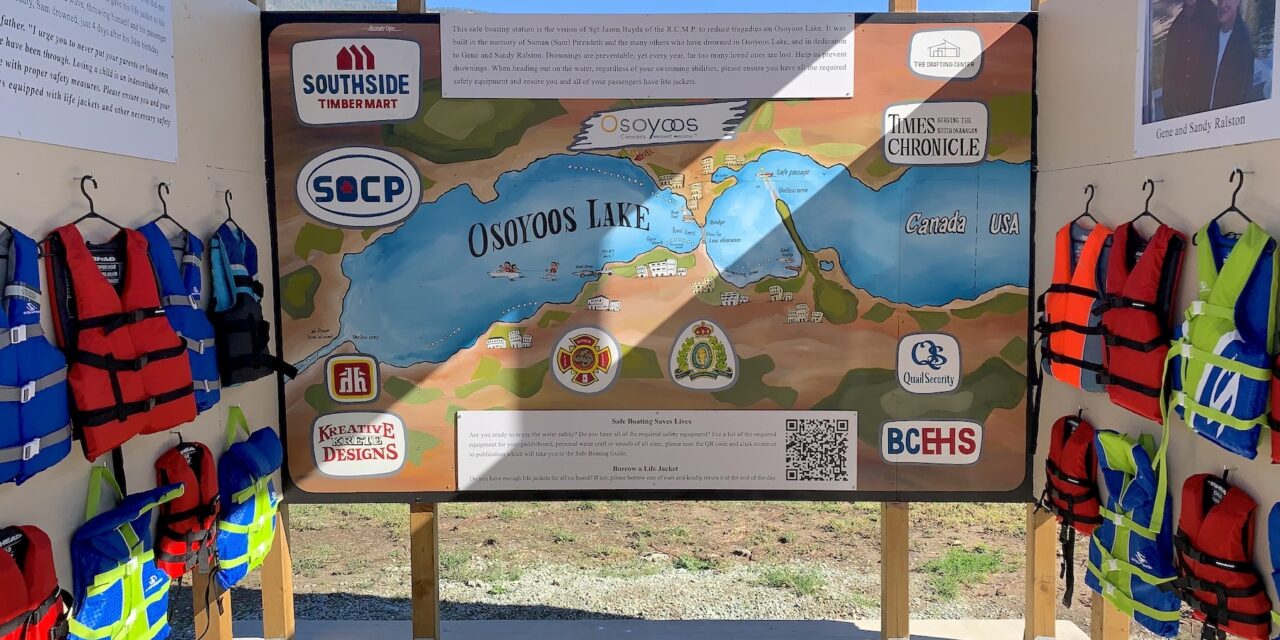
When the Times Chronicle highlighted the Osoyoos Safe Boating Station that was created last year offering safety information and free lifejackets for loan Dr. Babul said: “I know a lot of local efforts are in place such as that to make families aware, which is great, because we need any and all efforts and all hands on deck in any way possible, to raise the knowledge and understanding on water safety.”
She also highlighted the importance of using certified personal flotation devices or life jackets, and not for instance, arm floaties that you buy at the dollar store or buy online from overseas e-commerce platforms.
And some practical tips – applicable to both on and off the beach – for families and friends that get together with a big bunch of kids. There’s always the question of who’s in charge of watching the children. Often there is a mistaken belief that someone is watching them when perhaps that’s not the case.
“Always have a plan in place,” Dr. Babul urges. “ Maybe take turns, maybe have one adult watching a certain number of kids at all times, and then rotate – just always ensure that someone is watching the kids at all times.”
The bottom line for Dr. Babul is clear: “Drowning fatalities and injuries are predictable and preventable and if you take those measures, then you’ll have a great time, and everyone will be safe.”