By Times Chronicle Staff
The BC Community Bat Program is calling for volunteers to get involved in the annual BC Annual Bat Count which helps bat biologists understand how the BC bat population is fairing.
Bats in BC are key predators of many night-flying insects and are essential parts of BC’s ecosystems and provide billions of dollars of economic benefit by helping control agricultural, forest, and urban insect pests.
Starting June 1, bat biologists and volunteers will be enjoying late nights, counting bats at maternity roosts throughout the province.
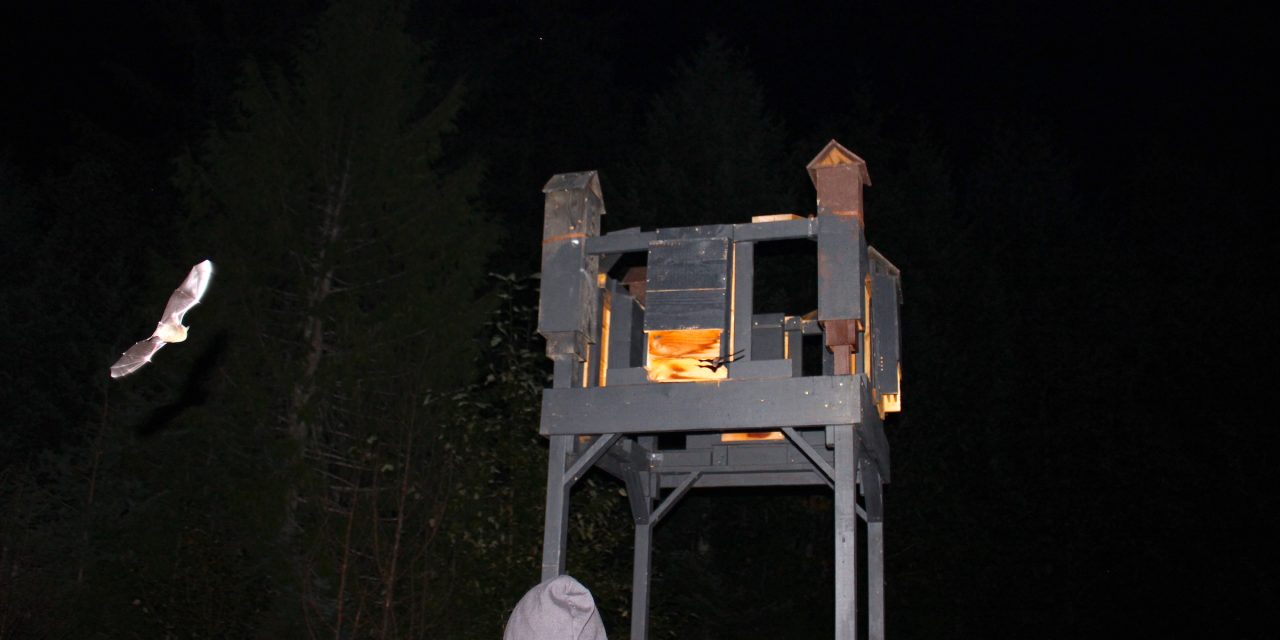
“The Annual Bat Count involves sitting outside a bat maternity roost at sunset, and for an hour, counting all the bats that come out of that roost to forage for insects,” says Paula Rodriguez de la Vega, Okanagan coordinator for the BC Community Bat Program. Last year, volunteers conducted 1,089 counts at 268 roost sites across the province.
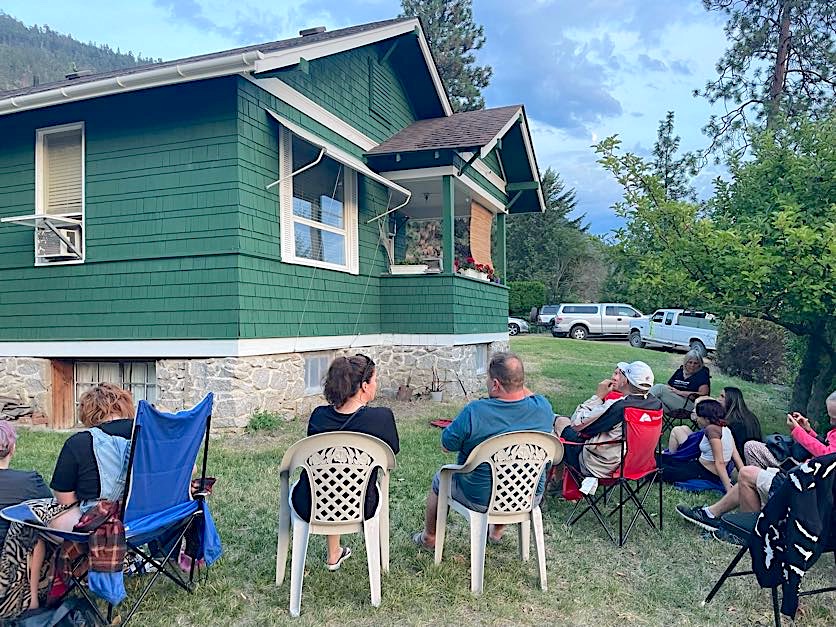
Volunteers counting bats.
Alexis Olynyk photo
“The data collected is really important as it helps us know how the bat populations are doing in BC,” says Rodriguez de la Vega. “We usually do four bat counts at every roost site – two in June to count just the females and two more starting mid-July when the pups are learning to fly.”
She adds that it is “an amazing experience, staying up until the darkness sets in while counting bats.”
She continues, “All your senses come alive at dusk. You hear the birds quieting down, see the light disappearing and the stars starting to shine, your skin feels the coolness of the night. All the while you are focusing on one spot as you count the bats one by one.”
Female bats roost together in the summer and raise their young in maternity colonies. Most of the species of bats in BC only have one pup per female. Pups are born in June and learn to fly in about 3 to 6 weeks depending on the species.
The males do not help with raising the young and usually roost by themselves in large trees, rock cliffs, boulder fields, or barns and buildings.
“We have sites all over the Okanagan and Similkameen region and are fortunate to have many dedicated volunteers. More are always needed though, so we would love to hear from anyone interested in helping,” says Rodriguez de la Vega.
Some public sites where bats are counted include the O’Keefe Ranch, Fintry Provincial Park, Okanagan Lake South Provincial Park, Peachland Historic School, and Sun Oka Provincial Park.
Many homeowners do bat counts as well, de la Vega says, including bat colonies on their barns, bat boxes, or even attics.
Additionally, partners like The Nature Trust, Allan Brooks Nature Centre, Osoyoos Desert Society, Environmental Education Centre for the Okanagan, Bat Education and Environmental Protection Society, City of Penticton, and others also lead bat counts.
Begun in 2012, the Annual Bat Count is the only long-term monitoring program focussed on bat summer roosts in BC. The counts help biologists monitor bat populations and track impacts to or recovery of species.
If populations decline, it could indicate impacts from white-nose syndrome (WNS), a fungal disease that has decimated bat populations in eastern Canada and US. The fungus that causes WNS was detected in 2022 in the Grand Forks region of BC, but WNS itself has not been detected yet in BC.
To report a bat colony or sign up to help with bat counts visit bcbats.ca, email [email protected], or call 1-855-922-2287 ext.13.
In partnership with the BC Ministry of Water, Land and Resource Stewardship, the BC Community Bat Program provides information and promotes local stewardship and citizen science.
The program is made possible due to funding from the Habitat Conservation Trust Foundation, BC Conservation Foundation, and many regional partners including the South Okanagan Conservation Fund.