By Sebastian Kanally, Times Chronicle
The Regional District of the Okanagan-Similkameen (RDOS) says it needs to better understand the financial risks before any agreement is made toward expanded transit service to Oliver and Osoyoos.
The RDOS discussed a Memorandum of Understanding (MOU) for a proposed future transit service expansion in the South Okanagan at their Oct. 17 meeting.
The board ultimately decided to kick the can back to BC Transit, to gain a better picture of the financial risks associated with their decision.
BC Transit requires a commitment from the RDOS (the MOU) before it will pursue any further procurement of buses and funding to bring the service to reality.
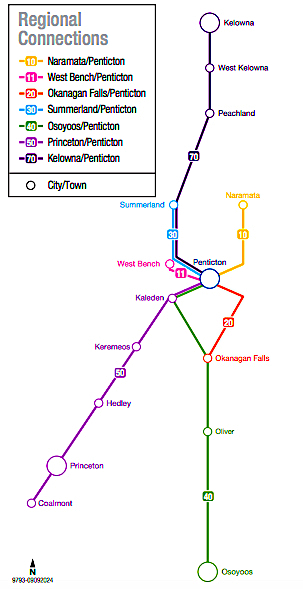
A map of BC Transit main routes in the RDOS area.
BC transit graphic
The MOU that was in front of the board had two components. First a proposed expansion of service to Route 70 which services Penticton to Kelowna, and second, a proposed additional service connecting to Route 40 in Oliver and Osoyoos.
The second proposed expansion would develop dedicated transit services in Osoyoos and Oliver. The expansion would include an additional 3,000 hours of service and 3 transit buses, amounting to a 122.55 per cent increase in service hours for the region.
The RDOS board was faced with this decision to support or not. If they moved the motion to commit to the MOU, it does not guarantee the service would arrive, it would allow BC Transit to procure the funding and buses.
If afterwards the RDOS turns the expansion down, or it does not come to fruition, the RDOS is then liable for the costs.
The board made two decisions. They decided to defer and decided to pass an additional motion that will inform BC Transit of interest in a “truly regional approach” instead of “a patchwork” as Mayor of Princeton Spencer Coyne described it.
The main reason for deferring back to BC Transit was the lack of clarity around the risks associated with the decision. It was reported to the board that the proposed expansion for Oliver and Osoyoos would come at a cost of $238,387 as an estimated “additional annual net municipal share”.
The board was unclear who would be paying for this as the report noted the transit service would serve Electoral Areas “A” and “C”, along with Osoyoos and Oliver.
In response to this, Director of Area “A”, Mark Pendegraft, explained that “I am assuming they are anticipating areas “A” and “C” to be contributing to this, and this is more than we have allowed through our tax requisitions for that, and I am not sure that I am prepared to support it, we don’t get much benefit from transit in Area “A” as it stands.”
Mayor of Osoyoos Sue McKortoff was also hesitant to support, explaining that “we should not be jumping into this until we have some more information on this and who’s going to pay for what and how is it going to work. So I can’t support this at the moment”.
It was further explained that the expansion of service would actually be focused primarily in the Town of Oliver, but would be “related to” the service that links to Osoyoos (Route 41).
With this discussion, the board turned to RDOS corporate officer Christy Malden to explain how this would be paid for.
She explained that if the cost is to be born just to Oliver there are two options. The first option would be adjusting the apportionment, so Oliver would pay more based on a percentage.
Or, Oliver would have to create a separate service, “so if it failed it would be on Oliver and BC Transit that would have to adapt accordingly.”
“So there is work to be done on this,” she concluded.
Mayor of Oliver Martin Johansen was not present at the meeting, but town councillor Petra Veintimilla was in attendance on the town’s behalf.
She noted she arrived “somewhat naively, thinking that all the funding had been sorted out and they were sharing this magnificent new program.”
Director of Area C Rick Knodel brought up the fact that discussions should be had around bus stops before any expansion in routes.
He commented, “We are racing forward and we can’t even supply a bus stop in an area that has 600 potential patrons of a demographic that normally uses the bus (Gallagher Lake), we are getting a cart way out in front of a horse before we can get some bus stops in. Moving the service on seems a little pointless.”
Despite the fact that this has been deferred multiple times already, chief administrative officer Jim Zaffino commented that “based on the risk that I see, I would wait till they come back to us with what the costs are, so that we can come back to the board with what the costs are”.
The costs he is referring to are exactly the amount the RDOS would be liable for if they agreed to this MOU as a result of them procuring the buses, etc.
This discussion quickly led to Coyne expressing his dissatisfaction with the transit service in the Okanagan-Similkameen which ultimately led to the second motion of expressing interest in a “truly regional service”.
He explained “Until route 50 becomes a regional service, I’m really reluctant to jump into further funding a bus service that we can’t even access. I will play along, but I’m not happy about it.”
“Until we start talking about a real regional service where we are all connected together, all the way from Princeton to Osoyoos, all the way up to Kelowna, this isn’t really a regional service. This is a bunch of patchworks that are not really connecting up and I’m pretty frustrated with it.”
“We want to get to Osoyoos too,” he joked.