By Don Urquhart, Times Chronicle
The Okanagan will remain at a Level 2 drought rating even as the annual valley-wide outdoor water conservation campaign – “Make Water Work” – winds down for the year as home and farm irrigation is shut down and winterized.
“The drought this year certainly wasn’t as bad as 2023, when severe drought fueled a frightening fire season in the Okanagan,” notes Okanagan Basin Water Board (OBWB) Communications Director Corinne Jackson. She said residents in part, should be thanked for doing their part to conserve this year.
But Jackson, who also manages the board’s Okanagan WaterWise outreach and education program and Make Water Work program, highlights there were still impacts on crops, and on fish. “And we still haven’t recovered from two years of drought,” she cautions.
“This means we need fall rains, a good snowpack, and a nice slow spring melt to recover. Whether that happens, or not, we can’t predict,” she added.
OBWB water managers are hoping that with days getting cooler and rains forecast over the next few days, that some Okanagan streams will see some relief after struggling this year. In particular, the South Okanagan’s Shingle and Shatford Creek remain at Level 3, Shuttleworth Creek is at Level 4 and has had problems with fish passage, and Vaseux Lake – which is dry at the mouth – is at Level 5.
During a regional drought call yesterday, it was decided to keep the Okanagan at Level 2 until the impact of the potential rains becomes clearer, the board said.
At Level 2 adverse impacts to socioeconomic or ecosystem values (e.g. impacts for farmers, or aquatic life including fish) are unlikely. At Level 3, these impacts become “possible,” at Level 4 they are “likely,” and at Level 5 they are “almost certain.”

Make Water Work winner Lisa Boulanger with ProSource Branch Manager Travis Turner. OBWB-OkWaterWise photo
Jackson lauded the “strong participation” in the Make Water Work campaign this year, particularly given the concerns around the valley’s water supply and the resultant need for everyone to adopt WaterWise behaviours.
Make Water Work is delivered in partnership with local governments, water utilities, along with garden centres and irrigation businesses throughout the valley. As part of the campaign, residents were encouraged to pledge to undertake at least one of six actions to reduce outdoor water use and be entered to win $500 in WaterWise yard material. Some 318 people pledged and one of this year’s winners is Lisa Boulanger of Kelowna.
Asked why she entered the contest, Boulanger responded that, “Water is so precious here and it’s not going to change so we are the ones that have to change.
Coincidentally, Boulanger is with the Kelowna Garden Club which has been encouraging members to move away from the traditional English cottage garden, or to at least use plants better suited to the Okanagan. Among some of the WaterWise gardening practices Boulanger uses is to mulch garden beds in the spring, which feeds plants and helps hold moisture so they require less watering, and she has installed drip irrigation.
“I try to lead by example,” she added, saying she plans to use some of her prize winnings to fix up an irrigation zone and plant an Okanagan-appropriate tree.
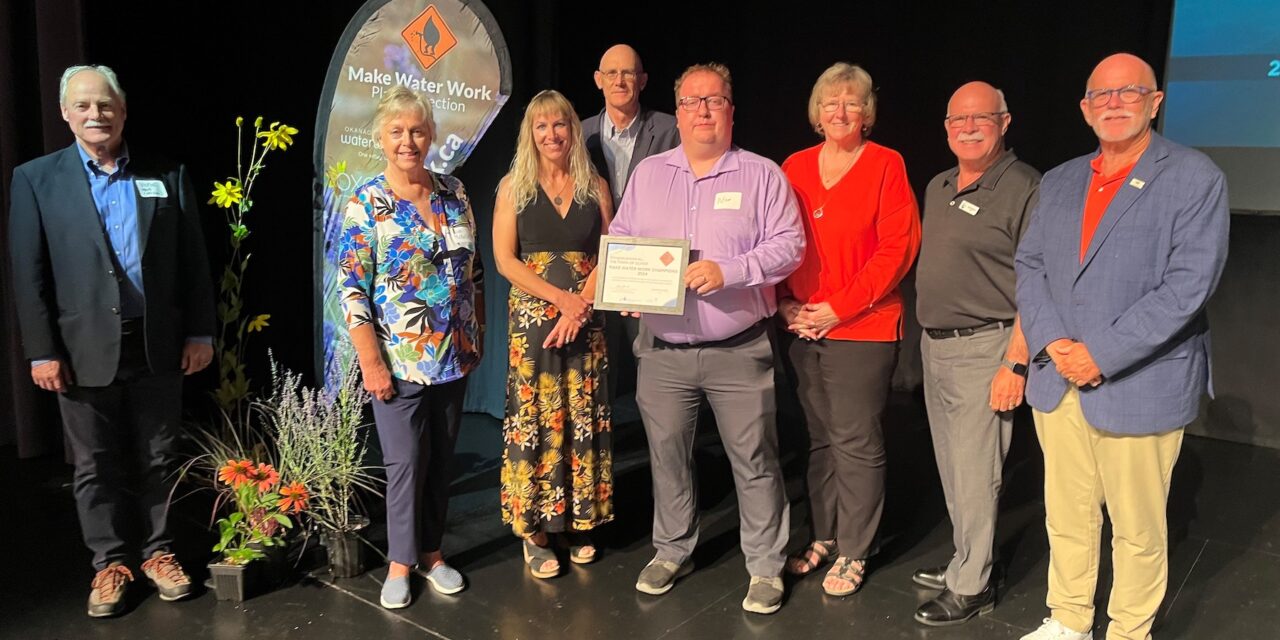
In addition to Boulanger’s win, the Town of Oliver reclaimed its “Make Water Work Community Champion” title for collecting the most pledges per capita. This is Oliver’s second win after taking the title in 2014.
The Make Water Work campaign has improved, grown in scope, and attracted new partners each year, according to Jackson. This year, the campaign partnered with FireSmartBC, noting the plants on the Make Water Work Plant Collection list that are also deemed FireSmart.
“This was important to us, knowing that our communities need to be prepared for both drought and fire, and that you can have both by following WaterWise and FireSmart principles,” Jackson said.
“Fall is an excellent time to plant,” she added urging people to look through the Make Water Work Plant Collection list and the partners that carry it at makewaterwork.ca/plants/. “If you’re not ready to do the landscaping work now, it’s also a great time to start planning for spring,” she added.
Jackson, who launched and has managed the board’s Okanagan WaterWise program and its “Make Water Work” and “Don’t Move A Mussel” campaigns, is leaving the organization later this week after 15 years.
“It’s been a dream to create programs, campaigns and resources in response to real-world, real-Okanagan, issues, and to grow partnerships to expand the reach of the Water Board’s messages and efforts,” she said.
The Make Water Work campaign was first launched in 2011 and is aimed at tackling the second largest use of water in the valley – residential outdoor use.