By Don Urquhart, Times Chronicle
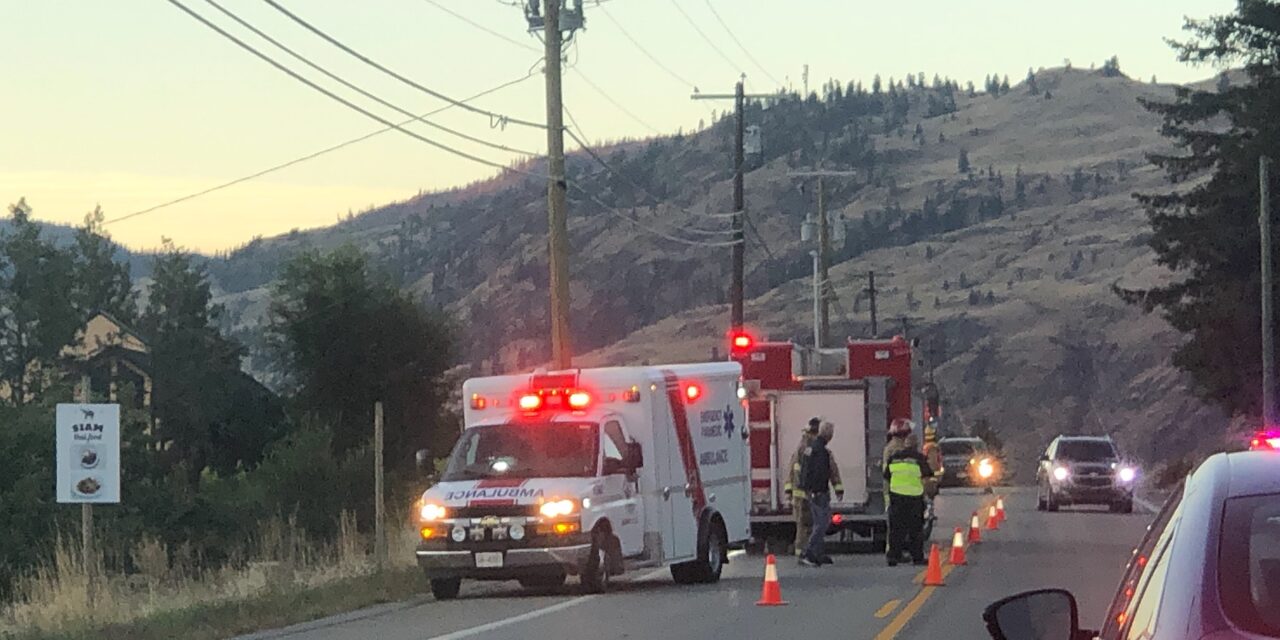
Hwy. 97 was temporarily down to one lane alternating traffic Wednesday (Oct. 2) morning shortly after 7 a.m. following a collision between a deer and an SUV between Road 10 and 11. Emergency responders were on the scene and while the SUV sustained significant front-end damage the extent of injuries if any of those in the vehicle is not known.
A further deer carcass from an earlier collision was also witnessed in the southbound passing lane of Hwy. 97 near Fruitvale Way.
Deer populations have been increasing in BC, increasing the likelihood of collision and drivers are advised that there are two distinct high-risk times for deer crashes – May and November – which have the highest rates of deer collisions, with fall being the worst according to the British Columbia Conservation Foundation’s Wildlife Collision Prevention Program (WCPP).
Deer migrations occur during early summer and mid-fall, increasing the risk of collisions with the May peak coincides with the fawning season which occurs from late May to June. The November peak coincides with rutting (mating) season, as males move to find females, as well as movement to avoid hunters, and withdrawing from crop areas during harvesting, the WCPP says.
Most deer collisions occur between 6 p.m. – 12 a.m. and 6-9 a.m. and during October and November peak most collisions occur between 5-8 p.m. and 6-7 a.m.
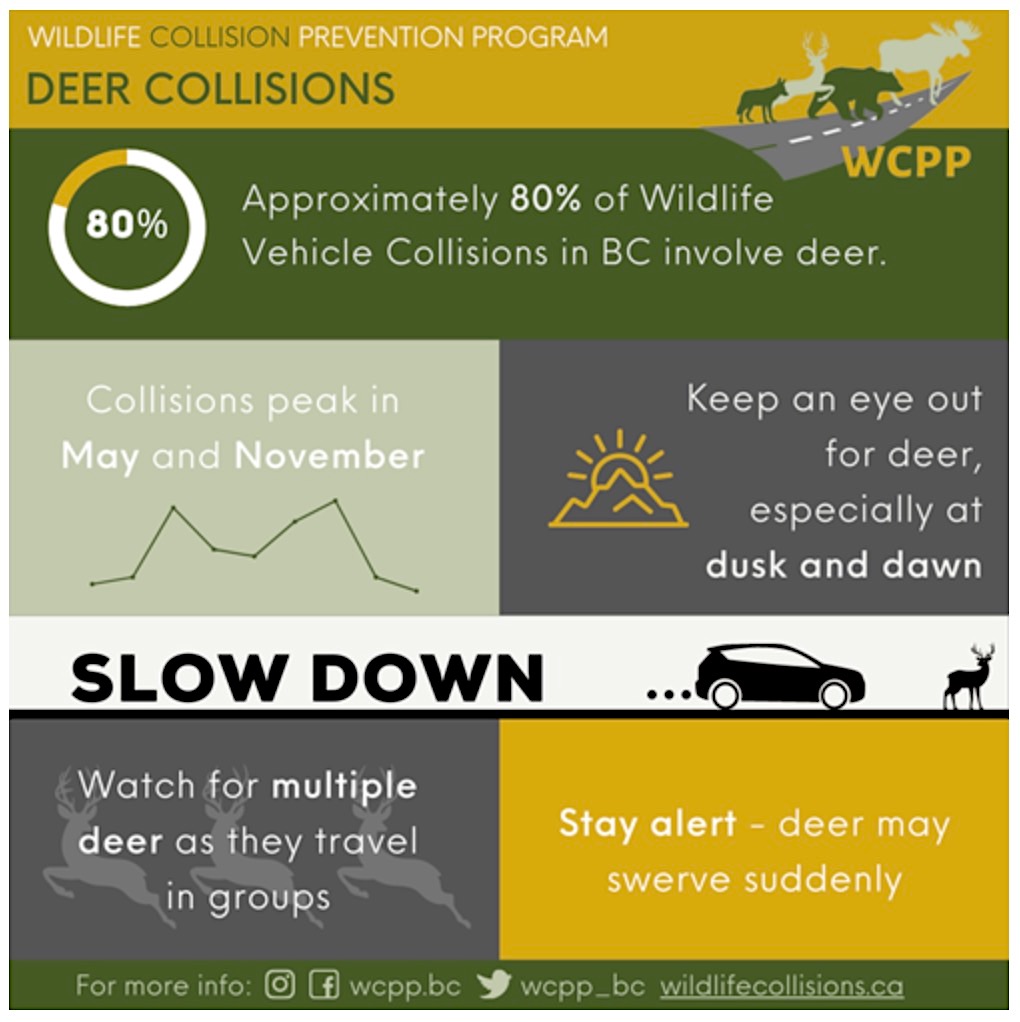
Be alert, particularly during peak season and times. Wildlife Collision Prevention Program graphic.
Deer are the most common wildlife-vehicle collision in BC, accounting for approximately 80 per cent of wildllife-vehicle collisions in the province according to ICBC. Around 8,992 deer collisions occur each year in the province according to a 4-year average, 2006-2010. However, the WCPP noted that it is estimated that approximately 50 per cent of deer collisions are not accounted for because of incomplete reporting.
Although smaller than other large mammals like moose, an adult male Mule Deer can weigh up to 180 kgs (396 lbs) and stand around 90-95 cm tall at the shoulders. Colliding with a deer is dangerous as they can damage vehicles and smash through windshields if hit with enough force. Approximately 7 per cent of all deer-vehicle collisions result in human injury or fatality.
The WCPP noted that cost calculations by the Traffic Injury Research Foundation show the average cost of deer-vehicle collisions to be slightly more than $8,191. This includes vehicle repairs, human injuries and fatalities, towing, accident response and investigation, potential hunting revenue lost for the animal killed in the collision, and cost of disposal of the animal carcass.
Avoiding a wildlife collision
Drivers are urged to slow down and be alert, particularly during peak deer times and to pay attention to the yellow diamond-shaped wildlife warning signs. The BC Ministry of Transportation and Infrastructure collects and interprets data on collision locations and places these signs in areas of frequent wildlife use or high collision risk locations.
If a deer is spotted use brakes rather than attempting to swerve around the animal. Watch for other deer as they often travel in groups and remain alert as deer may swerve or bolt suddenly.
Drivers are also urged to drive defensively and mentally prepare by thinking about what action they would take if a deer darted out in front of their vehicle.
The WCPP suggests that drivers and passengers should actively watch for:
- wildlife – on the road, in the ditch, on the shoulder, and in the right of way;
- movement on or alongside the road;
- shining eyes, which will be your headlights reflecting off the animal’s eyes. Moose are so tall that their eyes are normally above the beams of most vehicle headlights, and so are less likely to reflect the light;
- Flickering headlights of oncoming cars or tail lights of the vehicles in front of you – which may be an animal crossing the road;
- Roadside reflectors that disappear/reappear, which might indicate an animal crossing in front of them – watch out between dusk and dawn when light levels are low, and animals are active.
For more information visit the Wildlife Collision Prevention Program and the Province’s Wildlife on BC Highways.