By Don Urquhart, Times Chronicle
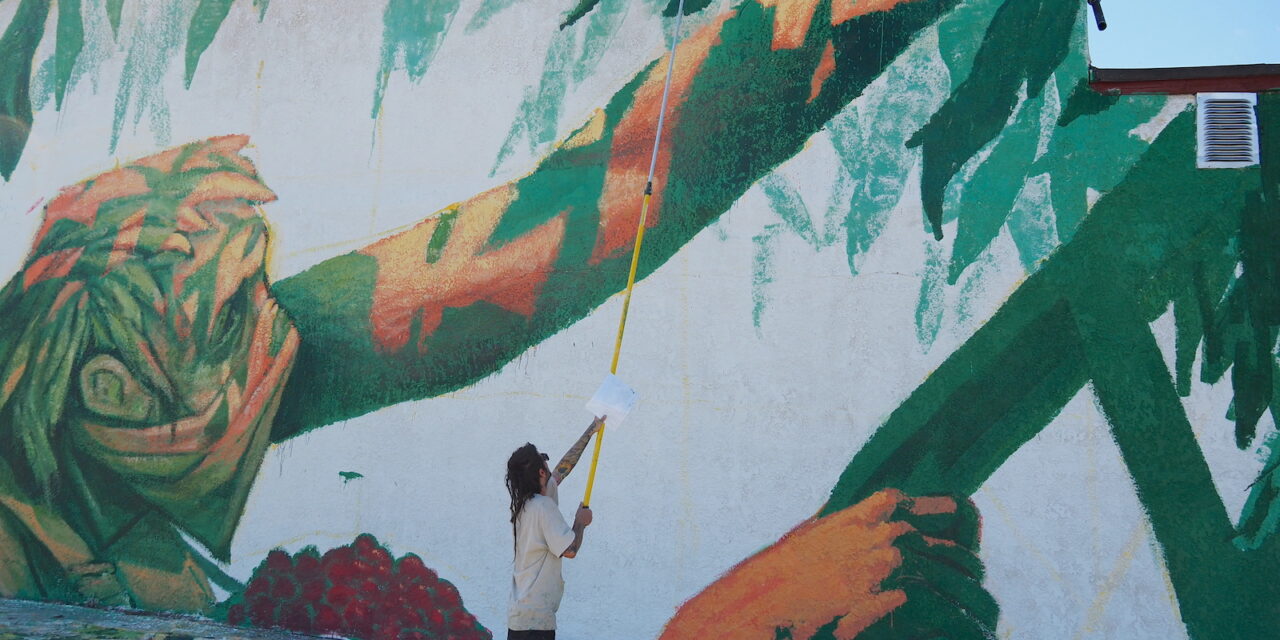
Three days and 76 litres of paint later, Osoyoos’ latest outdoor mural has taken shape on a blank wall on Main St. across from Nestor’s Market parking lot, adding yet another colourful piece to Osoyoos’ outdoor art collection.
The artwork covering the expanse of the side of the two story building housing the Pizza Factory at 8115 Main St., was created by Dominic Lessard who has created murals in Europe and across North America.
“For the last decade, I’ve told him that one day, I would love to have his artwork somewhere on a wall in Osoyoos,” says Wina Poliquin, president of Wide Arts National Association (Wana). Poliquin has been the key spark behind many of the murals around town and she is continually working on bringing more art to the buildings of downtown. Many of the current murals were created by local artist Mavik who uses spray paint to create his art.
Poliquin says the idea came to fruition after talking with the owners of the building who indicated they were very open to having a mural and from there it was just about raising the money to bring Lessard here and cover the costs of his work and materials.
“He’s French Canadian too so we have the same roots,” she says adding they both originally came to the Okanagan for seasonal fruit picking. In Poliquin’s case that was some 20 years ago and she never left.
“We were able to raise some money to be able to pay for a mural, proposed it and then it just kind of clicked in,” she said. Notably, all the funding was generated through Wana and Poliquin praises the building owners for providing the “canvas” and importantly, the freedom to choose what to create on that canvas. She also adds that the town is very supportive of the mural project.
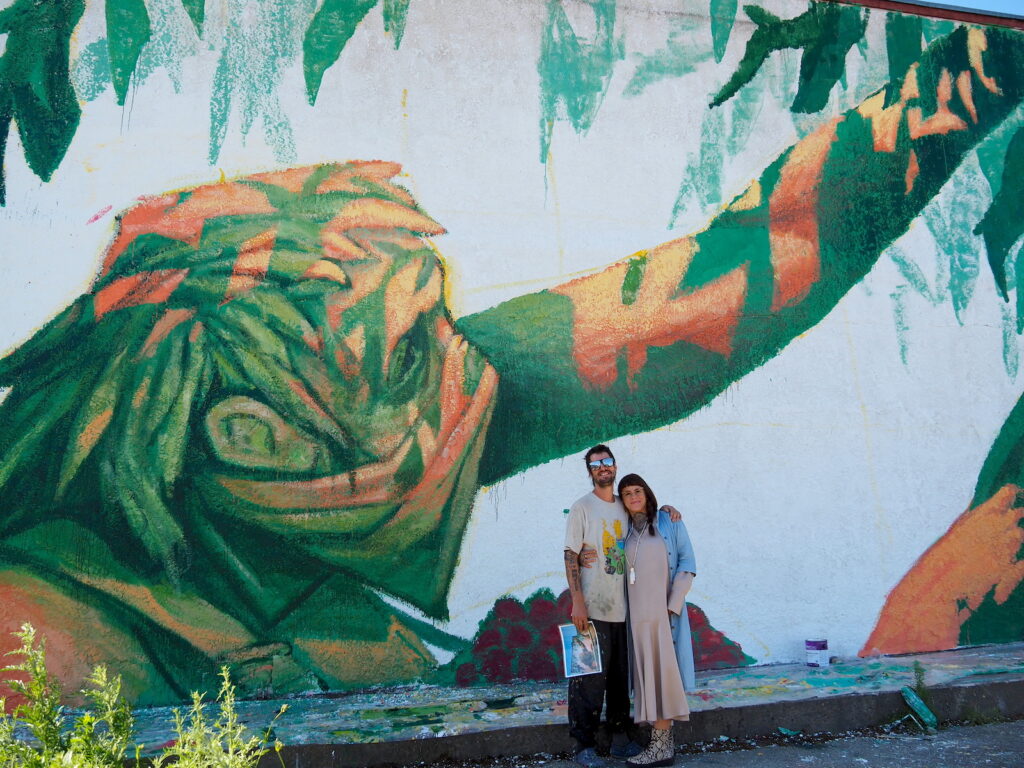
Friends and compatriots: Dominic Lessard (left) and Wina Poliquin from Wide Arts National Association (Wana).
This time around it’s not spray paint but a paint roller that Lessard took in hand to create his image. Unfortunately, his original creative plan had to be scaled back because the building wall has a texture on it which meant it used far more paint than he had originally counted on.
While spray painters appreciate textured walls because of the extra dimension it gives the mural, for Lessard it meant at lot more paint would be required to roll over the bumpy service.
As a result the original design consisting of several characters in the image, had to be scaled down to just one.
“I had to restart that maybe three or four times because the perspective was not right,” he says. “Most of the time, I do paintings with a bunch of characters or a bunch of things. It’s very rare that I paint only one character on one frame, there’s always so many things going on.
“When you have only one character, it needs to be super tight,” he laughs.
There may only be one character in this mural but it is certainly “tight” and a lot is going on in that scene with subtlety of expression, shades of light and a feeling of physicality.
The mural is an ode to migrant seasonal workers, close to the hearts of both himself and Poliquin, not only because of their previous experience here doing that work but also important in highlighting the difficulties in doing such work as well as the cultural enrichment these workers bring to the local community.
“It’s kind of a social resistance to be a migrant worker,” Lessard says adding he wanted to bring a kind of poetic element to the mural.
“There are symbols in the mural, like the light filtering through the leaves. I really like the impact of the body who is working and also the mask that this person is wearing is kind of a big symbol. To me, it can represent a little bit of a mask of resistance and at the same time it’s a mask that represents the right to protection from the pesticides.”
It’s also a form of anonymity he agrees, the seasonal workers that are anonymous, nameless amongst the community in which they temporarily live and work.
“They’re foreigners who are like nomads,” he says. “They choose to travel and leave their home to come here and work,” adding that seasonal working is very much related to nomadism because they follow the seasons.
He notes that historically nomads were often persecuted and while these modern-day counterparts are not “persecuted”, some in society may still look down upon them.
It’s often a precarious situation for seasonal workers, Lessard says, “Living in a tent you go there for work for two weeks, and then you move for another two weeks somewhere else. You don’t have a steady home so you’re more vulnerable to abuses from employers.”
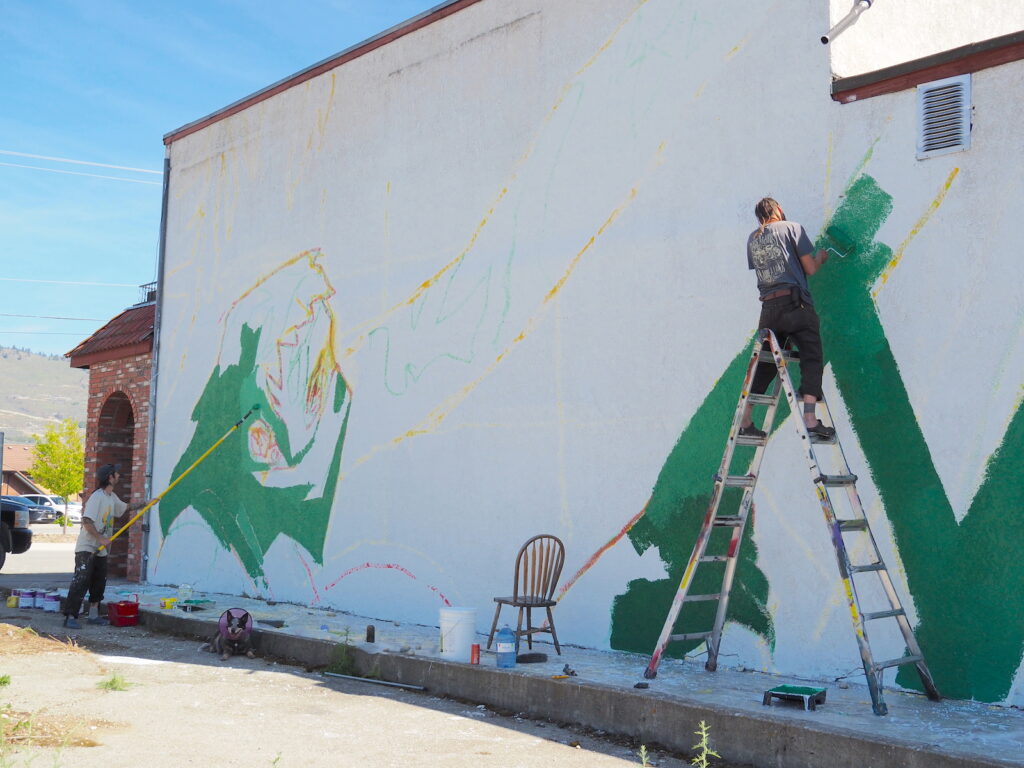
Early stages: Working on the mural using a grid pattern to guide the painting.
Another aspect of seasonal workers that Wina highlights is the fact that local “culture and the arts get enriched by the seasonal workers,” she says. “Be it the Mexican, Jamaican, or French Canadian people that come over here, they are often also freelance artists.
“We really need to keep encouraging them to be here and to share themselves with the community, be it with their seasonal work, or their music, or their food and stuff. It makes the whole place better,” she says.
Lessard chimes in, “That’s why my first sketches, there were like 10 people in it to show the community aspect. The bonds that are forged between the people that travel to work in the community.”
His technique of using rollers with very long extensions and brushes is unique in the mural world. While most muralists prefer spray paint Lessard prefers to “roll on”.
This goes back to the beginning of his career when he was working on a mural in Miami. He laughs that a couple of other murals were being painted by other artists working with spray paint and using scaffolding and tie-jacks. They were stunned to see Lessard creating with his rollers.
“We were painting big murals, as big as the others that had like $1,000 budgets, but we were doing it with $300,” he laughs. “So then I kept working like this and it became kind of my philosophy for my murals.” It also reflects his character as well, Poliquin adds with a laugh.
He also highlights that using a roller rather than spray paint creates a different kind of image. “It’s not the same, the tightness it’s not as clean, but that brings another perspective to it,” he says giving the example of listening to vinyl albums compared to digital music, or traditional photographs over digital.
Altogether it took him the better part of three days to complete the mural, with almost half that time just going to priming the wall. Had he done his original image with multiple characters it would have taken him up to two weeks to complete it.
He started off the mural by sketching out his artwork on a table and then applying it over an image of the wall canvas. Before he does this he’s already marked off a rough grid of about one metre square across the entire wall. This enables him to go from his small letter-sized printout to the final wall-sized image.
The self-taught artist who has loved painting from the first moment he held a brush as a child, is passionate that kids should be encouraged in whichever art form they show an interest. “I think it’s very important that the community does that because it’s not that much the system that does that,” he adds.
He’s also passionate about the importance of art and artists, highlighting the plight of many artists who struggle to earn a living. “But we’re working at this because we love it,” he added. Mural painting is only a small part of his artistic repertoire, with paint on canvas his main pursuit, and he also dabbles in metal sculptures from recycled materials.
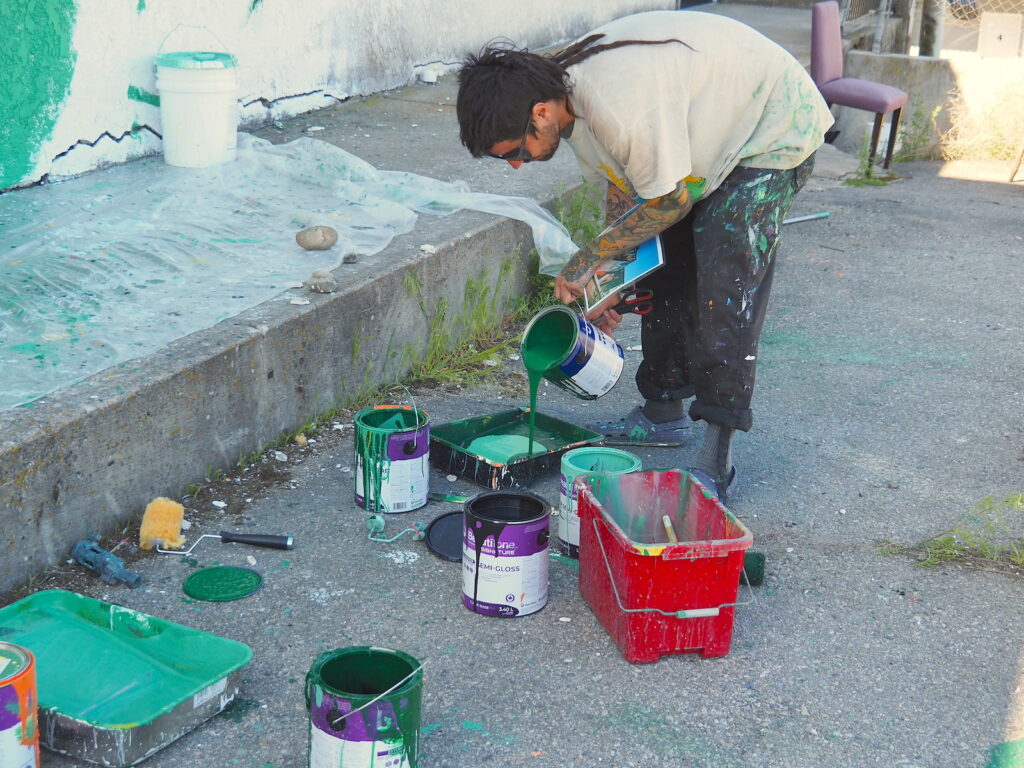
Muralist mixology: Dominic Lessard mixes paint as he works on the mural.
Lessard says he’s here because of Poliquin and Wana. “As an organization, they are entirely focused on art and pushing art not for profit but for the community to come together and enjoy.
“And that is gold, really gold and that’s why I’m here to paint,” he says, adding that there is always a struggle between creating art and making a living.
“Art and the economy are two things that don’t really go together well,” he observes. He gives the example of a building owner who wants to have a mural because it will help drive more traffic and more business. But this then either directly or indirectly shapes the creative process and direction.
“You do that a few times and then you start doing it more and more and then what happens inside you is that you lower what you personally have to say, what you feel because you start to say what people think they want to hear.
“So then you dilute your message. And at one point, you’re like, what was my message? Working as a muralist it’s very hard to find that balance between creating art and keeping the money coming,” he says referencing a phenomenon that stretches back to the artist/patron relationship of the Renaissance and further.
Luckily in this case the building owners gave free reign to his artistic sensibilities, no doubt aided by Poliquin’s charm.
Outdoor murals are not new but over time waxed and waned in popularity. There is a bit of resurgence going on for the last few years Poliquin says. This has particularly been the case post-Covid she says, partly fueled by an uptick in grant money by various levels of government.
“Super excited” is how she feels about this latest mural addition. “More murals! We want more murals,” she expresses in her typical enthusiasm. “We’re already talking about more murals, people are asking me for a mural festival, which I don’t know whether it will come together.
“But there’s definitely more walls right now that are showing up that we can do something,” she says, noting that Mavik will finish off the alley wall behind her Art Therapy Corp storefront and another possible space behind Geno’s Coffee House on the back of the Wanderhome building. “So we’re trying to see if we can do something there.”
“There’s so many spaces so hopefully we can get that ball rolling. It’s always a matter of funding,” she adds. Poliquin is coy about the cost of this latest mural saying that this is one is based on a “personal connection” but adds that commercially it would cost around $10,000 to commission.
“Most of the artists right now it really comes from their hearts, they just want to support the movement that we’re doing.”