By Don Urquhart, Times Chronicle
Osoyoos Council has voted to “opt in” to the Province’s principal residence requirement permitting short term rentals in Osoyoos under the government’s tough new framework introduced last October.
Following a presentation to council on March 12 by Urban Systems who have been assisting the town on developing a short term rental plan for over a year, councillors voted to include Osoyoos in the principle residence requirement meaning new provincial regulations will apply to all operators of short term rentals.
Under the requirement these short term rentals of less than 90 days will only be permitted in the home owner’s primary residence plus one secondary suite or accessory dwelling.
Technically the town does not need to follow the regulations around short term rentals laid out by the province because its population is less than 10,000 and it is a Resort Municipality Initiative (RMI) community.
But by voluntarily opting in to the short term rental requirements the town will get provincial support including more “teeth” to enforce errant home owners who are operating illegal short term rentals.
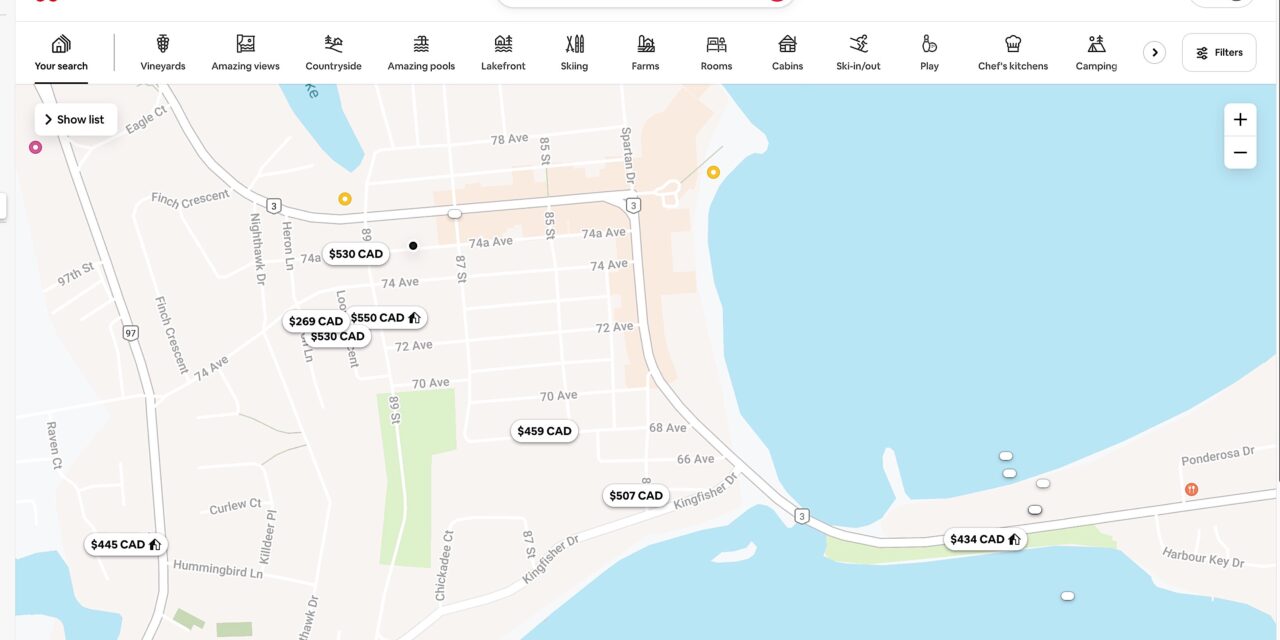
The province put into place the Short-Term Rental Accommodations Act as a response to the surging numbers of such accommodation as typified by AirBNB, VRBO, Expedia and FlipKey for instance, which exacerbated the shortage of affordable long-term rentals. Provincial data shows that more than 16,000 entire homes are being used as short-term rentals for the majority of the year in BC.
Many local governments, including Osoyoos, struggled to take action against illegal short-term rentals – in Osoyoos it is illegal to rent units for less than 30-days but expensive and time consuming bylaw enforcement meant few were ever punished – with the aim of the legislation to provide municipalities the tools and resources needed to manage the situation.
This is includes raising the fines that regional districts can set to prosecute bylaw offences from $2,000 to $50,000 and for maximum municipal ticketing fines from $1,000 to $3,000 per infraction per day.
Short term rental providers will also have to obtain a provincial registration number and a local business permit depending on local requirements.
The provincial registration number will form the basis for a short term rental database, or provincial registry, that will enable enforcement including having listing platforms remove rental listings of violators.
The province will also establish a provincial compliance and enforcement unit that will track compliance, issue orders and administer penalties for violations which will remove a substantial burden from smaller municipalities like Osoyoos.
Discussing the issue prior to voting Councillor Zach Porturica asked what the indication was in terms of other small communities under the 10,000 population threshold.
Mayor Sue McKortoff noted that in her recent conversations with other RMI community mayors some are choosing to opt in and others are not, “it seems to be both ways,” she said.
In response to Councillor Jim King’s question as to whether both a provincial and local business permit is required, Brittany Tuttle, Community Planner with Urban Systems, the consultancy firm that has been working with the town to develop a short term rental strategy, highlighted that short term rentals must be registered with the provincial registry. “It’s up to the local government to decide if a business license is required to operate short term rentals or not.”
She added that based on the direction previously expressed by Council prior to the provincial regulatory changes “we are so far proceeding under the assumption that you would still like to have a business license for offering short term rentals, but added if that can be revisited if council now feels otherwise due to the changing environment.
For Councillor Myers Bennett, his concerns revolved around those who purchased homes in Osoyoos for investment purposes. “They’ve got a pretty major investment and if we opt into this what happened to those people who bought a condo . . . and now we’re going to say you can’t use [short term rent] it. What’s going to happen to those people?”
McKortoff pointed out that these people still have the opportunity to rent out their units or homes, but “just not for one night at a time”. She added, “You certainly could rent it for longer than a month, which many people do and they will rent to snowbirds or people that come in for a month or two months at a time so that is still the option.”
Weighing in on this, Councillor Johnny Cheong noted that the whole purpose of the Act was to address the dire situation in not just BC but all of Canada. “It’s difficult trying to balance between having investment in short term rentals and at the same time, we’re looking at generations not being able to afford a primary residence.”
He also noted the need to attract skilled labour saying, “if you want healthcare practitioners, if you want services, people need somewhere to live.” These issues are compounded when extra housing stock is tied up as investments where people own multiple residences, he says. “I just want to clarify that there are larger implications to this Act and that is being able to have crucial level of services in Osoyoos and you need people to live here to do that.”
Porturica noted that enforcement around short term rentals has been a problem for some time. “We have legislation that says there is no short term rentals below 30 days in the Town of Osoyoos but up until now that has never been addressed. So we’re in a situation now where everything has been operating below the radar so I’m happy the enforcement has been dealt with,” he added
The new provincial regulations come into effect May 1, 2024 but will be gradually introduced over a two year period. Work on Osoyoos’ bylaw amendments will take place starting from this summer with projected implementation this fall.