By Don Urquhart, Times Chronicle
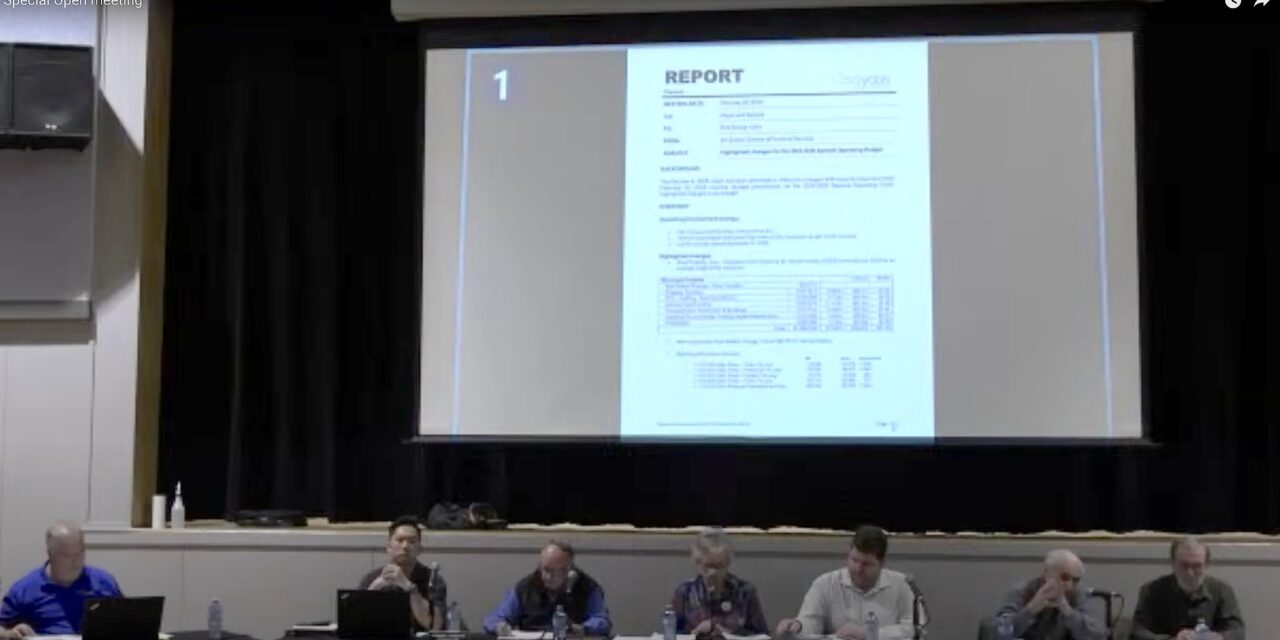
Under ongoing pressure to reduce the tax burden on Osoyoos residents, elected officials continued to chip away at the budget behemoth but gave pause at the recent special budget meeting at the Sonora Centre to consider the ramifications of “borrowing from Peter to pay Paul”.
With council members once again going over the budget in a bid to delay or eliminate budget items to bring down the tax hike which now stands at a combined 24 per cent hike for municipal taxes, water and sewer.
By then end of the one hour meeting a handful of items where trimmed, whittling down the tax increase from 11.61 to 10.91 per cent for a combined tax and utility hike of 23.69 per cent, down from 24 per cent.
As the trimming began a motion by Councillor Myers Bennett seeking to reduce the Asset Management Plan for Sewer from $1.323 million to $1 million and seconded by Councillor Jim King spurred an unexpected twist.
The motion led to a larger existential issues around how the town ended up in the deleterious position it now finds itself in and the ultimate increase in costs that would result from having to borrow should key infrastructure budgets continue to be chipped away.
Councillor Johnny Cheong asked Jim Zakall, Director, Finance/Deputy CAO at the town what size of reduction this type of cut would have on potential service level disruption or debt servicing in the future.
This would reduce revenues by 1.616 million over a five year period, Zakall said, adding “if all projects remained within the five year capital plan we would see additional borrowing within the five year plan for 1.616 million.”
This brought on the existential question of the night by Cheong. “What are we doing here? Because one million of borrowing over 20 years is $870,000 in just interest, which is $74,000 a year in interest. That’s over a two per cent tax increase just to service the debt,” he pointed out.
He referenced the water pilot study presentation made by Reseau at a recent Committee of the Whole meeting. The nonprofit group of academics assessed Osoyoos groundwater and projected that the new water treatment plant for ground water would now cost $30 million, up from original estimates at around $16 million.
“A more sustainable, viable option is to pull from lake water or surface water, which would be $40 million,” he noted.
“So the more we axe the asset management plan, sustainability funds and take away from reserves, we’ll have to pay in interest and it’s not that it’s a younger population that’s going to be servicing that debt – it’s in five years.
“That means prolonged property tax increases over decades,” he warned.
“So I ask again, what are we doing here? The numbers don’t lie,” he added saying the estimates are not from an engineering firm, they’re from academics that have no stake in the game.
Noting they are just estimates subject to change, he again emphasized that “by cutting more, we’re going to pay for more in the future. Over that 20 year span it’s going to hurt everyone, worse. So what are we doing?”
Councillor Zack Porturica picked up the thread saying “I echo those comments by councillor Cheong.
“Part of the reason why we’re in this situation right now is 10, or 15 years ago when municipalities like ours should have been planning for the future and planning to address the issues of today and address the issues of tomorrow, it didn’t happen, it didn’t happen to the extent it should have and we’re paying for it now. And we’re going to be paying for it in the future.
“Every cut that we make today, it’s going to prolong pulling off that bandaid and it’s gonna hurt and it’s gonna hurt more and more and more. It’s going to delay us from actually doing what we need to do to address the issues – to address the issues on water, to address the issues on our wastewater treatment.
He added that the systems were built 40 or 50 years ago and the town has pipes in the ground that have exceeded their life expectancy and need to be changed.
“We’re in a situation right now where we don’t have the funds. Borrowing isn’t the best option, it definitely isn’t the best option,” Porturica said.
“We can’t continue to ignore that these issues exist. I know that was a habit previously, it isn’t going to be the habit of this council and it shouldn’t be the habit going into the future,” he said.
King then asked how much savings would result if this item was reduced down to $300,000 from the $1.323 million in the budget to which Zakall responded that the average single family residence would see a reduction of $54.60 per year.
Mayor Sue McKortoff added her voice to the conversation saying she too is concerned about cutting anything more to the water and the sewer funds. “I think we have paired them down quite a lot after the last meeting and I think we need very careful about what we are asking for and what we want to cut.”
She noted that in many municipalities up the valley, including neighbouring Oliver, water and sewer bills are sent out separately up to four times a year which in many cases works out to be more than the cost in Osoyoos.
“We haven’t been doing that and I think we’re going to have to do that because other places pay a lot more than we are doing. We just happen to be asking for it all at once and I think that’s going to change,” she said.
The motion to reduce the Asset Management Plan for Sewer failed.
Cheong highlighted again the cost of cutting now only to pay more later saying: “We would lose 1.6 million over five years in terms of revenue. So we would need to borrow that.
“With the current interest rates over 20 years, we would, in essence, pay $1.4 million in interest. I want to make sure that these numbers are very, very clear as to what we’re dealing with right now.”
Earlier Councillor Jim King kicked off the discussions by thanking the fire department for its work in containing the recent Main St. fire before it could spread to other buildings.
He then said he wanted to highlight that the budget deliberations were not about “council versus staff” after he appeared to be pointing the finger at staff for the size of the original budget during the last council meeting.
“Instead of lambasting them we should be thanking them for what they do,” he said of town staff. “We’re all trying to do what we feel is right for the town to move forward.”
The budget issue will return to council at the next open meeting on March 26.