By Don Urquhart, Times Chronicle
The Town of Osoyoos has reached a critical point in the future of the community’s water system as ongoing capacity and quality issues have taken a precipitous turn with additional testing now showing confirmed carcinogens in the water.
To keep the water at safe levels for consumption, staff from the Operational Services Department undertakes a careful balancing act daily, blending the water from various wells and using spot chlorine treatment to minimize carcinogenic by-products.
In preparation for a new water treatment plant, eyed to be operational by end-2028, town staff working with a UBC/Reseau Water research pilot study have expanded the normal water testing parameters and in so doing have discovered high levels of ammonia and organic carbon.
Directly traceable to fertilizers used in industrial agriculture, these chemicals interact with the chlorine used to treat the water, creating byproducts that are known to be cancer causing agents.
All six of the town’s production wells contain organic carbon in substantial amounts as well as ammonia in wells #3,4 and 5, according to Kelly McDonald, Utilities Superintendent with the Town of Osoyoos who was presenting the annual water report at the January 16 council meeting. And two new wells not yet in production but drilled last spring also contain the chemicals.
While three of the town’s wells have historically contained manganese and iron, which when chlorine is added (a health requirement since 2017), turns the water shades of brown, the most productive well is now showing rapidly increasing amounts of manganese contamination.
“Well #3 was one of our best wells and then in 2017, it started showing signs of manganese and then by this year it’s increased 490 per cent. And well #1 has increased 1,340 per cent so they are deteriorating, our two best wells.”
Wells #4, 5, 6 and 8 have always shown manganese, and “they regularly go over the maximum limit. Almost all our wells have manganese now,” he says noting that some exceed the aesthetic limit where the water is noticeably tinged while others exceed the health limit. Of these wells #4, 5, and 8 are over the health limit and #1 is rapidly closing in on that level as well.
When asked by Mayor Sue McKortoff what these terms meant practically speaking, McDonald said it was the “maximum [specified] by Interior Health of what people should consume”. The aesthetic limit is the point at which it becomes visible in a glass or sink, or starts to stain clothes.
Because a new treatment plant will be coming it was important to test various parameters not normally tested to see if there would be any additional impacts on the treatment options for the new plant, he said. This included ammonia, Total Organic Carbon (TOC), lithium and also the level of chlorine demand that the water needs for treatment.
And what they discovered was the presence of ammonia, something that was not known until this point. McDonald said that Interior Health does not mandate testing for ammonia because it is rarely found in water in BC. The presence of ammonia is most likely a result of the widespread use of fertilizers in the valley. The ammonia can also cause nitrification of the water which can cause cancer.
“Ammonia and organic carbon are indirect pollutants,” McDonald explains, adding that ammonia does cause health effects but it is not well studied at this point. “The problem with those two contaminants is that they increase chlorine demand and then the chlorine demand creates by-products which do cause cancer.”
The presence of ammonia, aside from negatively affecting the removal of organic and inorganic carbon compounds such as iron, manganese and arsenic in the treatment process, also reacts with chlorine to potentially create by-products known as Haloacetic Acids and Trihalomethanes.
“The causes of this are industrial agricultural developments,” he said. The contamination of Osoyoos’ shallow aquifer from which the wells draw is likely from irrigation for farming and this “could be the reason why there’s so much ammonia and organic carbon in the water.”
The town regularly tests for nitrates and levels are below the Maximum Allowable Concentration (MAC) but are at a level consistent with agricultural contamination, McDonald said.
In order to keep the water within safe limits McDonald says the town “blends the wells” to keep the levels of by-products down. “Instead of trying to breakpoint chlorinate them [the wells], we add chlorine at various spots to keep the bacteria down, so it’s quite a labour intensive job to keep the water within the recommended limits.”
“Due to Operators blending the various well sources and flushing dead ends our testing on the distribution system has indicated that chlorine byproducts do not exceed the regulated maximum allowable concentration (MAC),” he said. “But there is still some of it in there,” he cautioned.
Continual testing ensures that the maximum allowed levels are not exceeded he says. And the expanded testing has also shown the substantial presence of Lithium, a substance that authorities in the US are now starting to regulate.
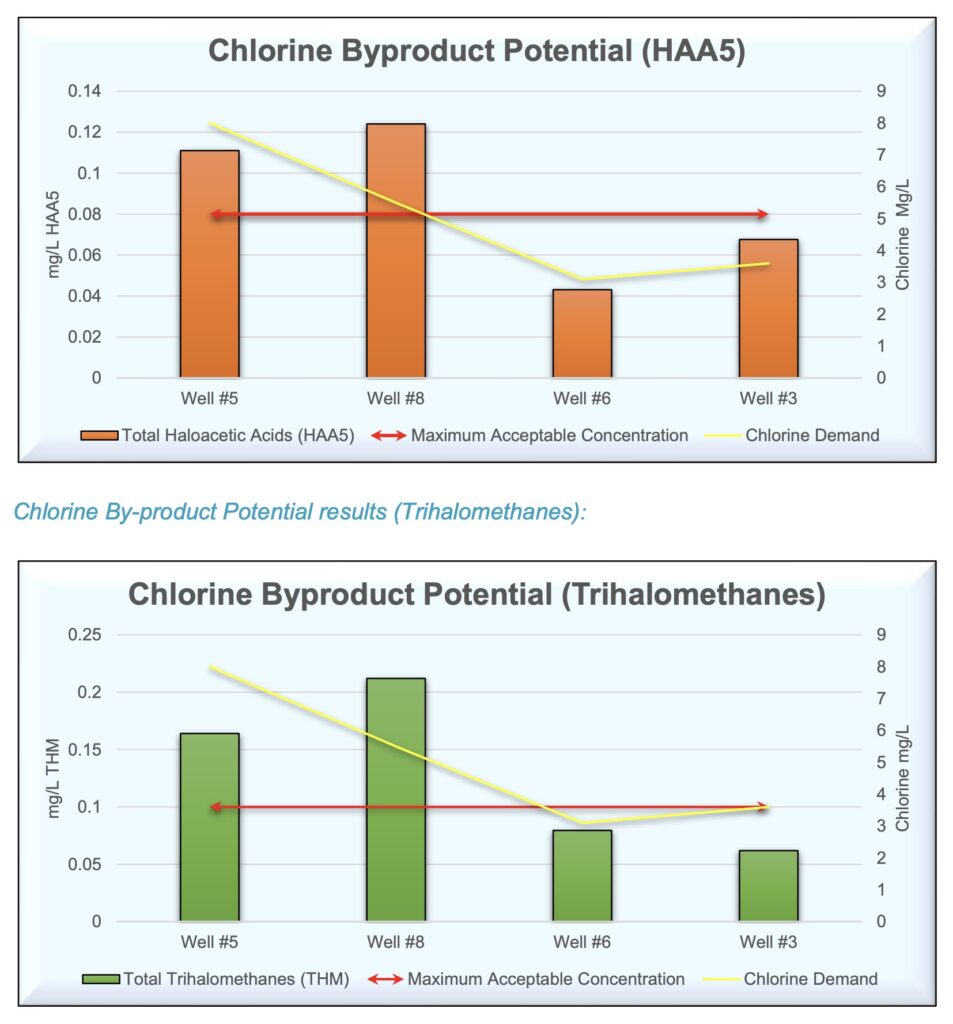
Graphs showing the two key carcinogenic by-products created when chlorine is added to the water and reacts with the ammonia. By decreasing the use of chlorine (using spot treatment) the levels of by-products can be kept below the maximum acceptable level, the town’s public works department says.
Meanwhile, water consumption remains a critical issue with Osoyoos residents consuming 1,500 litres per person per day – nearly 4.6 times the national average of 329 litres per person per day – not because of the arrival of large numbers of tourists in the summer as many believe, but from residents themselves irrigating their lawns and properties each night.
In summer 2023 the town’s domestic system (groundwater potable system) consumption fluctuated to an average daily water use of seven times the volume consumed in winter.
“Although the population of Osoyoos increases drastically in summer due to tourism, we believe this fluctuation is mostly due to residents irrigating their lawns and gardens as similar trends are not observed in the flow of returned wastewater,” explained McDonald.
Even with what McDonald described as an “admirable job” at enforcing water restrictions last summer by ByLaw Officers which had some effect between 2-6 a.m., “our well output was not keeping up with the demand, resulting in many mornings in the summer months where the reservoirs were depleting faster than our maximum output.
“This timing, along with our wastewater trends, point to the irrigation of lawns and gardens being the primary cause,” McDonald stated.
On one particular day – July 23, 2023 – the town’s consumption reached 5,641 m3 or 313 litres per second drawing from all six wells producing a maximum pump flow of 4,416 m3 or 245 litres per second. This resulted in a deficit of 1,225 m3.
“The trend is worrisome as there is no margin for mechanical failure or firefighting. If the timing of the Eagle Bluff wildfire was different, and residents did not change their watering habits, the outcome of the fire may have been different,” McDonald warns.
That fire also stressed the domestic distribution system to the limit with all groundwater pumps running at maximum capacity and still not keeping up with the demand, very nearly resulting in disaster.
Part of the problem McDonald explains was that because residents had to be evacuated so quickly most didn’t have time to turn their automatic sprinklers off which created an unnecessary drain on the system.
“So just at the point we had everything running at maximum, our operators running around, and just at the point it was starting to die I went up there to warn Corey [Fire Chief Corey Kortmeyer] and they had just finished using pumper trucks, so we are lucky,” he says.
The other near miss from the fire was the town’s remote monitoring and control system which was located in an Operational Services Department building within 100 metres of where the fire was raging. McDonald notes that if the fire had reached that building, “it would have changed the whole dynamics [of the fire fighting situation].
That current system is “long outdated and unreliable” and is being replaced by an updated system using cellular technology with a backup server in Kelowna.