By Don Urquhart
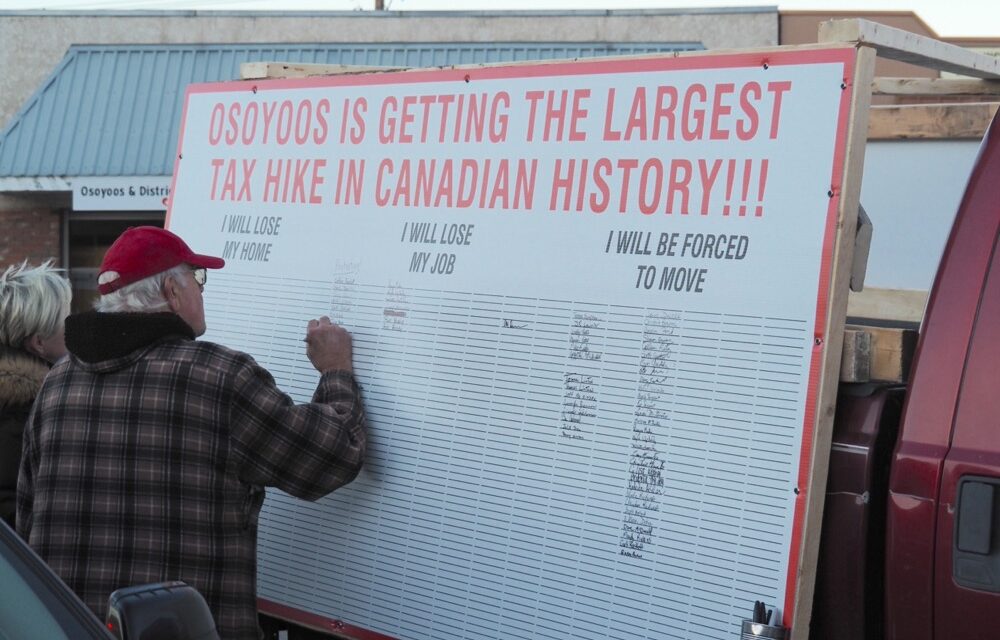
Osoyoos Town Council is open to the idea of relooking at the budget in face of major discontent over a nearly 40 per cent hike in combined tax and user fees for 2024.
Council members have also indicated their unanimity of holding a larger public forum at the Sonora Centre.
Over 200 people descended on town hall last week in protest over the tax hikes and a raucous crowd within the council chambers forced the adjournment of the council meeting.
Since then local social media platforms have been buzzing continuously over the issue, with residents bombarding town hall with emails and phone calls. Harassment has also been a major issue not just for councillors, but town staff even extending to the fire department.
A public forum was scheduled for the evening of Nov. 29, but at press time it appeared the event was not going to be attended by the majority, if not all, of the councillors based on RCMP recommendations.
Councillor Jim King told the Times Chronicle that, “We’ve discussed and we’re willing to relook at the budget.”
He said that council has spoken with organizers of the public forum on Nov. 29 and suggested that if questions and “maybe some ideas, which would be even more helpful,” come out of it they can be shared with council.
“And we’re talking about having an open forum in Sonora Centre so it’s open to the whole town, not just to a couple of hundred people,” he said.
Similarly, Councillor Myers Bennett acknowledged the hefty jump in tax and user fees citing this was due to the pressing need to fix infrastructure. “We can borrow the money but it will cost taxpayers a lot more in the long run, or we can just get it fixed.” But acknowledging the public opposition he added that “somewhere in between, there’s a proper balance.”
“It’s a budget and it can be changed,” Bennett said. Speaking ahead of the Nov. 29 public meeting Bennett reflected the hope of council that the meeting will be productive and produce constructive suggestions.
“I hope somebody brings a budget, puts it up and goes line by line,” and that will hopefully generate ideas that can be passed to council, he added.
Mayor Sue McKortoff urged residents to go through the “2023 Budget Frequently Asked Questions (FAQ)” prepared by Osoyoos CAO Rod Risling.
“If more people will take the time to understand all the issues in the budget . . . it’s a long document [the FAQ] but it explains it very well and I think that they might understand why we have to move forward.”
But McKortoff added, “we have options . . . we’re just not sure at this point what we can do, or if we do anything at all because we’ve put a lot of time and effort into this,” she said noting the budget was passed unanimously, including the water counsellors.
She also noted that the budget is not set in stone until the end of April. “So there is plenty of time to have a look, if that’s what we choose to do next. But we’re not about to at this point.”
She adds that this was part off the impetus for getting the budget out earlier than normal “so that we could see if there’s more feedback, see if there’s more things that we could do. And no guarantee at all, but we do have that option of looking at it again.”
And in a move that surprised fellow councillors, both Johnny Cheong and Zach Poturica used their Councillor Reports time during the Nov. 28 council meeting to make statements on the tax issue.
“I would like to apologize for the situation we’re in. I took office to serve people, not my own personal gain. I’ve taken time away from my family, from my 20 month old and from my business to do what I can to serve,” he said.
“Just because I have a name tag doesn’t make me any less of a human than anyone else. I don’t deserve to be harassed, my wife doesn’t and this isn’t the community that I’ve come to love over the last six and a half years. I think we can do better and that’s me included.”
Noting that he pays taxes like everyone else, he added that the current situation is “bleak”. “My daughter’s bath water shouldn’t be brown. Your water shouldn’t be brown. Residents shouldn’t need to be indoors because the sewage lagoons are experiencing failures and the stench is unbearable.”
“This is an impossible situation,” he adds pointing to the $60.56 million in water and sewer capital projects over the next five years. And that’s at today’s prices he notes.
To put it in context he highlighted that a one per cent increase in property taxes generates just under $32,000. “So we can all do some general math there and there’s a huge disconnect, he said adding “it’s very, very difficult to make the two pieces connect.”
He said he is committed to looking at everything on the budget and to hearing what residents have to say. He too expressed his support for the idea of an inclusive town meeting.
For Councillor Zach Poturica he noted that when elected last year the key issues to be dealt with were water and sewer as both sets of infrastructure are nearing their end of life.
“And what we’ve discovered in the last year or so is with the asset management plans is that our infrastructure is quite costly to maintain and costly to repair.” This situation is made all the more difficult he said due to the current economic conditions, inflation and supply chain issues.
“It’s important that this council has is very, very, very focused on fixing those two utilities.” The asset management plans enable council to have “a better understanding what the costs are going to be and we must act on those plans,” he said.
The issue can’t be be ignored and it’s not going to go away he added. “It doesn’t make sense to completely finance the large portions of capital expenditures due to current interest rates and market conditions,” Poturica said.
He also noted the rising levels of “hate, anger, and discrimination in our community that has resulted in residents fight with residents and businesses.”
“I appreciate the concerns raised with regards to the budget,” he said noting council makes the best decisions they can based on the information and guidance provided.
“These decisions may not always be popular,” as the town deals with its infrastructure deficits created by “artificially low tax rates and a very limited revenue basis.”