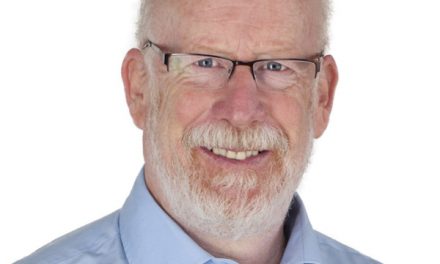
I wouldn’t be there, doing a job I love, it is wasn’t for Robert Doull, President of Aberdeen Publishing.
Bob, as we call him, made a brilliant and lasting impression on me when we first met. And here we are, on the final issue as a member of Aberdeen. I would be remiss if I didn’t take this opportunity to thank him.
When I met Bob, he was acting publisher, temporarily taking the reins in order to fill the gap in the team. I have a brief but dense resume and yet, I had not found my professional niche in Osoyoos. He read it and said, “you like to learn”. That was the moment I knew I would be valued as an employee. I told him I was only available for 21 hours a week. He told me that if I wanted to take a larger role, it was available to me. In fact, he told me I would be running the place one day. I had a lot of work experience but nothing in print media, so I thank Bob for his hours and hours of mentoring. He was always available when I needed him.
The Oliver and Osoyoos papers had just merged the month before I was hired. As he phrased it, it was a startup. I always saw the paper bringing communities together. I wanted the pages filled with what was important and interesting. A record of our lives.
Being a woman of colour, it may not be surprising that I held a vision of decolonizing the paper and removing pieces of systemic misogyny, but what is priceless is the complete faith given to me by Bob to rebuild the brand as I saw it. There are more female publishers than male ones in Aberdeen. It’s a simple thing, according to Bob, not hiring women would mean you are removing 50 per cent of the population from your search for the right person.
Bob helped me find Don Urquhart, who has played a large role in the process. To have someone you trust implicitly with tone and content is what allowed me to believe we could create something special here with this small community paper.
I will miss how Bob can illustrate any point with a fascinating story from his career. He is one of the most interesting people I’ve ever met.
I asked him a few questions and I’m going to share his words because they tell the story.
When did you start in the business of newspapers?
I got my first full-time job as a newspaper proofer in 1974. Prior to that I had done incidental freelance writing. In 1984 I sold my house, cashed my pension plan and bought a newspaper. Since then I have owned 50 newspapers and a couple of press operations; all in British Columbia and Alberta. Not all at the same time but in different configurations at different times.
What are a few of the major critical moments of the business that you have observed; or were part of?
When I started in the industry newspapers were still printed by stereotype – hot metal cast into a mould of type columns, illustration plates and advertising plates, all locked together into a form from which you made the mould and then poured the hot metal into it – the stereotype.
This eventually have way to photo-lithographic reproduction and photo typesetting. This was a process where you, as a reporter, handed your story to a compositor who would sit at a large square machine with a built-in keyboard, called a Compugraphic, and type your story slowly. Very slowly. Inside the machine each letter would be exposed to light on light sensitive paper and eventually a column of text would come out of the machine. You would then take the text, apply wax to the back and paste it on to large sheets marked into newspaper columns in non-reproducing blue ink. This was a manual process, which you had to complete using very sharp exacto knives. Occasionally you would run the knife through your finger holding the column of type and end up with blood all over your page. We used a lot of bandages. Photographs were even more difficult. Photographs could not be reproduced as continuous tones by newspaper presses. So you had to create an optical illusion to trick the eye into thinking it was seeing continuous images. You did that by converting the photo into thousands of tiny dots, all of which were a gradient on a scale of the colour grey. These were called halftones and then they were pasted on to your newspaper page.
Colour photographs were infinitely more difficult and rarely attempt in regular newspaper production. They had to be separated into primary colours and then each primary colour and black were separately rendered into dots. In fact, there used to be a career for a person called a “dot etcher” who lived hunched over a magnifying glass and did nothing but correct the dots on the separations.
The next big innovation was Cybertext which allowed you to hardwire an early computer to a Compugraphic. Cyber it was not.
Basically it was an electric typewriter with a tiny screen. But now a reporter could input their entire story, along with very difficult to memorize typesetting commands, and wait two hours the Compugraphic either ground through the typesetting process or broke down. And then it was back to paste-up, knives, bleeding and bandages.
Sometime around 1987, this thing called a Macintosh showed up and we were introduced to the magic of floppy disks. Macs have been with us ever since getting better and better and basically annihilating every step in the old newspaper production process. The first aid kits gathered dust. Now a reporter can input their own story, drag and drop photos on to a page, create headlines, run automated proofreading programs, change layout and send everything to the website and to the press without leaving their chair. The only thing that hasn’t changed is the writing itself. Reporters still have to ask hard questions and write lively copy. The only sin greater than being boring is being wrong.
What is it about print journalism that you are passionate about?
I am a reader first. I love to read good writing. Newspapers are magic to me. You spread them out on the table and there are stories about things you had no idea existed. They take you places you had not expected to go. Every newspaper comes with an element of surprise. They contain explosions of information that can leave you dumbfounded, dismayed, stunned, shocked, appalled, horrified, furious, outraged or amazed. And I like the smell of ink.
Thank you Mr. Doull! It’s been an honour to be on the Aberdeen team!