Lyonel Doherty, Times Chronicle
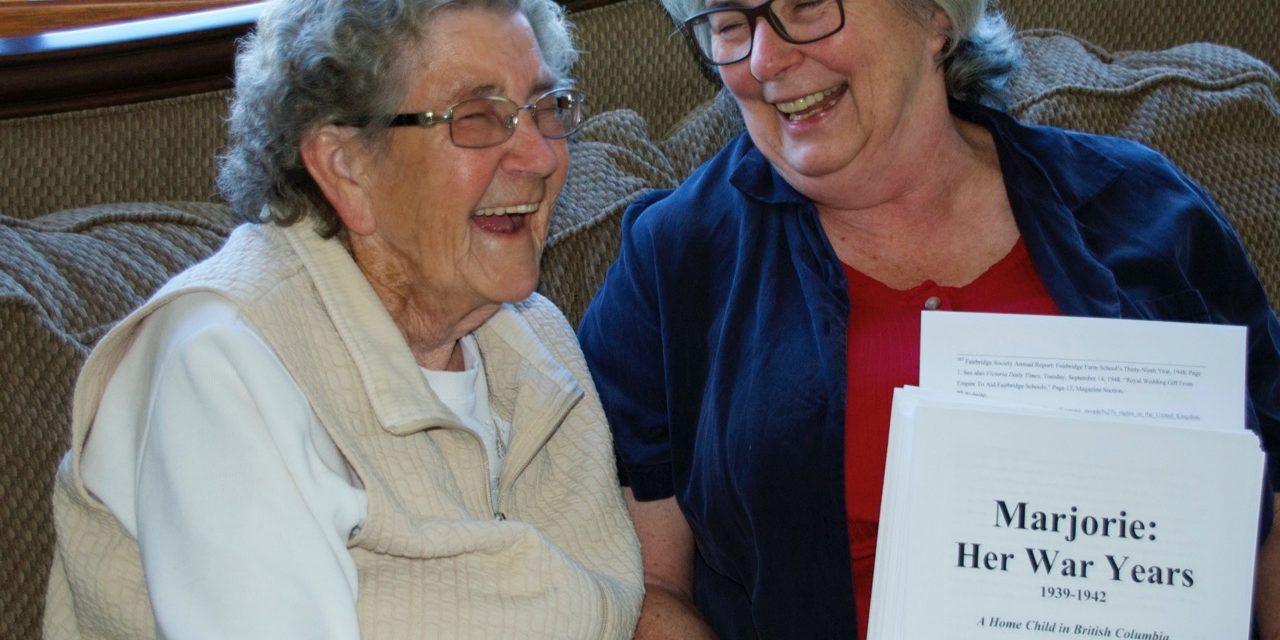
Patricia Skidmore grew up not knowing who she was. She didn’t even know her family history because her mother would never talk about her past; it was just too traumatizing.
“I felt I had no roots. My mother (Marjorie) would not talk about why she was in Canada without her parents and the rest of her siblings.”
Marjorie Skidmore was one of approximately 350 British children, along with her two siblings, sent to the Prince of Wales Fairbridge Farm School near Duncan, BC, to work as labourers and “domestic servants.” Many of these youth were considered underprivileged, selected from welfare cases, but some were surrendered by their parents who saw no future for them in the UK. But little did they know what their children would soon experience.
Many were told they were orphans, that their parents were dead, but Patricia said more than 95 per cent of these youth were not orphans.
Even after her mother passed away in 2017, Patricia is still crusading to raise awareness of this shameful piece of history that few people know about.
It was dredged up again recently with a lawsuit against King Charles for delayed compensation to Fairbridge survivors, most of whom are elderly and in poor health. Funds held in the Prince’s Trust are supposed to compensate farm school attendees for their suffering, but the distribution of these monies have reportedly been delayed.
Majorie, who lived in Oliver, was well in her 70s when she finally started opening up about being sent away from home at the age of 10.
“She blocked most of it out in order to face whatever frightening future they were sending her to,” Patricia said.
“I pressed her for details and she looked afraid and said ‘I can’t talk about it, I will get into trouble.’ She was in her mid 80s and still afraid, but that moment changed her as she finally realized that they could not ‘get’ her anymore.”
Patricia said the children were housed in cottages – 12 to a dorm, where a cottage mother presided with total control. “Many of them were untrained and had no idea how to cope with a group of children; many of the children were angry, displaced and afraid.”
Majorie told her daughter that these cottage mothers were cruel. The days were filled with chores and schooling, and there was little contact with the outside community.
“It has been well documented over the past few years that the children were subject to physical, verbal and sexual abuse.They were called British trash, guttersnipes, and told they would amount to nothing and they were unwanted in this country.”
Marjorie admitted they tried to run away a few times but had nowhere to go.
“These child migrants/home children were not expected to see their families again,” Patricia said.
She noted that what happened caused generational trauma for many.
“She (Marjorie) never forgave her mother, yet her mother had no say in the matter. Even when we found a letter stating it was to her mother Winifred’s eternal distress that she lost three of her children to Canada, she could not find it in herself for forgiveness as she felt her mother didn’t fight hard enough to prevent them from going.”
Patricia said it was Marjorie’s father who gave permission to have her sent away.
Patricia noted the suit against King Charles is a recognition of past wrongs. “But the reality is it’s too little, too late. I do not know what monetary compensation they can expect?”
But there’s a catch, she pointed out. Fairbridge attendees had to be alive on March 5, 2020 to be eligible for any compensation from the Prince’s Trust. “So the majority of families will not benefit,” Patricia said.
“The Fairbridgians who are still with us are well into their 80s and 90s. It is a recognition that for many of them, deporting them to the colonies, removing them from their families, their community, and their country was wrong. It is as simple as that.”
Patricia, president of the Fairbridge Canada Association, has been documenting this issue for a long time. She noted the schools, including one in Australia, had the support of the then Prince of Wales.
Although Canada had banned bringing in child migrants in 1928, the federal government was under pressure to allow one school to open in BC, Patricia said, noting some children were as young as four years old.
Reportedly, the children left the school at the age of 15 to find employment elsewhere. A portion of their wages was funneled back to school administrators who supposedly kept the money in trust until the attendee was 21. But Patricia doubts the youth ever saw much of this money.
The farm school’s history came to a close in 1975 when the Fairbridge Society sold the property to a developer in 1975.
Interestingly, Patricia recently received a letter from Will Garnett, the son of the principal who ran the school on Vancouver Island. In his response to the lawsuit, he wrote how he learned a great deal from the Fairbridge children on what really happened there.
He said these children were effectively “stolen” from their parents and transported to a stark school environment created, not for the benefit of the youth, but to help preserve the British empire that rewarded the rich at the expense of the poor.
Garnett said the children resided in barrack-like quarters and were fed poor quality meals and taught by incompetent, sometimes dangerous staff. Above all, the kids were not allowed to communicate with their relatives in England, he pointed out.
“The Fairbridge Farm initiatives were heinous crime centres (known about for decades),” Garnett wrote.
As Patricia pores over old photographs of her mother, she can’t help but picture her in that school shedding countless tears so many miles from home. Both were robbed of a mother/daughter relationship that never flourished until the truth came out. But despite all that happened, Marjorie never lost that smile that toiled through adversity and put the sun to shame.