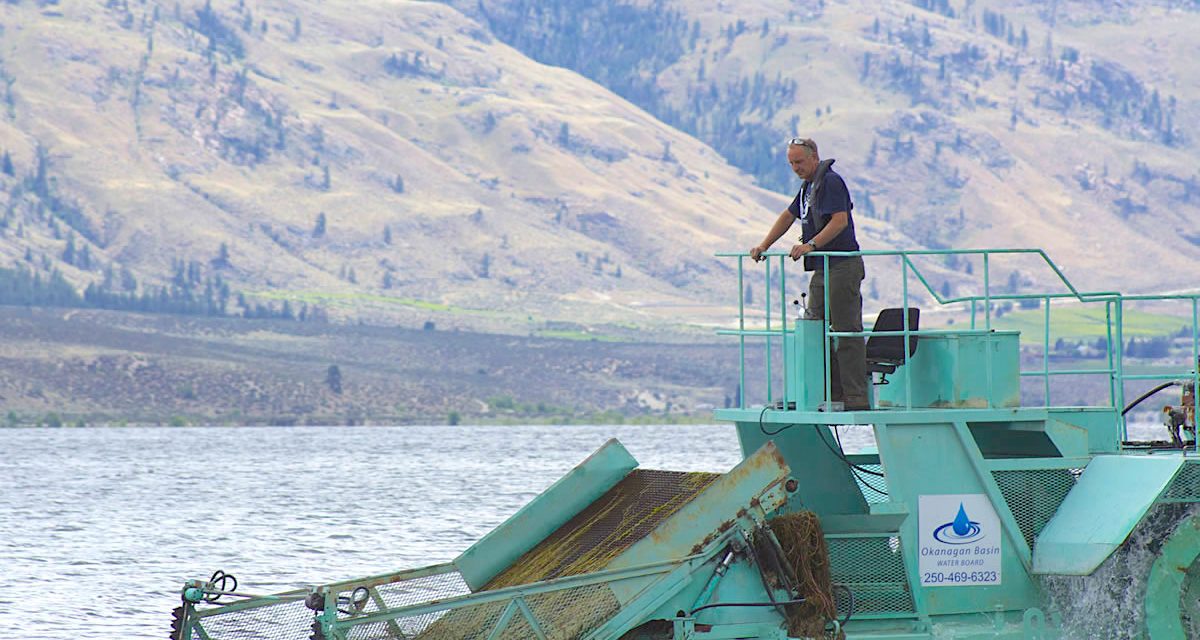
The Okanagan Basin Water Board (OBWB) is considering new, more energy- and time-efficient ways to tackle milfoil removal in Okanagan Lake, including an entirely new barge design by enterprising UBC Okanagan students.
Since 1999, the OBWB have operated their milfoil control program without support from the provincial government, who initially joined into a partnership with them in 1973.
This has led to a profound drop in funding in the new millennium and, as a result, the need to address problems with creativity and ingenuity.
James Littley, the operations and grant manager for OBWB, presented a new five-year replacement plan at the most recent board meeting that reflects these efforts to keep costs low with innovation instead of reductions in service or taxation increases.
For example, engineering students from UBCO joined the planning table with their capstone project this year: their design for a combination industrial shredder, hydraulic press, and de-watering barge would allow the milfoil control team to stay on the water for every stage of their harvesting process, as well as streamlining many other aspects of the job.
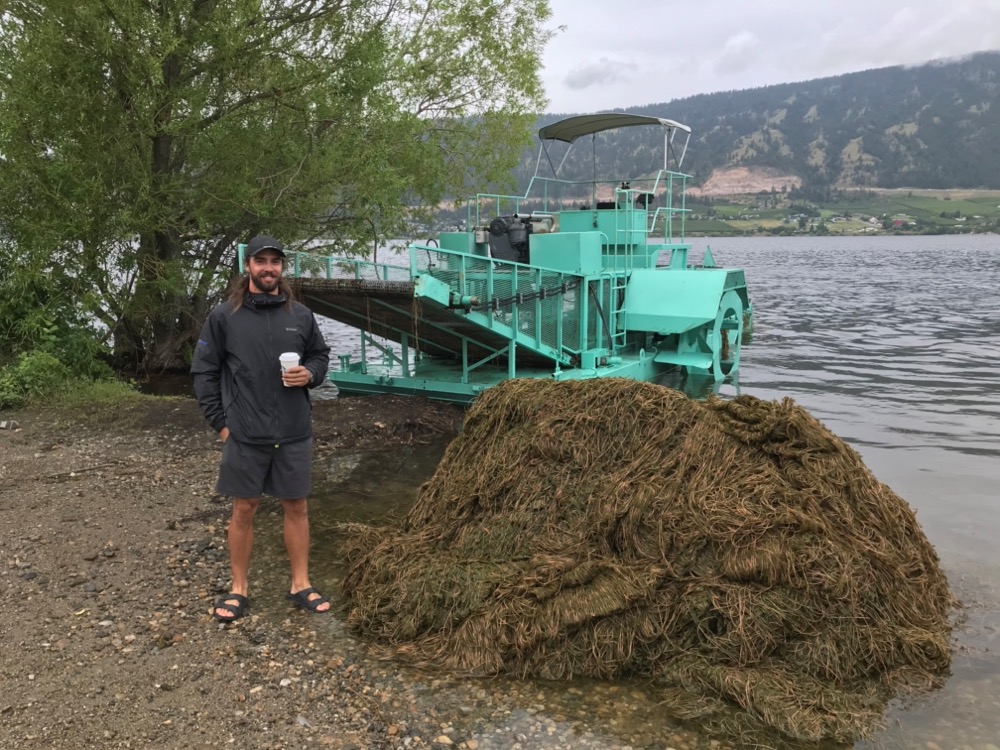
Luc Cowan with harvested milfoil. James Littley photo
One issue brought up at the meeting by Littley was a lack of land-based transfer points where control team members can drop off their harvested milfoil, which then gets picked up by trucks and taken away for disposal.
He also pointed out that existing transfer points were not exactly easy on the eyes, and none of the public spaces along the lake’s shore would be improved by “stinky piles of weeds.”
With the hybrid barge designed by UBCO students, milfoil could be harvested, shredded, drained, and stored out on the water, which they determined would reduce the weight of an average milfoil load by 91 per cent and allow the team to store and transport 10 times the current volume of harvested milfoil at a time.
Not only would this eliminate the need for more “stinky” transfer points, it would make the entire harvesting process more time-efficient and reduce wear on the vehicles used for pick up and transport to disposal sites.
Littley’s report also addressed the team’s concerns about the continued efficacy of their current equipment, many of which are born of changes to the lake itself and development along its shoreline.
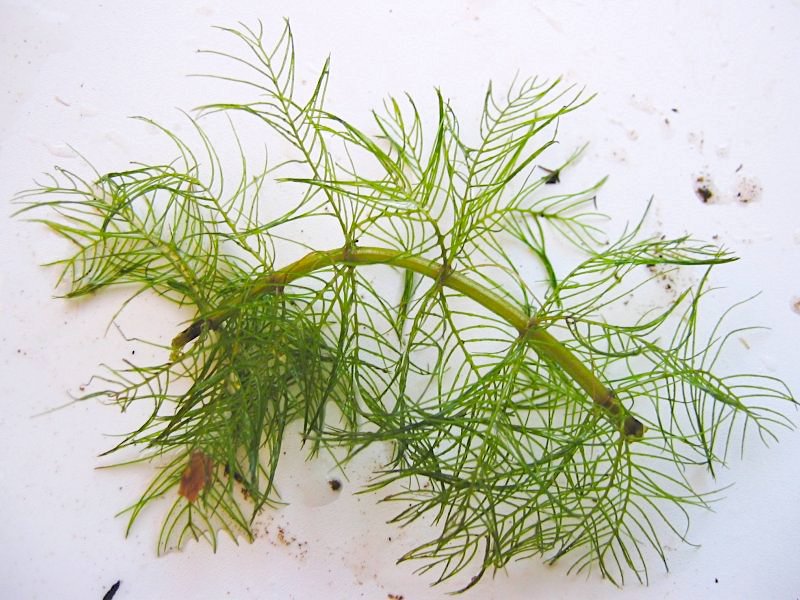
Myriophyllum verticillatum, or Eurasian milfoil. Kristian Peters photo
“People are settling into new areas of lakefront in the valley, while local governments improve lakefront parks and beach areas,” said Littley in his report. “This has reduced our access to sites which we have historically used for the program. We also face a risk from the unknown effects of climate change and its impact on milfoil growth.”
Rather than continue to sink money into the repair and replacement of equipment that was designed for a very different job than the one they face now, Littley felt that his team should focus on research and development while maintaining their current fleet at a functional level.
Alongside some necessary vehicle replacements, Littley suggested that processes such as de-rooting, machine launching, lake-to-shore transfer of weeds, and reducing the overall biomass for transport could be made more efficient and flexible to changing conditions throughout the next five years.
With OBWB approval of the new five-year report, which includes an added $50,000 to be earmarked for R&D, advancement will likely be the name of the game for milfoil removal in the near future.