By Don Urquhart, Times-Chronicle
I hate to be the bearer of bad news, but it’s official – Canada’s resident rodent celebrities have pronounced six more weeks of winter on this year’s Groundhog Day.
The annual tradition marked every February 2 reaches a determination on how much winter is left for the year. If the groundhog sees its shadow, it will be scared and return to its burrow, translating to six more weeks of winter. If it doesn’t see its shadow and lingers, an early spring is in store.
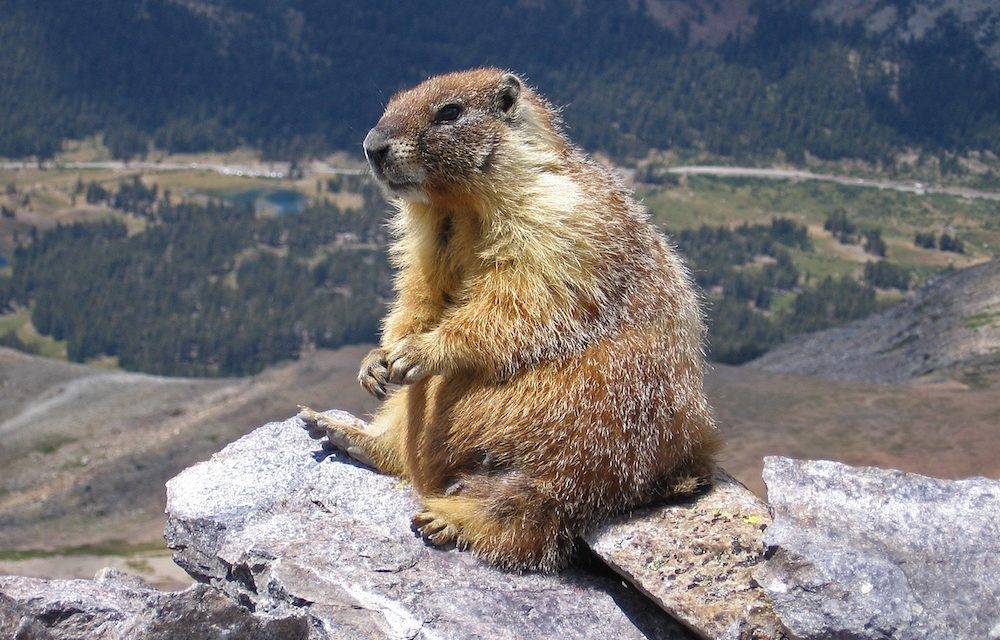
Groundhogs (found in eastern Canada) are actually a type of marmot. Pictured above is a yellow-bellied marmot common across many parts of B.C. Don Urquhart photo.
The raining king of groundhogs is Punxsutawney Phil, from the U.S. state of Pennsylvania where this unique tradition first began in 1887. This year Phil says six more weeks of winter.
Canada’s most famous groundhog is Wiarton Willie, who resides in Ontario. Willie, clearly in a contrarian mood this year, emerged from his burrow and lingered without seeing his shadow meaning an early spring.
But for the rest of the country’s rodent meteorologists, it’s not looking good for spring. Nova Scotia’s Shubenacadie Sam, Quebec’s Fred la Marmotte and Manitoba Merv, Alberta’s Balzac Billy, unfortunately, all saw their shadows.
In B.C. Van Isle Violet confirmed this trend of more winter. Here in the Okanagan, we might have something to cheer about, as Okanagan Okie has sided with Wiarton Willie in predicting an early spring.
There is one significant caveat to this, however. Okanagan Okie is not actually real, he’s a stuffed animal. This may throw a few wrinkles into the prediction.
Okie resides at the Allan Brooks Nature Centre near Vernon where they say Okie is a stand-in for the resident marmots in the area who apparently are too busy sleeping to dish out forecasts.
Groundhog Day has its roots in Germany where the ancient Christian tradition of Candlemas would see clergy blessing and distributing candles for winter.
The candles represented how long and cold the winter would be and Germans expanded on the concept by selecting an animal —the hedgehog — as a means of predicting the weather.
German settlers took this tradition to Pennsylvania switching from hedgehogs to groundhogs which were common in that area.
Oh and just in case you’re wondering, human meteorologists in Canada say groundhog predictions carry an accuracy of about 50 per cent. Maybe just flip a coin next year!