By Don Urquhart, Times Chronicle
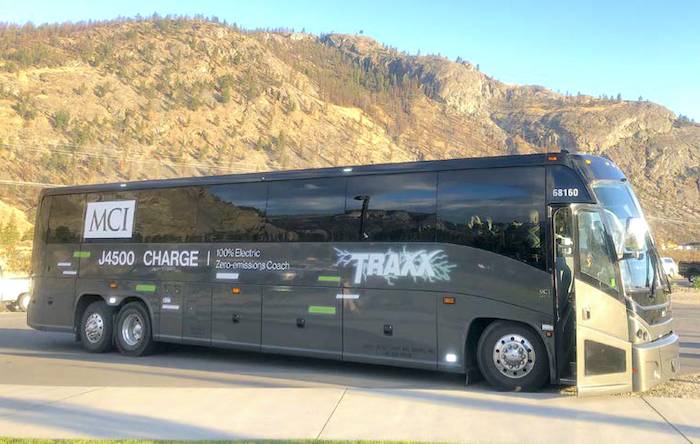
The TRAXX Coach Lines electric bus that has been setting its own world records and literally turning around and breaking them, made a quiet appearance at the District Wine Village recently as the company continues its unique roadshow.
Moving in a dream-like, silent state, the electric bus pulled up to the District Wine Village with nary a sound other than a slight ‘pssk’ of the air brakes. In fact, the passengers made far more noise than the bus itself, something quite contrary to the diesel beasts we are all accustomed to.
The tour and charter bus company has partnered with Winnipeg-based Motor Coach Industries (MCI) on the manufacturer’s latest electric bus, the J4500 Charge. TRAXX has been testing the bus powered by an electric motor running off of three latest-generation ZALT lithium-ion batteries and raising awareness with trips between the Interior and the Lower Mainland.
On Aug. 30 the TRAXX set a world record for the ‘longest and highest voyage by an electric motorcoach in North America’ taking the 56-seat electric bus from its depot in Kamloops to the Vancouver Giants Hockey Club in Delta, some 356 km away.
The trip also involved an 830 metre elevation gain to reach the Coquihalla Summit at 1,440 metres. But this steep uphill was complemented by the long downhill towards Hope which enabled the bus to recharge its batteries through its regenerative braking system.
“This has never been done before,” said Steve Ceron TRAXX director of business development on the electrified feat.
Bus captain, Bart Van Dyk said the range is highly dependent on the topography as the mountains in B.C. have a significant impact.
“We had a little bit better when we went Kamloops to Vancouver which was about 360 km and we still had 100 km left in the tank when we arrived in Delta.”
Van Dyck said the driving experience when at highway speed is pretty much the same as a diesel-powered bus. But at lower speeds around town it’s very quiet, “you have to be very careful, you have to let people know you’re coming because there’s no engine noise,” he noted.
In part, the driving experience is exactly the same because it is the same bus but just powered differently. The diesel engine and fuel tank are removed and an electric motor and massive lithium-ion batteries are installed.
This adds nearly 2,270 kg to the overall bus weight, even minus the combustion engine, which means actual commercial service luggage would be constrained.
A bus driver for some time, Van Dyck said it’s a novelty for him and he did undergo specific training in order to maximize performance. “I’m very conscientious of what’s happening, I try to use the least energy possible to extend my range as much as possible and we’ve been very successful with it so far.”
In fact, a day earlier the team broke their own world record in a drive from Delta to Kelowna. “We had to set a world record in order to break a world record,” he said with a laugh.
Ceron noted the company did three, one and half hour tours around Vancouver and the bus still had 52 per cent battery left. “We drove by people in Kitsilano and because people are sitting outside right next to the street they were intrigued by the fact they couldn’t hear any engine noise,” he said.
There are a number of hurdles for wider uptake of these ‘green’ buses, not least of all the price tag. At around $1.4 million each, they are more than double that of conventional diesel buses which come in at around $650,000.
The frustrating thing for TRAXX is the lack of government incentives. While individual consumers and even transit bus operators get various government subsidies, there is nothing for the tour and charter operators – either for the vehicle itself or the charging infrastructure, according to Ceron.
“We want to be the first people to have this, we think this is the future of the industry but we are also working on alternative technologies as well.” This includes fusion fuel which utilizes hydrogen.
“I think we have to take the industry by the coattails. It’s an industry that’s been stagnant for a long time and I think we can use the pandemic to come out of this a far greener company,” Ceron said.
With two more of these e-buses on order from MCI, he stated the immediate plan is to keep pushing the envelope. “The more we get the word out, the more people that see this, the more potential lobby we can have to get some infrastructure put in place.”
Following the sojourn to Oliver, the next scheduled stop the next day was Winnipeg where the bus was due to be torn down and analyzed from top to bottom.
“It’s had some wear and tear, we’ve really ridden it hard, not something you wouldn’t ordinarily do with a bus, but this one we’ve got to make sure everything’s in place, how did the motors work, the batteries perform, etc.,” he said.
The tour and charter bus company operates more than 160 coaches across Saskatchewan, Alberta, British Columbia, Washington, and Oregon and has B.C. hubs in Kamloops, Kelowna, and Vancouver.