Lyonel Doherty
Times-Chronicle
A local climate change activist is pointing the finger at Royal Bank of Canada for its so-called “climate-wrecking” projects.
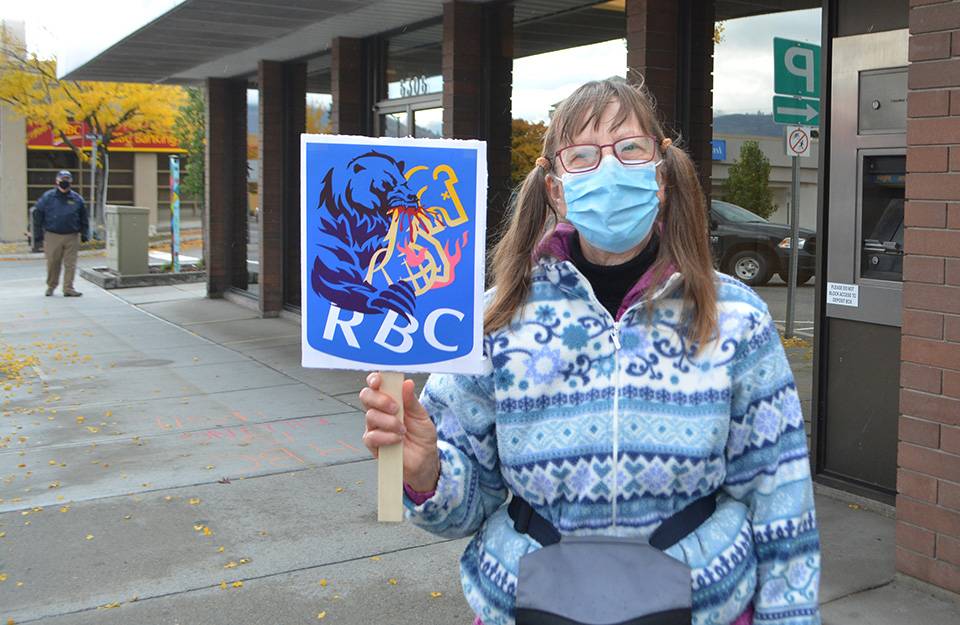
Kerry Mewhort from Oliver stood in front of the RBC building Friday morning with a small placard depicting a Wet’suwet’en bear chomping on the RBC lion (the bank’s logo).
She began by writing chalk statements on the sidewalk but was quickly confronted by a bank representative who said she couldn’t do that on RBC property. While the representative said Mewhort was allowed to be there, he informed her that police may be contacted. Shortly after, someone from the bank came out and washed away her chalk statements.
Mewhort explained that RBC has pumped more than $200 billion into climate-wrecking projects since the Paris Accord was signed in 2015. According to her, RBC is Canada’s largest financier of fossil fuel development, and the fifth largest in the world.
She pointed out that RBC supports the Coastal GasLink and Trans Mountain pipelines that are being driven through Indigenous communities without prior consent.
“The message is we want them (RBC) to stop investing in fossil fuels because they are contributing to Canada’s climate emissions more than any other sector.”
Mewhort noted that a recent statement by RBC did not admit to anything regarding its fossil fuel investments.
Andrew Block, spokesperson for RBC, issued the following statement to the Times-Chronicle.
“RBC believes climate change is one of the most pressing issues of our age and we are committed to supporting the transition to net zero.”
The statement adds that RBC will direct
$500 billion in sustainable financing by 2025.
“In addition to setting a goal of net-zero emissions by 2050, we are also working to establish interim targets related to emissions.”
RBC stated that Canada’s journey to net zero represents the largest economic transition in our lifetime.
“We will work with clients to map out their transition plans, and measure progress. Importantly, this includes heavy emitters, whose carbon reduction strategies and transition will be critical to achieving Canada’s targets.”
RBC says there are many types of energy solutions to meet growing energy demands “as we make the transition to a lower carbon economy.”
But Mewhort said if we are going to avoid the worst of climate catastrophe, we must do something in this decade, starting now, not 2050.
She pointed to severe weather events such as the “heat dome” that the Okanagan experienced this summer.
“We need the world to know that this is not okay . . . it’s all about money and greed.”